Get Full Government Meeting Transcripts, Videos, & Alerts Forever!
Get email alerts on the Prescription Drug Donation topic
No spam. Unsubscribe anytime.
Sen. Jana Hughes urges committee to fix federal rule snag blocking Nebraska prescription drug donation program
Summary
Sen. Jana Hughes told the Health and Human Services Committee that LB 10 would clarify that a 2013 federal tracking rule does not prevent Nebraska's prescription drug donation program created by LB 1035 from operating, and that an amendment would allow the governor to access donated medicines during declared emergencies.
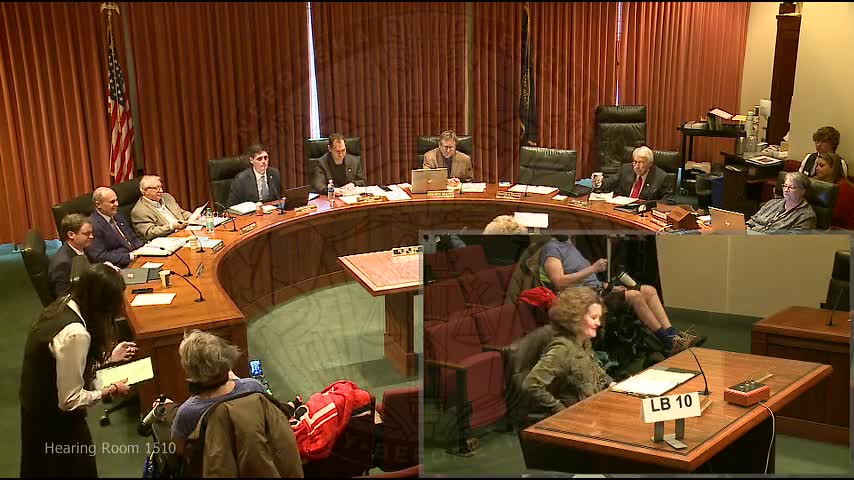
Sen. Jana Hughes, sponsor of LB 10, told the Nebraska Legislature's Health and Human Services Committee that LB 10 is a technical cleanup intended to let Nebraska implement a prescription drug donation program enacted last year in LB 1035.
Hughes said LB 1035 authorized the Department of Health and Human Services (DHHS) to contract with an established Iowa redistribution program to accept sealed, unexpired blister‑pack medications and redistribute them to underinsured and uninsured Nebraskans. Hughes said an implementing federal rule tied to the federal Drug Supply Chain Security Act (DSCSA) created uncertainty about whether donated prescriptions were subject to federal tracking requirements; that uncertainty, she said, paused Nebraska’s rollout and led the governor’s office to remove the money the executive branch had set aside to start the program.
The bill would explicitly clarify that the federal DSCSA rule does not apply to prescriptions collected under Nebraska’s donation program and would make a second change to allow the governor to access donated medications for individuals impacted by a state of emergency. Hughes said she has handed out amendment AM 12 to replace the word “victim” with “any individual who is impacted as a result of a state of emergency declared by the governor” and to include an emergency clause so the change can take effect quickly.
Hughes described the policy goal as avoiding waste and cutting state costs by reusing eligible donated medications rather than incinerating them. She said the fiscal note for the earlier bill included roughly $80,000 for DHHS administration and that the state currently spends “about $700,000 to $750,000” a year on drug disposal, figures she cited in committee discussion. Hughes also told committee members that the governor’s budget request had zeroed out the implementation funds after the federal rule prevented the program from being implemented on schedule.
Committee members asked logistical questions: Sen. Murph Repie told the committee he had toured the Iowa facility with Hughes and said the Iowa partner (referred to in testimony as SafeNet Rx) operates a relatively compact warehouse with significant inventory and volunteer support. Repie and other senators asked which medicines would be eligible; Hughes said donated drugs must be unexpired, in tamper‑evident packaging (for example, blister packs) and would not include refrigerated products, controlled substances or expired items.
A member of the public, Josephine Liprinowitz, spoke in support during public testimony, urging continued access to medications for people leaving correctional facilities and calling attention to continuity of mental‑health medications on release.
No committee vote occurred during the hearing. Hughes asked the committee to advance LB 10 with AM 12 so DHHS could resume implementation work and for the Legislature to restore startup funding once the federal issue was resolved.
The hearing record includes testimony describing how Iowa’s partner program has operated for years and how that state uses a waiver process to allow continued operation while it adjusts to federal rules; Hughes said Nebraska lacks an equivalent waiver and that LB 10 would supply the statutory clarity the department needs to proceed.
Hughes closed by asking the committee to send the bill to general file with the amendment in place so the donation program can begin providing donated, eligible prescriptions to Nebraskans in need.
The committee took no formal action during the hearing.