Get Full Government Meeting Transcripts, Videos, & Alerts Forever!
Get email alerts on the Tax Court Backlog topic
No spam. Unsubscribe anytime.
Tax Court reports backlog surge; clerks cite postponements and antiquated case system
Summary
The Maryland Tax Court told the Public Safety and Administration Subcommittee that appeals rose sharply in FY24, leaving a clearance rate below target; the court seeks options to modernize case management and allow online submissions to reduce processing time.
David Perpert, presenting the Department of Legislative Services analysis of the Maryland Tax Court, told the subcommittee that "about 1100 appeals were filed with the tax court in fiscal 2024," an increase of roughly 50% from the prior year, and that the clearance rate was 72% compared with a 90% goal.
Why it matters: the Tax Court provides administrative review for property, assessment and tax disputes. A growing backlog and a low clearance rate lengthen resolution times for taxpayers and taxing authorities.
Perpert said the court's 12-month clearance rate has met its goal in recent years but the 8-month clearance target has lagged. He cited three main causes: frequent postponements requested by parties (346 postponements were granted in FY24), reliance on a paper-based administrative workflow and an antiquated case database that cannot accept electronic appeals filings, and post-hearing administrative steps required for judges to sign formal closing orders. "The manual paper reliant process was cited as a reason for past delays," Perpert said.
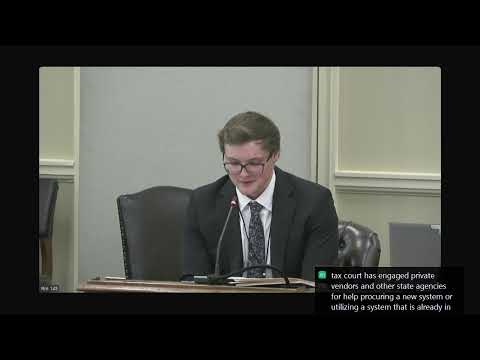
Andrew Berg, clerk of the Maryland Tax Court, told the panel the court concurs with the governor's allowance for FY26 and is exploring options for a new case management system. He said the court has been working with the Attorney General's office and vendors to find a solution and is evaluating whether statutory changes are needed to permit online submission of appeal documents. "The tax court has engaged private vendors and other state agencies for help procuring a new system or utilizing a system that is already in use by another state agency," Perpert had said in the presentation.
The subcommittee asked the court to estimate costs and timelines for implementation and to describe steps already taken to reduce the time between a hearing and the judge's signed order. The court provided written testimony addressing many of those questions and offered to return with more detailed procurement and cost information.
Ending: DLS recommended concurrence with the governor's allowance; the court agreed and committed to provide follow-up material on case management options. No formal vote was recorded during the hearing.