Get Full Government Meeting Transcripts, Videos, & Alerts Forever!
Get email alerts on the Housing Element topic
No spam. Unsubscribe anytime.
Mount Shasta staff outlines 2023–2031 housing-element implementation and near-term priorities
Summary
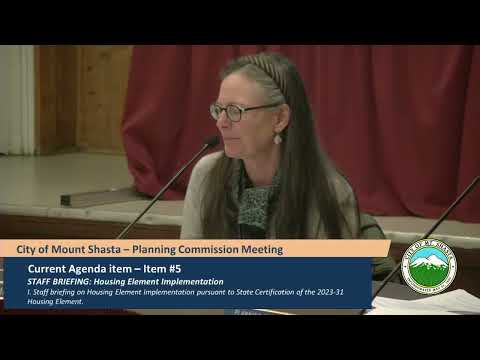
Jeff, a city planning staff member, briefed the Mount Shasta Planning Commission on Jan. 21 on the city’s 55-page housing-element implementation package covering 2023–2031, describing priority programs, monitoring steps and likely municipal-code changes needed to maintain HCD compliance and unlock state funding.
Jeff, a city planning staff member, briefed the Mount Shasta Planning Commission on Jan. 21 on the city’s housing-element implementation documents, describing the 55-page packet as the operational baseline for executing the 2023–2031 housing element.
The plan, Jeff said, organizes seven goals and 57 programs and includes an eight-page housing action plan that staff will use to produce annual reports to the California Department of Housing and Community Development (HCD). “The document… is not intended, as in any way homework for you. You won't be tested on it,” Jeff said as he summarized the materials.
Why it matters: Certification and ongoing compliance with HCD requirements determine the city’s eligibility for state housing funds and influence local zoning and permitting changes. Jeff told commissioners that several high-priority programs flagged by HCD are already complete or underway and that many of the remaining programs will require municipal-code amendments, monitoring systems and public outreach over the coming year.
Most important points
- Scope and timeline: The housing element covers 2023–2031. The packet includes goals/policies (first ~20 pages), an eight-page housing action plan (monitoring and annual reporting), and a sites inventory used to compare developer proposals to the city’s suitability analysis.
- RHNA and pipeline: Jeff said the city exceeded its prior 8-year RHNA (regional housing needs assessment) count with 44 units and that the next 8-year RHNA allocation shown in the packet is two units. He also said a pipeline project at the corner of Chestnut and Ivy has consultants engaged and staff expects site work possibly in late spring.
- Priority programs and compliance: Jeff identified seven priority programs (table 2.2 in the packet) flagged by HCD. He said objective design standards have already been adopted and that additional municipal-code updates are needed to reflect recent state statutes and to implement by-right multifamily housing, updated ADU rules, parking-generation adjustments and other compliance items.
- Affordable and special-needs housing: The plan calls for incentives, density bonuses, replacement policies for lost housing capacity, monitoring of deed-restricted affordable units, and outreach to affordable-housing developers. Jeff noted that Mountain View townhomes will bring new units that help meet the city’s targets.
- ADUs, tiny homes and manufactured housing: Jeff said state law trends toward more permissive ADU definitions (including tiny homes on wheels) and that the city’s ADU and manufactured-home rules will need periodic updates. He said manufactured homes are presently treated similarly to single-family dwellings in the municipal code.
- Implementation mechanics: The housing action plan lists timelines, target areas and measurable outcomes. Jeff emphasized annual reporting to HCD each April and suggested staff may create a housing advisory committee or use workshops to spread workload and public engagement.
Commissioner and public questions
Commissioners asked about public outreach, fee structures tied to affordable-housing mitigation (linkage or in-lieu fees), and whether funds could be indexed to inflation. Jeff described common practices: a mix of funding sources (transient-occupancy-tax allocations, linkage fees, and in-lieu contributions) with periodic escalator clauses and nexus studies to justify fee levels.
A public commenter, Evan Drake, introduced himself during public comment as a local builder and member of the Siskiyou Housing Alliance and urged commissioners to pursue tiny-house permitting pathways.
Next steps and staff direction
Jeff told the commission staff will prioritize municipal-code amendments and program rollouts over the next 12–16 months, produce a housing-action progress column for annual HCD reporting, expand the city website housing landing page and run workshops and targeted outreach to developers and employers. He said staff will return with specific ordinance changes, fee analyses and outreach plans for commission review.
Ending
Commissioners were asked to review the packet and return questions; Jeff said he will circulate the housing-action materials and accept commissioner input as staff drafts municipal-code amendments and outreach plans. He recommended commissioners consider forming or supporting an advisory subcommittee to help dig into detailed program implementation.