Get Full Government Meeting Transcripts, Videos, & Alerts Forever!
Get email alerts on the Elected Official Compensation topic
No spam. Unsubscribe anytime.
Lycoming County approves pay schedule realigning sheriff with other elected officers and raises tax-collector fees
Summary
The Lycoming County commissioners approved a multi-year salary schedule to bring the sheriff to parity with other elected officers and voted to increase the per-bill payment for tax collectors to $3.75 starting in 2026; both items passed by voice vote.
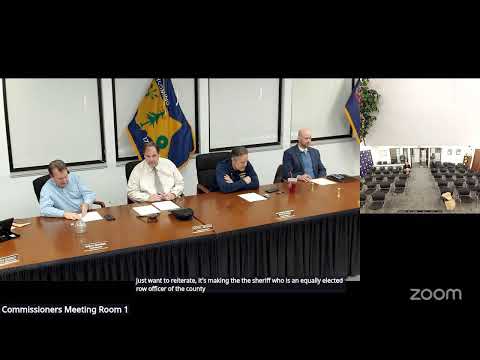
Lycoming County commissioners on an evening public meeting approved a salary schedule that increases the sheriff to align with other county elected officials, and separately approved higher per-bill compensation for tax collectors.
The board approved a four-year pay schedule for the sheriffthat sets a 9.5% increase in 2026, a 3% increase in 2027 and 2% increases in 2028 and 2029 to bring the sheriffinto parity with other county row officers. Commissioners voted by voice to adopt the schedule after a presentation and discussion; the motion was made and seconded and commissioners responded "aye." The meeting also approved raising tax-collector compensation to $3.75 per bill for 2026 and $3.75 per bill for 2027, also adopted by voice vote.
Why it matters: the sheriffhas been on a different election and pay cycle than other county elected officials since a change in 1964, creating periods in which increases granted to other officials did not apply to the sheriff. Commissioners said the schedule corrects that long-standing discrepancy; county officials and the sheriff discussed options to avoid future misalignment, including a statutory change to term length.
Sheriff Lusk, who addressed the commissioners at the meeting, traced the cycle back to the 1960s and described how a midterm appointment and a later adjustment to the sheriff left the sheriff out of sync with other elected officers. "This has been going on since 1964," Sheriff Lusk said, recounting the county political history and how a predecessorreceived an extended term that shifted the election cycle.
A county official who presented the schedules explained the amounts and timing, saying the 2026 increase is intended to bring the sheriff to the same pay level as other elected county officers and that subsequent annual increases mirror those set for other row officers. A commissioner who supported the change said the board was correcting "another long term wrong." The same commissioner noted that any sheriff who wishes to receive future scheduled pay must stand for election under the current rules.
On tax collectors, commissioners said increases aim to stem a loss of local tax collectors by improving compensation for a position historically performed by neighborhood residents. One commissioner said they hoped the higher per-bill rate would encourage more candidates to run for the office.
Votes at a glance
- Agenda item 2.1: Approve sheriff salary schedule (2026 9.5% / 2027 3% / 2028 2% / 2029 2%). Motion made and seconded; outcome: approved by voice vote ("aye"). Mover/second: not specified in the transcript.
- Agenda item 2.2: Approve tax collector compensation (per-bill payment of $3.75 for 2026 and $3.75 for 2027 as presented). Motion made and seconded; outcome: approved by voice vote ("aye"). Mover/second: not specified in the transcript.
Discussion versus formal action
The meeting record shows both vote actions adopted by voice vote; the transcript also includes discussion about the historical cause of the sheriff being out of cycle since 1964 and a commissionerclarification that a statutory change at the state level would be required to change term lengths. Commissioners reiterated that the sheriff would only receive future increases if he is reelected under normal election rules.
What remains unsettled: Commissioners discussed the structural options to prevent future misalignmentincluding changing the term length for the sheriffbut noted that would require a statutory change at the state level and was presented only as a possible remedy, not an action taken at the meeting.
The meeting concluded with no public comments on the agenda and formal adjournment.