Lycoming-led five-county solid-waste plan opens 90-day public comment period
Summary
County planning staff presented a draft five‑county solid waste management plan required by the Pennsylvania DEP, saying the plan received a positive preliminary review and will guide waste and recycling policy from 2025 through 2035.
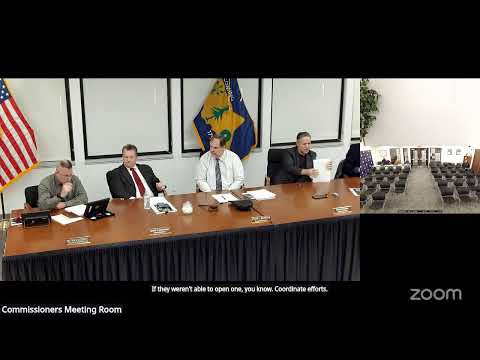
Shannon, a planning and community development staff member for Lycoming County, told commissioners the five‑county solid waste management plan — covering Columbia, Lycoming, Montour, Snyder and Union counties — has entered a 90‑day public comment period after receiving a positive preliminary review from the Pennsylvania Department of Environmental Protection.
"We kicked this off in fall of 2022," Shannon said, and added that the draft required only "very few revisions" following DEP comments. The plan, she said, projects regional waste generation and recycling needs for 2025 through December 2035 and was prepared with regional steering committees and stakeholder input.
The plan adopts an open, market‑driven approach to disposal rather than mandating where haulers must take waste. Shannon and other staff said more than 90% of the region’s waste currently goes to the Lycoming RMS landfill because of proximity and cost; the next largest destination is the Wayne Township landfill in Clinton County. The draft includes maps of facilities that accept at least 400 tons and demographic and per‑capita projections built using U.S. Census data.
Shannon and other staff identified several priorities for implementing the plan if adopted: updating memoranda of understanding (MOUs) among the five counties, negotiating an implementation agreement and a separate agreement with RMS to reserve disposal capacity, expanding secure drop‑off locations, improving household hazardous waste collection and boosting recycling coordinator funding. She noted specific safety concerns tied to lithium batteries and said a battery disposal program now appears on RMS’s website.
Commissioners and staff discussed next steps and timing. Shannon said the county must adopt the updated plan by May 31 and that the planning office will present the plan to the remaining partner county in the coming week. The office asked the public to submit comments to Malik or Shannon via the county planning department web page listed in the presentation.
The presentation included technical details on waste streams (municipal solid waste, residuals, sewage‑treatment residues, construction and demolition waste, ash residue and asbestos) and a projected regional recycling rate of about 34 percent under current market conditions; the state’s target cited in the presentation is 35 percent. Shannon noted market conditions and the cost of recycling influence participation and tonnage.
The county will collect public comments during the 90‑day period, revise the draft as required by DEP and return to the commissioners for final adoption by the statutory deadline.
AI generated
The text on this page is AI generated. Summaries, highlights, analysis, and video transcripts are all produced from the original source material.
AI can make mistakes, so if you spot one, and we will fix it for everyone.
Note: the source content is unaltered by us. Any content source we link to, be it a video, an audio recording, or a document, is presented exactly as its publisher released it. That publisher is usually a government body, sometimes an individual official or another organisation.