
Planning Board continues debate on 'cottage community' zoning amendment after extended public comment on density and water risks
Get AI-powered insights, summaries, and transcripts
Subscribe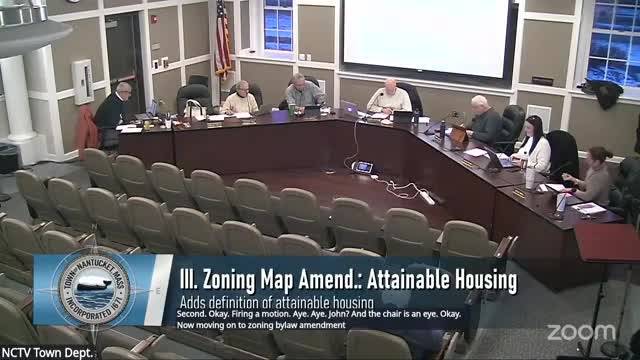
Summary
At a Jan. 22 special meeting, the Nantucket Planning Board continued its public hearing on a proposed zoning amendment to allow a new "cottage community" development type after residents and experts raised concerns about housing density, septic/sewer and local water contamination.
At a Jan. 22 special meeting, the Nantucket Planning Board continued its public hearing on a proposed zoning amendment to allow a new "cottage community" development type after more than an hour of technical presentation and public comment.
Planning Department staff member Megan Trudell summarized the draft: the proposal would create a special-permit “cottage community” option intended to support year‑round homeownership for households making up to 240% of Area Median Income (AMI). It would be allowed only on conforming lots in specified residential and some commercial/mixed-use districts, require deed restrictions enforced through the town’s Affordable Housing Trust, limit new cottage units to three bedrooms and 24 feet in height, and require site‑plan review, parking, clustering and open‑space standards.
Why it matters: supporters say the model can produce smaller ownership units targeted to local needs; opponents warn the draft, as written, could enable a large increase in dwelling units on some parcels, stressing roads, septic/sewer and water systems and potentially increasing exposure of municipal wells to PFAS contamination.
Board and staff details: Trudell said the deed‑restriction monitoring would be administered through the Affordable Housing Trust and that the draft excludes preexisting nonconforming lots. She described a density formula in the draft and said the units must be owner‑occupied year‑round; short‑term rentals would not be permitted under the current draft.
Public comments: multiple residents and stakeholder organizations spoke at length. Art Gasparo reviewed parcel‑level scenarios and said the proposal could produce far more units on some lots than currently allowed, producing unintended overdevelopment. Several residents, including a speaker who identified a personal history of thyroid cancer, urged the board to pause the amendment until the town clarifies water‑supply and PFAS remediation plans. Emily Molden of the Nantucket Land and Water Council and other public commenters requested a fuller infrastructure impacts analysis before the board forwards an article to Town Meeting.
Board direction and next steps: after hearing technical questions and numerous public comments, the board voted to continue the hearing to its February 6 meeting and asked staff to prepare parcel‑level examples showing hypothetical build‑out under the draft in multiple zoning districts, plus an analysis of potential impacts on water, sewer, traffic and parking. The continuation motion passed by roll call.
What was not decided: the board did not adopt any final language or make binding changes to the draft at the Jan. 22 meeting. The continued hearing will return to the board for more data and possible redrafting before any recommendation to Town Meeting.