Get Full Government Meeting Transcripts, Videos, & Alerts Forever!
Get email alerts on the Food Labeling Country Of Origin topic
No spam. Unsubscribe anytime.
Committee approves bill requiring U.S.-origin labeling for beef; agencies warn implementation limits
Summary
Senate File 84, a measure requiring beef that is born, raised, slaughtered and processed in the United States be labeled as a product of the United States, was reported favorably out of the Agriculture Committee after an amendment allowing Wyoming/local labels that meet that test.
Senate File 84, a measure requiring that beef derived from cattle "born, raised, slaughtered and processed in the United States" be labeled as a product of the United States, was reported favorably out of the Agriculture, State & Public Lands & Water Resources Committee after an amendment clarifying that Wyoming-branded or "local" labels that meet the same U.S.-origin test would qualify.
Senator Steinmetz, sponsor of the bill, told the committee the measure "requires that if it's born, raised, slaughtered and processed in the United States shall clearly be labeled as a product of the United States of America." She said the statute is intended to provide a market advantage and informational clarity for consumers and producers and noted that federal country-of-origin labeling once applied to beef but now covers a narrower set of products.
Department of Agriculture staff cautioned that implementation has limits. Doug Miyamoto, speaking for the Wyoming Department of Agriculture, said Wyoming processors and in-state supply chains can be documented and labeled, but many retailers and wholesalers cannot currently prove that boxed beef or commingled cuts originated entirely in the United States because importers and processors are not required to segregate or supply that information. "Wyoming retailers and wholesalers, in many cases, can't prove that the meat should be labeled as US beef," Miyamoto said, and he recommended caution about placing compliance burdens on local businesses that may not have source documentation.
The department advised that a Wyoming-only label ("Wyoming beef") could be implemented with existing staff because in-state processors can provide traceable documentation; Miyamoto said the agency could develop a Wyoming-specific label and require its application for meat products derived wholly from animals born, raised and slaughtered in Wyoming. The department also said it would not require additional staff for a Wyoming label and that existing inspection systems can support state-origin certification for in-state processing.
Public commenters included Bill Winnie of Sublette County, who said he prefers to buy U.S. or Wyoming products when labeling is available, and representatives from commodity groups including the Wyoming Farm Bureau Federation and the Rocky Mountain Farmers Union, who expressed support for country-of-origin labeling.
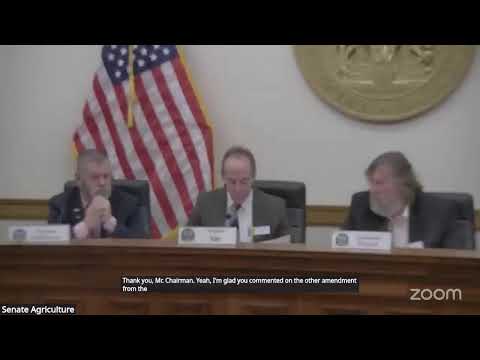
Action: Senators moved and seconded the bill and an amendment clarifying that Wyoming/local labels that meet the U.S.-origin test qualify. Roll call recorded ayes from Senators Crago, Eyde, McEwen, Pearson and Chairman French; the committee recorded the vote as 5 ayes and reported the bill favorably to the floor as amended.
Why it matters: Supporters said the requirement would let consumers identify and prefer domestic beef and provide marketing value for producers. Agency testimony warned that mandatory labeling for "product of the USA" could be hard to enforce at the retail level when boxed or commingled product lacks source documentation; state implementation would be feasible for fully in-state production chains.