Get Full Government Meeting Transcripts, Videos, & Alerts Forever!
Get email alerts on the Special Education topic
No spam. Unsubscribe anytime.
Wichita Falls ISD special programs presentation details growth in special education, bilingual and student supports
Summary
District staff presented detailed data showing increases in special-education enrollment and other special programs, reported staffing changes and service improvements, and urged community and legislative support for additional resources.
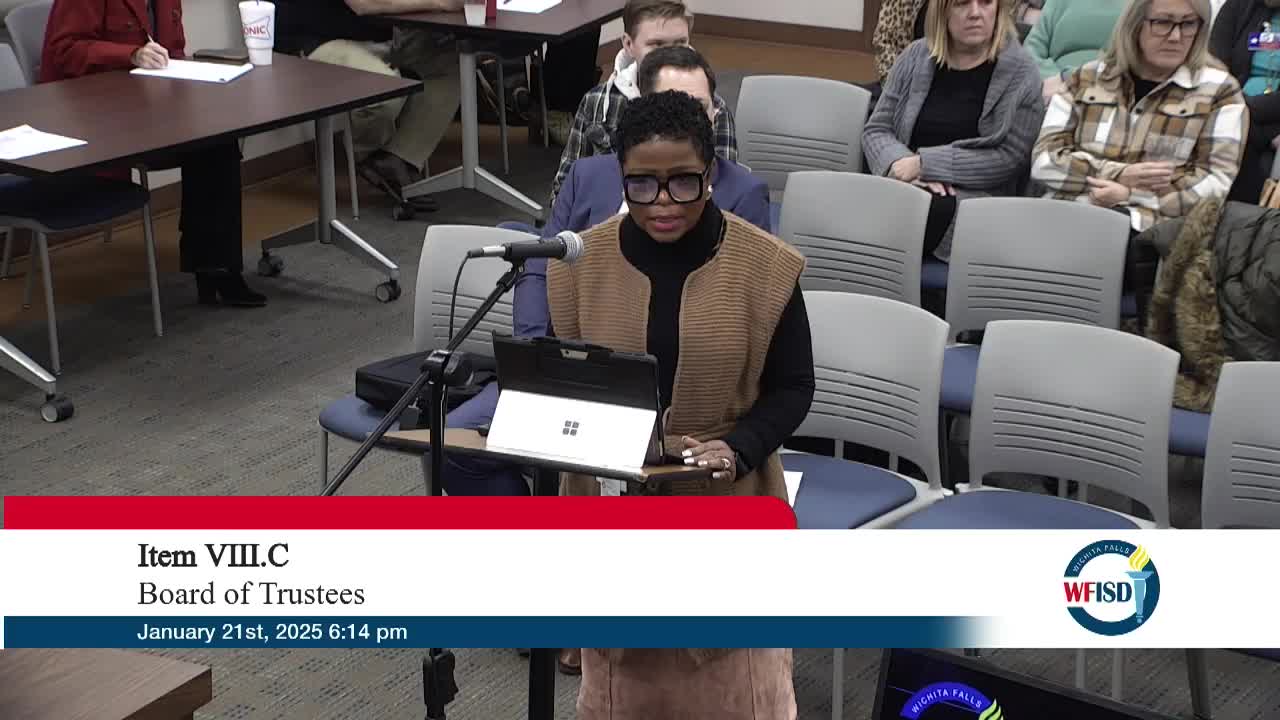
Miss Duong, a Wichita Falls Independent School District staff member, delivered a data-driven overview of the district’s special programs to the Wichita Falls ISD Board of Trustees, describing increases in special-education enrollment, program reorganizations and a range of student supports.
The presentation summarized eight programs grouped under the district’s special programs umbrella — including emergent bilingual/bilingual and ESL services, the Parent As Teachers (PACT) program, gifted and talented services, homeless and foster care supports under McKinney-Vento, 504 accommodations, and the district’s special-education (Sped) programs — and outlined recent staffing, program and outcome data.
Why it matters: District staff said special-education enrollment and related needs have risen faster than the state average and that supporting those students requires additional staffing, training and funding. The presenter asked the board and the community to press legislators for increased special-education funding during the current Texas legislative session.
The presentation highlighted measurable program changes and operational details. Duong said WFISD’s combined bilingual/ESL population is about 13% of students versus a state average of 24.5%, and noted a 5.91% increase in that population since the 2022–23 school year. The Parent As Teachers program served 97 families, an increase of approximately 86.54% since 2022–23. The district’s TAG (talented and gifted) program serves roughly 247 third- through fifth-graders; 441 students had been nominated for GT assessment as of Jan. 15, 2025.
On homelessness and foster care, Duong said the district’s homeless population has decreased about 2.84% since 2022–23 and the foster population about 5% in the same period. She also explained McKinney-Vento criteria (doubled-up households, hotels, etc.) and said the district’s homeless rate is about 1.5% versus a state average of 1.4%.
Special education was a central focus. Duong said the district’s special-education population has increased about 13.06% since 2022–23 and now represents approximately 22% of WFISD’s student population, higher than the state average of about 14% (23–24 report). She listed drivers the district believes contribute to the higher local rate: hosting regional programs (including the Regional Day School Program for the deaf and hard of hearing), military families from Sheppard Air Force Base, group homes and specialized local programs that attract families seeking tailored supports.
Duong said district responsibilities include child-find and evaluations, private-school evaluations for students in the attendance zone, provision of related services (dyslexia, speech via teletherapy, homebound services), Medicaid documentation for reimbursements, and serving as fiscal agent for the regional day school program that covers 37 districts.
Duong reported operational improvements and staffing notes: vacancies that existed in 2024 have largely been filled; all school psychologists and diagnostician vacancies were filled for the first time in three years; the district has seen an 18.2% reduction in restraints and a 14.29% reduction in staff injuries compared with the same period last year; and the number of staff trained in the district’s care-and-crisis protocol rose sharply.
She described targeted pilot work to increase inclusive placements and reduce the number of students spending 60% or more of instruction in self-contained settings; participating campuses include Fowler, Franklin, Bow WISE, McNeil, Memorial and Legacy. Duong said the district submitted a strategic support plan to the state to address academic areas needing improvement, especially science and social studies for students served by special programs.
On funding and next steps, Duong asked the board and the community to advocate for more state special-education funding during the legislative session. She also said the department will present proposals to Superintendent Donni Lee on options to support diagnosticians, paraprofessionals, inclusion teachers and bilingual supports — proposals that, she said, will outline options and research but will not immediately request specific personnel or funding levels.
Direct words from the presentation included Duong citing her personal mantra: “To whom much is given, much will be demanded,” and saying, “I pray that this legislative session bears fruits that we can continue to support our special education students.”
The board asked clarifying questions during the presentation (definitions of McKinney-Vento homelessness, referral and eligibility processes, and program placement issues). Duong answered with program-level clarifications: referrals are requests for Sped evaluation that can come from principals, MTSS chairs, parents or community providers; many referrals result in evaluations and eligibility determinations; and the district is using updated dyslexia evaluation processes under the special-education umbrella.
Ending: Duong closed by thanking staff, parents and community partners and said she will return with more detailed compensation and staffing options for board consideration. Staff-level proposals and any formal requests for new funding or personnel were not made at this meeting and will return to the board for future action.