
Syosset board hears detailed review of 2023–24 budget; health insurance, special education and transportation drive increases
Get AI-powered insights, summaries, and transcripts
Sign Up Free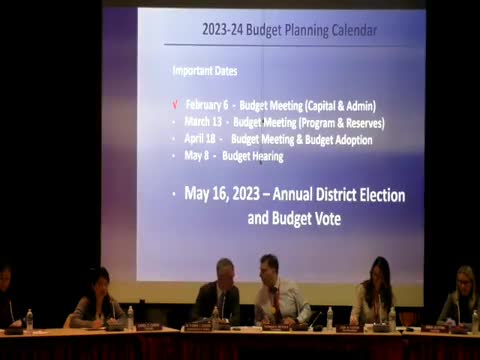
Summary
District administrators presented a second review of the 2023–24 budget, outlining a 6.71% rise in program spending, a $7.6 million increase in benefits driven largely by a $5.1 million health insurance jump, and planned use of reserves. Board members pressed for details; district plans a final revenue/reserve review and budget adoption in April.
Board members held a detailed second review of the Syosset Central School District’s 2023–24 budget, focusing on benefits, program spending, transportation and the planned use of reserves.
Dr. Ruffo, a district staff member who presented the budget, told the board the district’s “primary goal always is to preserve our existing programs and services.” She said benefits are a primary pressure point: the district is showing an overall $7,600,000 (about 12%) increase in benefits for 2023–24, with health insurance accounting for roughly $5,100,000 of that rise.
The program section — the largest portion of the budget at about 76% — is forecast to increase 6.71% or $9,800,000. Dr. Ruffo said instruction (code 2110) represents roughly one-third of the district budget at $87,000,000 and is projected to rise about $4,300,000 (5.2%), driven by secondary staffing adjustments, contractual salary steps and BOCES services. Special education (2250) is projected to increase about $1,360,000 (4.4%) driven by staffing shifts tied to students’ IEPs and a higher contingency for possible out‑of‑district placements.
Transportation remains a notable pressure: Dr. Ruffo said contracted transportation is a major driver of the roughly $13,000,000 transportation line, and noted the district uses the state contract, which applies May CPI adjustments; she cited May CPI at 6.3% and said that contributed to contract increases. The presentation also flagged gasoline and utility costs rising toward $400,000 for the year.
On reserves and cash-flow options, Dr. Ruffo described the district’s expected use of restricted reserves: roughly $4.5 million was used in the current year and about $6.0 million is being proposed for 2023–24, with a significant portion related to ERS/TRS pension rate variances. She said the district is exploring structuring TANs (tax anticipation notes) with staggered maturities to reduce borrowing costs and has discussed options with bond counsel and fiscal advisers.
Board members asked for clarifications. One member noted a $250,000 special education contingency and asked whether it was tied to potential placements; Dr. Ruffo answered that the PPS department is seeing an uptick in initial referrals and the contingency preserves budget space should some of those referrals result in placements. Another member pressed on the $830,000 increase in computer‑assisted instruction; Dr. Ruffo said part of that reflects year‑one Chromebook replacement costs and a roughly $300,000 E‑Rate project that offsets some of the expense.
Superintendent Dr. Rogers framed the presentation in a broader context, telling the board the district has “robust shock absorbers” but this year’s inflation metrics are unusually high and the administration is trying to communicate changes to the community without causing undue alarm. He noted higher substitute costs driven by a severe flu season and longer COVID‑related absences and reiterated that Syosset’s enrollment trend differs from many Nassau County districts: Syosset has experienced net enrollment growth since about 2015.
What happens next: Dr. Ruffo said the administration will return at the April meeting with an updated review of contested line items, final revenue estimates and a reserves review ahead of scheduled budget adoption.
Ending: Administrators emphasized the district’s approach will continue to prioritize maintaining programs while identifying expenditure reductions or phased capital projects to limit tax‑cap impacts.