Get Full Government Meeting Transcripts, Videos, & Alerts Forever!
Get email alerts on the Education topic
No spam. Unsubscribe anytime.
Goose Creek CISD reviews 2023–24 TAPR, outlines timeline to pilot state dopted "Bluebonnet Learning" materials
Summary
District staff presented the Texas Academic Performance Report (TAPR) for 2023 24, highlighted gaps in ELA and math, and laid out a spring-to-fall timeline to review and possibly adopt the state provided Bluebonnet Learning (formerly Amplify/Eureka) high-quality instructional materials (HQIM).
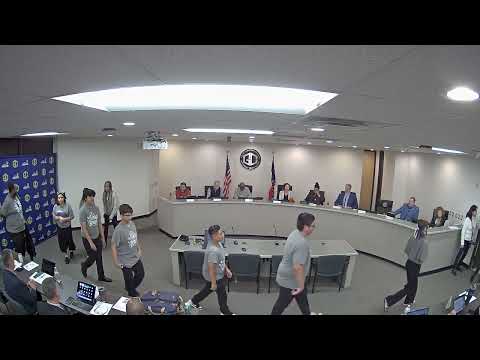
The Goose Creek CISD Board of Trustees heard a public hearing and presentation on the district
23/24 Texas Academic Performance Report (TAPR) and an accompanying update on current instructional work and a proposed timeline to review state-provided HQIMs on Jan. 13.
The TAPR, compiled by the Texas Education Agency, uses PEIMS and student assessment data and was released less than a month before the meeting, presenters said. Kendall Jackson, a district presenter, told the board the TEA report and related accountability markers remain delayed in part "because of the pending court case." Jackson summarized district performance: elementary 3 through 5 ELA is about 6 to 7 percentage points below the state and region, math about 10 points below, and science roughly 4 points above. Across tested grades the district is "about 4% below the state and region," Jackson said.
Why it matters: district staff said targeted attention to ELA and math instruction, plus remediation in science and social studies where the district took larger hits, could affect future accountability and student outcomes. The board also heard a multi-step plan for evaluating and implementing the state provided HQIMs, described at the meeting as Bluebonnet Learning (state rebrand of products called Amplify and Eureka).
District context and findings
Jackson and other instructional leaders told trustees that recent TEA changes to assessments (the STAAR redesign and new item types) and scoring practices increased the number of zero scores on constructed responses and shifted the profile of results. "Writing was assessed in grades 3 through 10 ... there was a human scoring element of the constructive responses," Jackson said, noting hybrid and human scoring elements had changed across years. She said TEA also aligned dyslexia guidance with federal guidance, which increased the district's special education counts and affected Domain 3 measures.
On high school indicators, staff reported stronger results: College, Career and Military Readiness (CCMR) measures and dual-credit completion rates were above state and regional averages. Jackson noted a Lee College incentive referenced to dual-credit completers but did not provide a complete, district-verified dollar calculation at the meeting.
HQIM review and implementation timeline
Olivia Callahan, director of elementary instruction, walked the board through a district timeline for evaluating and (if approved) implementing the Bluebonnet Learning materials. Key dates presented include a stakeholder survey window (Jan. 17
through 24), a local Instructional Materials Review and Approval (MRAA) meeting (Jan. 30), committee prioritization and a February 17 board update, followed by alignment work in late February and March planning for professional development and procurement. Callahan said the district will offer teacher-facing sessions at the technology building and emphasized that HQIM implementation requires time for teachers to "internalize" lessons before full roll-out.
On the products the district is piloting, staff said some campuses already use parts of Amplify/Bluebonnet and Eureka in early grades and Carnegie in secondary honors pilots. "Bluebonnet Learning encompasses math and reading language arts," Callahan said.
Supports, grants and targeted interventions
Instructional leaders described a package of grants and supports tied to the work: LASSO learning-acceleration supports, a Texas RAL grant, Region 4 supports, and private foundation cooperation (Gates Foundation and Moody Foundation referenced) for planning and coaching. The district also said staff had won a modest ExxonMobil grant of about $15,000 to support teacher incentives for after-hours professional learning.
Levers to address TAPR findings
District leaders listed targeted actions already in place or planned: restructuring administrator PLCs to build content knowledge, common unit assessments and benchmark cycles, expanded coaching and PLC supports, emphasis on handwriting and writing instruction across contents, additional monitoring of tier-1 instruction, and targeted small-group interventions (for example, an "Ignite" interactive tutoring program for students identified in the bottom percentiles).
Direct quotes from the meeting
"The TAPR is compiled by TEA for every district in campus, and it uses 2 forms of data," Kendall Jackson said during the presentation.
"Bluebonnet Learning encompasses math and reading language arts," Olivia Callahan told trustees while describing the state rebrand of HQIM products.
Ending: next steps and board schedule
District staff told the board they will upload the full TAPR PDFs to the district website and return to the board with additional data at the Feb. 17 superintendent report, including special education determinations and staffing updates. Staff also said MOI (middle-of-year) MAP results, a data point the district considers highly predictive, will be reported at the next meeting.