Get Full Government Meeting Transcripts, Videos, & Alerts Forever!
Get email alerts on the Budget Fy26 topic
No spam. Unsubscribe anytime.
Chariho presents FY26 omnibus budget; officials flag transportation costs, fund-balance concerns
Summary
Superintendent Gina Picard presented a FY26 omnibus budget that shows a 3.2% proposed increase before state aid (2.1% after the governor's proposed aid). Committee members, town officials and residents pressed the district and state legislators on transportation funding, unfunded mandates and the district's low fund-balance policy.
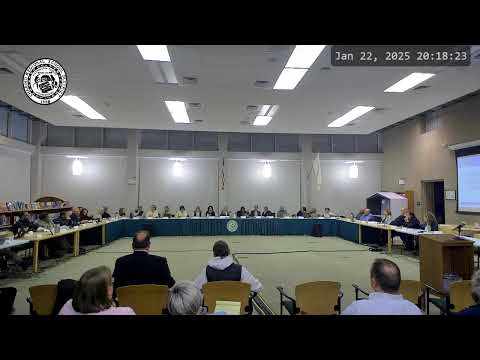
Chariho Regional School District Superintendent Gina Picard presented the district's fiscal year 2026 omnibus budget to the Chariho School Committee and regional town representatives, framing the proposal as fiscally responsible while warning that transportation costs and unfunded state mandates are the largest current pressures on local taxpayers.
"This budget ensures Chariho stays on track to provide high quality and rigorous public education to all of our students," Picard said as she opened the presentation, adding that the figures discussed were based on the governor's preliminary FY26 budget.
The nut graf: The proposed FY26 budget shows a 3.2% spending increase before state aid and a 2.1% increase after using the governor's current aid numbers. Officials and public speakers used the omnibus hearing to press for legislative changes to how the state funds regional transportation and to urge the district to revisit its fund-balance policy amid rising health-care and special-education costs.
Most important details first: Picard said the district is using the governor's Jan. 14 estimate of state aid, $15,304,248, and an estimated $3,000,000 in career-and-technical tuition revenue to build the FY26 budget. She noted the district's preliminary budget increase of 3.2% is "before state aid" and therefore becomes a 2.1% increase after the current state-aid estimate.
Picard and district staff pointed to several drivers of higher costs: projected health-care premium increases of 15% to 20%, updates to science curriculum materials, rising utilities and facility needs, higher out-of-district transportation and DCYF tuition costs, and capital-project planning tied to state-stage applications.
Fund balance and audit advice: The presentation cited the Government Finance Officers Association guidance that a fund balance equal to roughly two months of expenditures is prudent. The district's current policy sets a 2% to 4% fund-balance target; Picard said auditors have advised increasing that target to 7% to 10% for greater fiscal stability. For FY26, the budget proposes a 2.25% allocation to the fund balance.
Transportation and state policy dominated committee and public questions. Picard and several state legislators at the hearing urged greater state action to address inefficiencies in a statewide contract that the district says costs roughly $9 million before buses run and contributes more than $4 million in local transportation expense for Chariho. Representative Megan Carter described a pilot with RIPTA and Davies Career & Technical School and urged attendance at the state transportation commission hearing to press for reform, saying, "If that works and it's successful, then they might be able to launch that in other parts of the state." She also urged advocacy on the problem of transporting students to private and charter schools within state-defined zones.
Unfunded mandates: Multiple school committee members, town officials and residents urged compiling a district-level accounting of unfunded state mandates. The committee discussed aligning line items by UCOA (budget) codes and collaborating with RIASBO (the Rhode Island Association of School Business Officials) and neighboring districts so legislators can see aggregated fiscal impact. The committee asked district finance staff to coordinate with other districts on a uniform list.
Grants and one-time funds: Picard highlighted more than $3,000,000 in multi-year grants the district has secured for FY26, including Project AWARE and other federal and USDA-linked funds used to support mental-health training, internships and farm-to-school programming. Assistant Superintendent Michael Camiller said the youth mental-health grant used a train-the-trainer model and that the initial grant covered about $26,000 in upfront training costs.
Public comments: Residents emphasized both taxpayer strain and program priorities. Mike Colosnati of Richmond urged the committee to press the state to pay for mandates and estimated at the hearing that mandates are a major portion of district cost increases. Clay Johnson, a Richmond resident, urged sensitivity to lower-income and fixed-income households affected by tax changes. Gary Stoner asked the committee to explain the benefits and costs of specific mandates and what would happen if the district did not comply.
Questions about specific line items surfaced at the table. Sharon Davis of Hopkinton submitted an analysis of codes with an 8% or greater increase and highlighted the district's health-benefit account, saying it showed a $464,000 increase over FY25 for benefits-related line items. District finance staff replied that the FY25 health-benefit line is currently overdrawn by roughly $45,000 based on year-to-date statements.
Other operational points: The presentation reiterated that as enrollment shifts across Charlestown, Richmond and Hopkinton, per-pupil charges among the towns change (Charlestown pays a higher per-pupil share because it receives less state aid). Picard noted the district ranked among the state's top high schools in combined ELA, math and science proficiency in the league's published data, a point used to justify continued investment.
Next steps and schedule: Chair Louise Dinsmore reminded attendees of the FY26 schedule: a Chariho budget workshop on Jan. 28, a school committee budget approval meeting on Feb. 11, the regional school-district public hearing on March 4 and budget adoption on March 11. Picard and town leaders also agreed to continue coordination on enrollment projections and to share large development applications from town planning offices with the district when they reach preliminary plan stages.
Why it matters: The FY26 budget shapes school services, local tax levies and the district's ability to meet state requirements. Officials said much of the district's fiscal stability hinges on state decisions about transportation funding and whether the General Assembly will address the cost impacts of unfunded or partially funded mandates.
Taper: Committee members and state legislators urged coordinated advocacy at the Statehouse and more detailed local accounting of mandate costs; the district said staff will continue to refine the budget ahead of the Feb. 11 approval meeting and the March public hearing.
Quotes used in this article come directly from participants at the omnibus FY26 budget meeting of the Chariho Regional School District (see provenance).