Get Full Government Meeting Transcripts, Videos, & Alerts Forever!
Get email alerts on the Public Transit Long Range Planning topic
No spam. Unsubscribe anytime.
Pierce Transit pitches Destination 2045 plan to University Place council; restores service depends on added funding
Summary
Pierce Transit presented its Destination 2045 long‑range plan, showing service scenarios tied to funding and growth; staff emphasized a 500,000 annual‑service‑hour baseline, capital needs (buses, facilities, mechanics), and options including a 'fast, frequent and reliable' BRT‑light network.
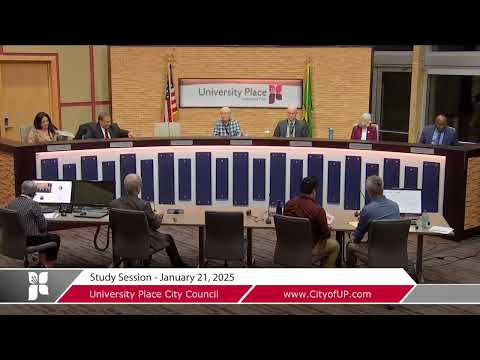
Pierce Transit staff briefed the University Place City Council on Jan. 21 about Destination 2045, a new long‑range plan that lays out alternatives for restoring and expanding transit service countywide if additional funding becomes available.
Darren Stavish, principal planner for Pierce Transit, and Anna Peterson, senior planner, described four illustrative growth scenarios the agency has modeled. The agency’s pre‑pandemic metric was about 500,000 annual service hours; the scenarios show incremental service increases — for example, 20% more hours for Scenario A and up to 80% more in Scenario D — with each scenario requiring more buses, operators and facility capacity.
Stavish said the scenarios are illustrative and dependent on funding: “Our goal is to get back to that 500,000 annual service hours with our September 2026 service change. … If funding were to allow that number of service hours, some elements of scenario D could happen.” Peterson added that the scenarios assume returning service to areas that opted out of the district in 2012 for the higher‑growth options.
Capital and workforce constraints: Planners emphasized that restoring and expanding service requires the “four B’s” — buses, bodies, buildings and (CEO joked) “BUCs.” Stavish said the system’s ability to expand is limited by available buses, parking/maintenance facilities and the ability to hire and retain operators and journey‑level mechanics. He said operator vacancies and mechanic shortages constrain service: “we're down 65, 70 vacant operator positions” at times and shortages of mechanics can keep dozens of buses out of service while awaiting repair.
Service concepts and equity: Pierce Transit described potential bus rapid transit (BRT) corridors and a lower‑cost alternative called the “fast, frequent and reliable network,” which would deliver many BRT passenger amenities — signal priority, enhanced shelters, off‑board fare options and skip‑stop service — at far lower capital cost (roughly $1–3 million per mile vs. full BRT). Planners said routes correlate with growth projections from the Puget Sound Regional Council and with areas of higher transit propensity.
Funding and cost: Council members asked about funding options. The agency confirmed sales tax is the largest predictable funding source and that scenario costs are tied to sales tax rates. Council member Metz Ploski noted that scenarios A, B and D were described as requiring a sales tax rate of roughly 0.9% (current rate 0.6%), while Scenario C would require about 1.2%; planners said detailed dollar amounts and spreadsheets are in the draft plan. Stavish and Peterson encouraged council feedback and public comment; the first draft of the plan is available through Feb. 3 for review.
Next steps: Pierce Transit will consider public and city feedback and produce subsequent drafts. Staff urged city officials to coordinate with county and regional partners as the agency refines cost estimates and funding strategies.