Get Full Government Meeting Transcripts, Videos, & Alerts Forever!
Get email alerts on the District Finance topic
No spam. Unsubscribe anytime.
Lebanon schools report $16 million cash cushion; officials warn early state bills could cut property-tax revenue
Summary
The Lebanon Community School Corporation reported roughly $16 million in operational fund balances at the end of 2023 and cautioned trustees that proposed state tax bills could reduce local property-tax revenue.
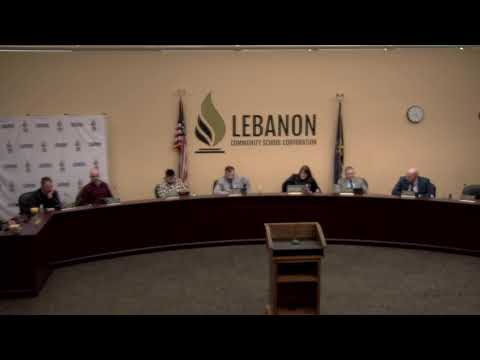
The Lebanon Community School Corporation’s finance presentation on Jan. 21 showed the district closed calendar year 2023 with roughly $16,000,000 in operational fund balances and a fund-balance-to-expenditures ratio of about 40%, a level the presenter called “healthy” for an unexpected operating need.
That financial picture was delivered during the board of finance hearing by Mister Martin, a staff member, who walked trustees through six fiscal indicators the Distressed Unit Appeals Board (DUAB) uses to evaluate fiscal strength. “So, what you're seeing there is the sum of our operational funds on hand, is just at $16,000,000 as of end of year 2023,” Martin said. He added: “You'll see end of 2023, we were running at 40%.”
The presentation explained how cash is held and managed. The district keeps an operating account with a nightly peg of $1,500,000; surplus funds are swept into a designated sweep account (about $12,500,000 as of Dec. 31, 2024). Other deposits are held at Trust Indiana and LPL Financial; Martin said roughly $2,300,000 remains invested in mortgage securities and the district is moving funds to higher-yield vehicles where prudent. He noted the district’s operating referendum fund produced about $5,000,000 in 2023 — roughly 6% of total revenue — and that state per-student aid has been visually flat despite enrollment growth.
Why it matters: the board’s policy requires a minimum 10% fund balance but Martin said a district of Lebanon’s size should target roughly 20% as a practical minimum. He pointed to growing insured building values and higher deductibles for wind-and-hail claims — “1% of the insurable value is your deductible for a wind and hail claim” — as examples of why cash reserves matter.
Martin also warned trustees about early 2025 bills filed in the Indiana General Assembly that would limit how and when referenda are placed on ballots and, more significantly, could eliminate taxation of business personal property put into use on or after Jan. 1, 2025. “No personal property, business personal property that is put into use on January 1, 2025 will ever be taxed,” Martin said, summarizing the draft language. He said business personal property currently accounts for about 12% of the district’s gross assessed valuation and that Lebanon’s assessed valuation is roughly 45% commercial, 45% residential and 10% agricultural — a mix that would make the district especially sensitive to changes favoring commercial property.
Board members asked about potential outcomes and next steps. Martin noted the DUAB indicators he cited are updated only through the end of 2023 and that 2024 data were not available on the DUAB site, limiting the report’s currency. He recommended ongoing communication with state legislators and membership organizations (School Boards Association, Superintendents Association, Business Officials Association) to try to influence any final legislation.
Other financial details provided in the presentation included: interest-rate performance on money-market deposits (some accounts earned about 4.35% for the full year), an explanation that bond- or capital-related accounts (2021 GO, 2022 Capital Referendum, 2023 GO, First Mortgage Bonds) represent construction/project cash not available for operating uses, and a reminder that some project funds are held at trustee banks and reported for transparency.
The board received the presentation; no formal action was required or taken on the financial report itself.