Get Full Government Meeting Transcripts, Videos, & Alerts Forever!
Get email alerts on the School Budget topic
No spam. Unsubscribe anytime.
Tewksbury budget workshop: salary pressures, special-ed costs and a cut to capital outlay shape FY26 proposal
Summary
Mister Libby, a district staff member, reviewed the Tewksbury Public Schools preliminary budget for fiscal 2026 during the Jan. 22 school committee budget workshop. Libby said the district’s plan shows a 3.44% increase for salary, operating and capital outlay (3.63% overall when town-managed fixed costs are included) and reflects “a tighter financial picture.”
Mister Libby, a district staff member, reviewed the Tewksbury Public Schools preliminary budget for fiscal 2026 during the Jan. 22 school committee budget workshop. Libby said the district’s plan shows a 3.44% increase for salary, operating and capital outlay (3.63% overall when town-managed fixed costs are included) and reflects “a tighter financial picture” after several years of favorable budgets.
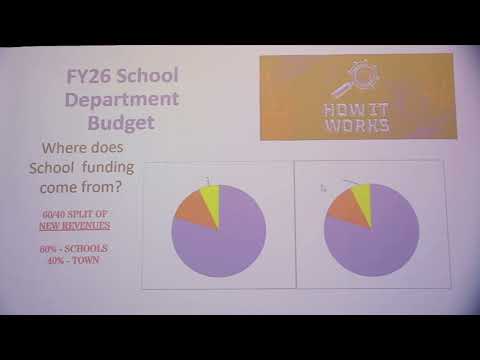
The budget leans on payroll savings and shifting contracted special-education supports to employees. “The school budget is made up of four major parts,” Libby said, explaining that salary typically accounts for roughly 70–71% of the district’s expenses. To balance projected needs with town revenue estimates, the district and town manager agreed on approximately $1.9 million in new town support, above the roughly $1.2 million that would have followed the historical 60/40 split of new revenues.
Why it matters: salary and contractual increases now consume most of the operating budget, forcing school leaders to cut capital spending and identify recurring versus one-time revenue sources. Libby told the committee the district reduced next year’s capital outlay to $250,000 from a historical $789,000, a change he described as a 68% reduction compared with prior practice; he said larger facilities projects will likely require town-meeting articles going forward.
Special education and circuit breaker: Libby outlined steps to implement recommendations from a recent special-education audit, including reorganizing in-district programming and increasing district-employed aides to replace contracted Educational Support Personnel (ESP) services. The budget increases circuit breaker spending in FY25 by just under $2 million because of higher tuition and transportation costs for out-of-district placements. Libby used a sample high-cost student claim to explain circuit-breaker mechanics: an educational cost of about $155,000 plus $25,000 in transportation, with state reimbursement historically modeled at 75% for educational costs and at 44% this year for transportation; Libby noted transportation reimbursement might later change at the state level.
Transportation was a focal point of committee questions. Libby said the district is in year three of a three-year contract with the current vendor, with an expected cost increase “a little over $200,000.” He said the district will put bus services out to bid in the fall and is exploring ways to reduce costs, including revising run patterns and negotiating service-level terms in future contracts. Committee members discussed options such as late‑bus pricing, penalties for missed service levels, and potential fees for certain transportation uses, while noting that charging for busing could increase parent driving and local traffic.
Grants, revolving funds and food service: the presentation enumerated 49 active grant and revolving funds (the district expects to close three in FY25 and operate 46 going forward) and reminded the committee that many funds must be spent for their specified purposes. Libby said food-service operations remain self-funded but will begin absorbing employee benefit costs; the district added roughly $400,000 in benefit charges to federally funded programs and some revolving accounts, which is being credited in the FY26 budget. He also warned of a possible $170,000 reduction to Title I funding for FY26, a risk the district said it will plan for until state allocations are confirmed.
Capital projects and facilities: Libby said some projects funded earlier with ESSER or warrant-article money have been completed, but many planned capital projects — including a Ryan School HVAC effort — are being delayed or rebid because of current economic uncertainty. He said an age‑appropriate playground for Heath Brook was flagged as a short‑term need tied to increased preschool enrollment at that school.
Next steps and committee direction: Libby told committee members the budget is fluid and will continue to be revised in consultation with principals, department heads and the town manager through the town’s warrant-cycle and until town meeting. He said detailed account-level documents and summaries by cost center and by DESE function code would be posted on the district website the following day. The committee agreed to move the separate mid-year goals update to the next business meeting and to focus this session on budget review. The meeting adjourned by unanimous voice consent at about 6 p.m.
Ending: Libby and committee members emphasized ongoing work to align staffing, grants, and operational choices with enrollment projections and state funding signals; several committee members asked for additional analyses on per-school staffing roll-forwards, transportation run efficiency, and the impact of shifting contracted services into payroll.