Get Full Government Meeting Transcripts, Videos, & Alerts Forever!
Get email alerts on the Mental Health Services topic
No spam. Unsubscribe anytime.
PACT for Families outlines regional youth mental‑health services, local survey shows mixed risk indicators
Summary
PACT for Families staff told McLeod County commissioners about program expansions, funding shifts and local student-survey results that show lower-than-national suicide indicators but a small increase in high adverse‑childhood‑experience counts.
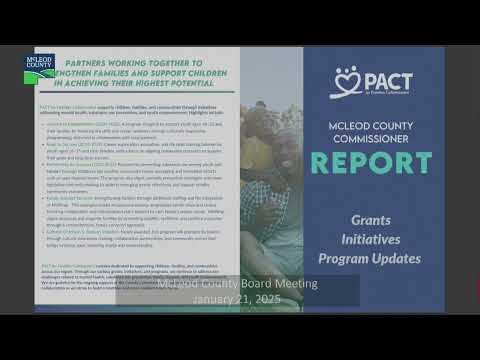
Sarah, executive director of PACT for Families, gave McLeod County commissioners an update on the collaborative’s programs supporting children and families across five counties during the meeting.
The presentation described outreach and direct-support programs, recent discretionary grants and an expansion of the federally funded Journey to Independence program. "We do not have any licensed therapists working for PACT for Families. All of our staff are unlicensed," Sarah said, adding that staff provide in‑home, one‑on‑one life‑coach style support and make referrals to licensed providers when a diagnosis or therapy is needed.
PACT for Families traces its collaborative structure to state legislation in the early 1990s; McLeod County joined the collaborative in 2011. The group coordinates partners across corrections, family services, public health, schools and community organizations to identify local gaps in mental‑health care and to promote services. Staff highlighted outreach during May’s Mental Health Month, distribution of resource cards in English, Spanish and Somali with QR links to local resources, and a sensory‑friendly movie program produced with the Burridge Foundation that is temporarily paused because of a change in theater ownership.
The update listed training and prevention work delivered in the past year, including Trust‑Based Relational Intervention training on trauma‑informed approaches, Youth Mental Health First Aid (suicide‑prevention) and Trevor Project Ally training for LGBTQ+ youth supports. Discretionary grants awarded in 2024 included a GSL Public School kindergarten‑camp request, funding for speaker Corey Greenwood and support for a social‑emotional learning library at GSL. The collaborative continues to fund multi‑county initiatives such as the Talking Is Teaching early‑childhood program.
Local funding for the collaborative comes from Local Collaborative Time Study (LCTS) dollars. The presenter said the collaborative’s funding has declined since its early years; the presentation corrected a previous misstated figure and noted the budget currently brings in about $425,000 a year, down from roughly $400,000 a year originally. As part of that shift, school social‑worker funding moved from partial county support to a model where schools will employ social workers directly in 2025 and 2026.
The Journey to Independence program, which previously served youth 16–21, received four more years of SAMHSA funding and has expanded service to youth ages 14–21. PACT staff reported McLeod County had 14 youth served in 2024 and 18 in 2023, a combined 32 youth for those two years. A new transition program serving youth with developmental disabilities covers ages 16–25. Family support services were noted to be expanding in 2025 with one additional part‑time family liaison position; staff said McLeod County had five families served in 2023 and 2024 under that program.
Forrest Rice, an evaluator for PACT for Families, reviewed local school‑survey data from the SHARE survey. He described the instrument as comprehensive and said McLeod County results allow local comparisons with state and national data. Rice highlighted adverse‑childhood‑experience (ACE) measures: just over half of students reported zero ACEs, which he described as positive, but the county showed a somewhat elevated percentage of students with four or more ACEs. On suicidal‑behavior questions (thoughts, plan, attempt), he said McLeod County rates were notably lower than national Centers for Disease Control trends. Rice also summarized a community‑partner readiness assessment showing high leadership commitment (82.6 percent) but low active leadership involvement in program implementation (13 percent), calling that gap a “red flag.” He said the collaborative will use local data to pursue targeted funding and partnerships.
Commissioners asked about partnerships with county mental‑health providers and schools, how referrals and diagnoses are obtained, and how PACT’s staff work with families and school personnel. Sarah said anyone can make a referral and that PACT assists families in obtaining diagnostic evaluations from licensed providers when needed, while providing interim family‑liaison support.
The presentation concluded with staff noting continued outreach to schools, ongoing community trainings and the pending hire for the family‑liaison position. Commissioners thanked the presenters for the update and local data insights.