Get Full Government Meeting Transcripts, Videos, & Alerts Forever!
Get email alerts on the Energy Geothermal Nuclear topic
No spam. Unsubscribe anytime.
State energy push: Operation Gigawatt, geothermal research and nuclear pathways draw multi‑million budget requests
Summary
Department of Natural Resources, the Office of Energy Development (OED), and the Utah Geological Survey (UGS) briefed the committee on a coordinated push to expand Utah’s energy capacity — including geothermal, nuclear planning and a governor’s 'Operation Gigawatt' — and presented budget requests and federal grant activity.
Officials from the Department of Natural Resources (DNR), the Office of Energy Development (OED) and the Utah Geological Survey (UGS) told the Natural Resources budget committee the state needs new base‑load resources and better data to meet rising electricity demand and protect economic competitiveness.
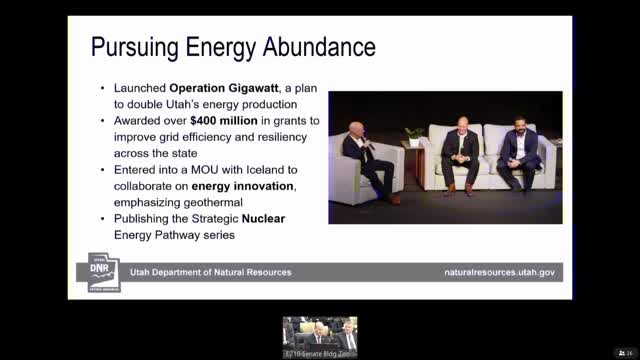
OED Director Emmy Lisovsky said the office is implementing “Operation Gigawatt,” the governor’s initiative to double Utah’s energy production over the next decade, and described legislative budget requests to support that work. Lisovsky said the office secured more than $400,000,000 in federal grant funding and published a “nuclear energy pathways” paper to inform possible future development.
Why it matters: Presenters cited rapid load growth driven by data centers, artificial intelligence, electrification and other demand drivers, while numerous existing power plants are expected to retire without clear replacement plans. Officials said geothermal and nuclear represent base‑load options that could support economic growth and grid reliability.
Key requests and commitments - Operation Gigawatt: The governor’s budget includes a one‑time request of $20,400,000 and ongoing $400,000 for Operation Gigawatt, intended to accelerate energy‑resource development and grid resilience. Joel Ferry, executive director of DNR, referenced a $20,000,000 request in his remarks and noted $4,200,000 in geothermal research funding the department is seeking as part of the governor’s package. - Utah Geological Survey geothermal request: UGS Director Bill Keach presented a $4,300,000 request to expand geothermal data collection and subsurface testing statewide; Keach said preliminary internal estimates suggest substantially more geothermal potential than previously recognized. - Private and federal leverage: Presenters described private investment examples and federal award activity. Lisovsky said OED secured roughly $400,000,000 in federal grants in 2024. Keach cited private development in Milford (pilot activity led by Fervo Energy) that followed an initial public research investment and that later attracted larger private capital commitments.
Technical context and data Officials outlined several technical and planning elements that they said must be addressed for larger builds: - Grid pressure and retirements: Joel Ferry said many existing power plants are scheduled to be retired over the next two decades and only a fraction currently have replacement plans. - Geothermal potential: UGS cited expansive geothermal resources across western Utah and said an updated assessment increased preliminary potential estimates (Keach said the most recent internal figure suggests multiple gigawatts of recoverable resource statewide; he reported a working estimate of 49 gigawatts in updated briefings). - San Rafael Energy Lab and research: Lisovsky and OED highlighted the San Rafael Energy Lab’s work on advanced cycles and battery recycling, and OED said the lab’s live modeling tool (in partnership with NREL) will provide public data on supply/demand scenarios.
Committee questions and follow‑up Members asked about office turnover and capacity at OED, regulatory barriers, and how state investments would attract private capital. Lisovsky said she had been on the job fewer than three months and that the office had no departures since she arrived. Representative Shelly urged reviewing regulatory barriers in addition to financial incentives.
Outcome and next steps: Presenters asked the committee to consider the governor’s energy funding items and UGS’s geothermal request during budget deliberations; no committee votes were taken in the hearing. Officials said they will provide further technical and fiscal details to staff as requested.
Ending: Officials characterized the proposals as early‑stage investments to attract private capital and support decarbonization options while maintaining grid reliability; the committee took the materials under advisement.