Get Full Government Meeting Transcripts, Videos, & Alerts Forever!
Get email alerts on the Public Health Preparedness topic
No spam. Unsubscribe anytime.
Committee hears DHHS bid to secure $10M federal preparedness grant; requests $707,100 state match and authority for non‑lapsing funds
Summary
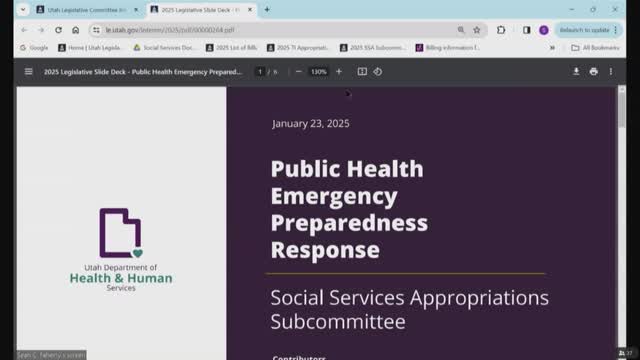
Department of Health and Human Services asked the Social Services Appropriations Subcommittee for $707,100 in ongoing general fund to secure $10 million in federal public health preparedness dollars and to authorize unspent balances to carry forward for preparedness uses; county partners provide a 10% local match.
Department of Health and Human Services officials told the Social Services Appropriations Subcommittee that a relatively small state appropriation would secure $10 million in federal funds for public health preparedness that flow to local health departments, hospitals and tribal partners.
Janae Duncan, division director for population health, explained the request is primarily intended to provide the state share of a federal grant match. She said the department is requesting $707,100 in ongoing state general fund to secure continued CDC preparedness grants; the federal award would support core preparedness activities across Utah’s 13 local health departments, seven tribal partners, 30 hospitals and several healthcare associations. Jordan Mathis, executive director of the Bear River Health Department, told the committee that the federal funds pay for local risk assessments, planning, exercises and implementation and that local governments commit required matching funds.
Committee members pressed for clarity on who provides the local match and how secure that contribution is. Local health department representatives and department staff said local partners provide a 10% match of whatever portion they receive; that equals roughly $1 million statewide (10% of $10 million). During questions, the department explained the state match previously used to qualify for the federal grant had been transferred to another agency and therefore no longer counted as state match; the requested appropriation would restore the state portion and avoid putting the federal grant at risk.
Committee members also asked for a clearer accounting of what county and local jurisdictions are already contributing and the sustainability of those commitments. Department staff said counties have provided matching funds historically and that the department would follow up with a precise list of county contributions and a detailed breakdown of how the requested state funds would be used. Staff noted a portion of the state request covers supplies and warehouse support in addition to match requirements.
The committee later considered a package of committee motions that included several non‑lapsing intent language items for public health; the package passed with one exception (see votes article). Several members voiced concern about allowing local health departments to retain unspent local health emergency funds across fiscal years, and the committee removed the local health emergency non‑lapsing item from the package.
Ending: The department’s preparedness request remains under active review by the subcommittee; agencies agreed to provide more detailed county match accounting and a breakdown of how the $707,100 would secure and be spent to sustain the $10 million federal drawdown.