Get Full Government Meeting Transcripts, Videos, & Alerts Forever!
Get email alerts on the Opioid Settlement topic
No spam. Unsubscribe anytime.
Committee reviews opioid settlement spending; corrections treatment and forensic surveillance requests presented
Summary
Lawmakers on the Social Services Appropriations Subcommittee reviewed how Utah has allocated opioid settlement proceeds and heard two formal funding requests: a Department of Health and Human Services plan to expand opioid use disorder treatment in prisons and a request from the Office of the Medical Examiner to fund forensic epidemiology work.
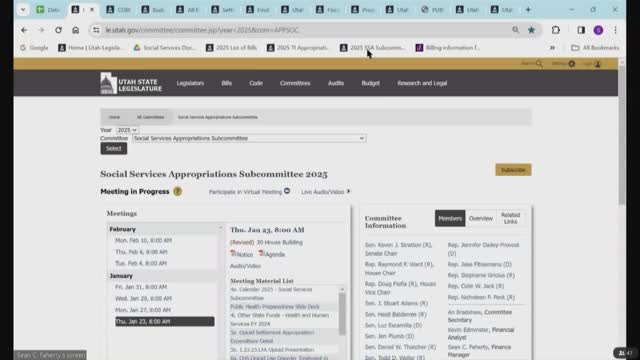
The Social Services Appropriations Subcommittee on a schedule item reviewed the state’s opioid settlement balance and heard presentations on two funding requests: a Department of Health and Human Services proposal to expand medication‑assisted treatment for incarcerated people, and a request from the Office of the Medical Examiner for ongoing funding to support forensic epidemiology and overdose surveillance.
The committee was told Utah is expected to receive about $275 million from national opioid settlements over roughly 19 years; roughly half of those collections historically are allocated to counties and local governments. Sean Faherty, legislative staff, summarized past appropriations and said about $64 million of collections to date remain unappropriated. He explained committee practice has been to treat collected but unspent settlement dollars as a limited pool and approve multi‑year (commonly three‑year) appropriations so the committee reviews commitments periodically.
Dr. Stacy Bank, executive medical director, Utah Department of Health and Human Services, introduced the corrections health presentation and Dr. Mark Wisner, director of correctional health services, outlined a two‑year request of $5.7 million from the opioid litigation restricted account to expand opioid use disorder (OUD) treatment and hepatitis C care for people incarcerated in Utah’s prisons. Dr. Wisner said roughly 17–23% of the state’s prison population has OUD and that the department’s current grant funding treats fewer than 200 incarcerated people — about 12% of those estimated to need treatment. The request would expand treatment to up to 500 individuals per year, increase access to Medicaid‑assisted treatment, provide hepatitis C treatment, and fund transition supports prior to release.
Dr. Wisner described medications to be used: buprenorphine formulations (oral Suboxone for in‑custody treatment) and a long‑acting buprenorphine injection (SUBLOCADE) given approximately 90 days prior to release to “buy time” for connections to community providers and Medicaid enrollment. He said the funding is intended as a bridge while the state builds infrastructure for a Medicaid waiver for justice‑involved individuals, estimated to take about two years to implement; the waiver would shift long‑term costs to Medicaid. Committee members asked about clinical details, cost breakdowns, and long‑term sustainment; Dr. Wisner and Dr. Bank said they would provide a more detailed budget and performance measures to analysts.
Dr. Deirdre Amaro, Utah’s chief medical examiner, presented the office’s request for $280,000 in ongoing opioid‑litigation restricted account funding to support a permanent overdose fatality examiner position and part‑time epidemiology staff. Amaro said the Utah Office of Medical Examiner (OME) is the primary source of timely, case‑level overdose fatality data and that 2023 had the highest number of overdose deaths on record in Utah, with 2024 on pace to match or exceed it. She told the committee that accurate, rapid forensic data and next‑of‑kin interviews are essential to measure program effectiveness and to inform prevention efforts. She noted the fatality examiner position is referenced in statute but not currently funded on an ongoing basis.
Committee discussion emphasized two themes: measurement and sustainability. Several members pressed for clear performance measures and benchmarks — including overdose reductions, hepatitis C cure rates, and linkage to community treatment — and asked whether three‑year funding windows would be sufficient to show long‑term impact. Dr. Amaro said the OME would provide outcome measures the committee could use to evaluate effectiveness. Dr. Bank said the corrections proposal would be designed to bridge into Medicaid coverage after the waiver is active and that the department expects to continue pursuing grants to augment any gaps.
No formal appropriation votes were taken on either presentation; committee staff scheduled additional discussion of opioid settlement requests at subsequent meetings and reminded members a full statutory review of prior opioid appropriations will occur in the 2026 general session.
Ending: The committee did not act on specific appropriation motions at this meeting. Staff reiterated the legislature’s typical approach of funding opioid settlement items in multi‑year blocks and reviewing them at fixed intervals; the committee asked staff and agency presenters to supply a budget breakdown and performance measures for the prison OUD treatment proposal and to provide the OME’s proposed metrics for the epidemiology request.