Get Full Government Meeting Transcripts, Videos, & Alerts Forever!
Get email alerts on the Higher Education Reinvestment topic
No spam. Unsubscribe anytime.
Utah higher-education leaders outline data-driven ‘strategic reinvestment’ to align programs with workforce needs
Summary
Commissioner and system staff described a legislative-driven process to evaluate academic programs by enrollment, cost per FTE and wage outcomes to reallocate resources toward workforce priorities while minimizing harm to current students.
Commissioner Landward of the Utah System of Higher Education told a legislative committee that the system will use a data-informed framework to evaluate academic programs and guide a strategic reinvestment process requested by the 2025 Utah Legislature.
The commissioner said the approach rests on three pillars: affordability, creating financial value for the state and students, and advancing economic development by preparing a workforce that attracts industry. "We want this to be an objective data informed process," the commissioner said, describing a mix of enrollment, cost-per-FTE and wage-and-employment metrics the system will use.
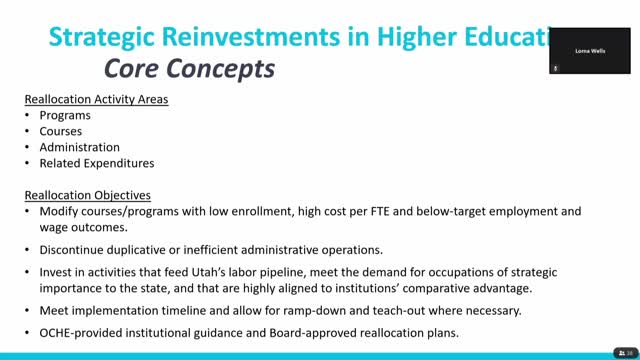
Why it matters: the legislature asked the system to identify programs that could be modified, consolidated or invested in to improve returns for students and taxpayers. The system said it will prioritize programs with low enrollment, high cost per full-time-equivalent student and below-target employment wages, but will not use a single formula to make decisions.
System staff described the tools and data inputs. Carrie Maine, chief economist for the Utah System of Higher Education, said the office is grouping instructional offerings by Classification of Instructional Programs (CIP) codes to produce smooth historical time series of declared majors, course-generated FTE, completions and geographic coverage. "We are then also looking at all the degrees and certificates conferred," Maine said, adding that the office matches graduates to workforce records to see industry placement and wages.
Vic Hockett, associate commissioner with Talent Ready Utah, described an occupation-prioritization methodology that filtered 656 four-digit SOC occupations to 199 jobs that require an associate’s or bachelor’s degree, then to 144 occupations meeting a 20% projected growth threshold or repeated industry prioritization. Hockett said the system used the state Department of Workforce Services star ratings, a Utah-specific fill-rate metric (modeled on the BLS JOLTS approach) and other variables to rank occupations into quartiles.
Committee members emphasized multiple goals. Senator Millner asked that the system include national benchmarks for cost per degree. Senator Johnson and others warned against blurring the distinction between technical colleges and research universities, urging protection for liberal-arts and general-education outcomes that cultivate “durable skills,” not only immediate job placement. Commissioner Landward and staff said durable skills — critical thinking, communication and collaboration — are part of the reinvestment criteria.
Staff stressed transition safeguards for students. The commissioner said reallocation timelines will consider students currently enrolled in impacted programs; the board and presidents will develop guidance for teach-out and student transition plans. "We want this to be a process that doesn't unintentionally harm the students who have enrolled in our institutions," the commissioner said.
Process and next steps: the commissioner said the legislature provided a statutory framework and asked the system office, presidents and the board to develop detailed criteria. System staff will continue refining program-level metrics, provide institutions data and tools for reinvestment plans, and return to the committee for feedback as the process advances.
Ending: System leaders told legislators the approach will combine multiple indicators — enrollment trends, completion and placement rates, wage outcomes, and program cost — and that no single metric will be determinative. The office and presidents said they will balance efficiency with mission-driven offerings and will present reinvestment proposals with transition plans for affected students.