Get Full Government Meeting Transcripts, Videos, & Alerts Forever!
Get email alerts on the Theft Aggregation topic
No spam. Unsubscribe anytime.
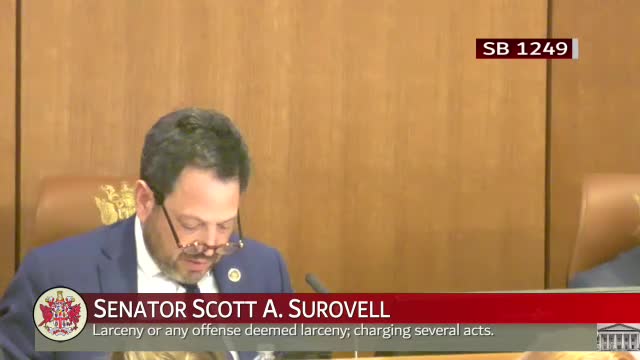
Committee debates bill to aggregate multiple thefts into single larceny charge; advocates and opponents clash
Summary
Senate Bill 1249 would allow multiple larceny acts within six months to be aggregated into a single indictment; supporters said it targets organized, repeat offenders while opponents warned it could sweep in people who steal out of necessity. The committee voted to report the bill (PBI) after extended debate.
Senator Durant presented Senate Bill 1249, a proposal to allow multiple larceny acts committed within a six‑month period to be aggregated into a single indictment for grand larceny. Durant told the panel the change is aimed at “professional thieves” who intentionally keep each individual theft under the felony threshold to avoid prosecution.
Durant described examples prosecutors have encountered: repeat offenders who steal just under the felony threshold from multiple stores in the same period and then resell goods. “This keeps the professional thieves from gaming the system by stealing only $999 a day,” Durant said.
Opponents, including civil‑rights and youth groups, said the language is overbroad and could re‑criminalize conduct the General Assembly narrowed in the repeal of petty larceny third‑offense reforms. Senator Carol Foy and several speakers asked whether the bill could capture low‑income or homeless people taking small necessities on separate days that together exceed $1,000; one opponent said the bill could “reinstat[e] an attempt to aggregate petty larceny offenses” and capture people stealing food or other necessities.
Commonwealth’s attorneys and law‑enforcement witnesses testified in support, describing repeat offenders who target retail thresholds. Prosecutors said existing organized retail crime statutes are hard to use because of difficult proof elements, and that the bill focuses on repeat, intentional behavior rather than isolated, necessity‑based thefts.
After extensive testimony and several suggested drafting changes, the committee moved the measure to be passed by indefinitely (PBI) for further work and technical cleanups.