Get Full Government Meeting Transcripts, Videos, & Alerts Forever!
Get email alerts on the Advisory Operations topic
No spam. Unsubscribe anytime.
Pacific Fishery Management Council lays out advisory body rules, travel and tech procedures at 2025 briefing
Summary
At a 2025 all-advisory-body briefing, Pacific Fishery Management Council staff reviewed council operating procedures, termination and attendance rules, travel and stipend policies, and the digital platforms advisory members must use, including RingCentral and Concur.
The Pacific Fishery Management Council told newly appointed advisory body members at a 2025 all-advisory-body briefing that they must follow the council operating procedures, request alternates at least 30 days before meetings, file travel reimbursements through Concur and use the council’s RingCentral platforms for virtual meetings.
Kelly Ames, deputy director of the Pacific Fishery Management Council, opened the session and summarized the council’s primary rules and online tools, saying that “the COPs are the primary reference for the day to day operations of the council and its advisory bodies.”
Why it matters: Advisory bodies supply the council with the technical and constituency-based advice that informs fishery management recommendations to the National Marine Fisheries Service. Council staff emphasized adherence to procedural rules and digital platforms to ensure efficient administration of meetings, travel and public materials across the large geographic scope of the council’s jurisdiction.
Council operating procedures and behavior standards
Merrick Burden, the council’s executive director, framed the advisory role as central to council decisions and noted the scale and stakes of the work. “What sets our council apart is the strong role of our advisory bodies,” Burden said.
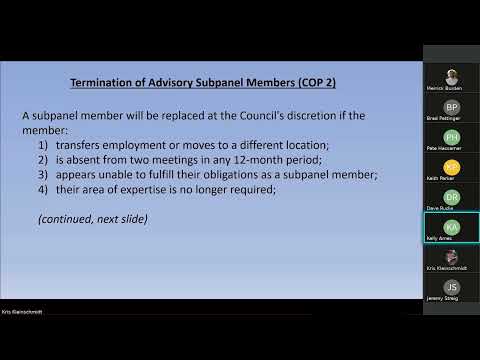
Ames reviewed key items in the council operating procedures (COPs) and advisory body ground rules available on the council website. She said advisory subpanel members can be replaced if they transfer employment or move location, miss two meetings in any 12-month period, appear unable to fulfill obligations, or “violate the rules of conduct for employees and advisors and contractors of regional fishery management councils.” The deputy director said the council chair, in consultation with the executive director, can remove a member for cause and listed examples that include felony convictions, violations of marine resource regulations and substantiated harassment.
Ames also summarized decorum rules and the council’s harassment reporting procedures, directing members to the rules and procedures section of the website for full guidance.
Attendance, alternates, stipends and travel
Ames said the COPs allow up to two absences per year for advisory body members and described the council’s alternate-request process. “Requests must be received at least 30 days prior to the first day of the advisory body meeting or the first day of the council meeting held in conjunction with the advisory body meeting,” she said, adding the council will strictly enforce that 30-day requirement going forward.
On stipends and travel, Ames noted stipends may be paid “subject to the availability of appropriations” to advisory members who are not federal employees or state marine fisheries agency employees, and reimbursement requires timely submission of forms. She also said official travel invites will come from a noaa.gov account, will include per diem rates, authorized travel dates and hotel information, and that travel changes must be approved by the administrative officer, Patricia Herring.
Platforms and materials
Chris Kleinschmidt, the council’s IT manager, walked members through the council website, the RingCentral meeting platforms and the Concur expense system. He described two RingCentral products: RingCentral Video for day-to-day advisory meetings and RingCentral Webinar for full council meetings, noting the webinar product separates remote attendees from active participants to manage hybrid participation.
Kleinschmidt demonstrated the council meeting pages that host briefing book materials, public comment e-portal links, recordings, transcripts and decision summaries. He noted the council has gone paperless: briefing book materials are distributed electronically on the meeting’s dedicated briefing-book page and updated there if revisions are needed.
On reimbursements, Kleinschmidt said Concur is used for booking travel and filing expense claims, requires multifactor authentication, and that members will need to set up a profile and link a bank account to receive reimbursements.
Public materials and recordings
Staff explained that meeting videos are posted to the council’s YouTube page with timestamps for agenda items so members and the public can replay sections of interest. The council’s website also hosts an e-portal for written public comment and sign-ups for oral testimony.
Next steps and reminders
Ames closed by asking advisory members to return intent-to-serve forms if they have not done so, to monitor email from council staff (which will come from noaa.gov addresses), and to contact their assigned staff officer with questions about specific advisory body assignments. She said the briefing recording will be posted to the council website for future reference.
Ending: Staff remained available after the recorded session for follow-up questions and assistance with website navigation, travel, Concur setup and other onboarding needs.