Get Full Government Meeting Transcripts, Videos, & Alerts Forever!
Get email alerts on the Sunshine Law Public Records Ethics topic
No spam. Unsubscribe anytime.
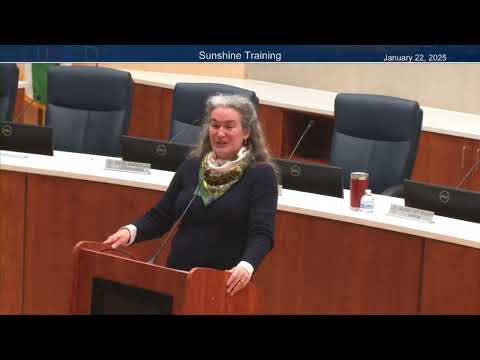
City attorney reviews Sunshine Law, public-records obligations and ethics for Dunedin committees
Summary
City Attorney Jennifer Cohen led a training session for Dunedin board and committee members on the Sunshine Law, the Florida Public Records Act and local ethics rules, emphasizing legal constraints on communications.
City Attorney Jennifer Cohen delivered a training session for Dunedin board and committee members on the Sunshine Law, the Florida Public Records Act and local ethics rules, emphasizing legal constraints on communications and practical steps committees should take to avoid violations.
“The Sunshine Law was actually enacted in around 1967,” Cohen said, placing the law in its constitutional and statutory context and citing Article I, Section 24(b) of the Florida Constitution and statutory provisions in chapter 286. Cohen explained the law’s three core requirements: meetings must be open to the public, reasonable notice must be provided and minutes must be kept.
Key takeaways: Cohen told attendees that any gathering, deliberation or discussion of two or more members of the same board about matters foreseeable to come before that board can constitute a meeting under the Sunshine Law — whether in person, by telephone, email, social media or text. She recommended caution even for informal contacts and urged members to avoid multi-member exchanges about board business outside a noticed meeting.
Public records and social media: Cohen explained that documents used in official business — including emails, texts and social-media posts about city business — are public records. She advised committee members to send position papers, posts or other materials to the city clerk so the clerk can distribute them and retain the record. Cohen warned that deleting records after a request has been made or failing to preserve relevant electronic records can lead to penalties or court-ordered seizure of devices in extreme cases.
Quasi-judicial matters and ex parte communications: Cohen distinguished legislative items (where broader public outreach is proper) from quasi-judicial proceedings (such as certain land-use or code-enforcement hearings). For quasi-judicial matters she said members must avoid ex parte communications with parties to an application and follow neutral, evidence-based procedures at public hearings; members with potential bias or conflicts should disclose them and consult counsel.
Ethics and disclosure: Cohen summarized Florida ethics rules applicable to board members who must file, noting the city’s routine use of the Form 1 disclosure. She explained recent legislative activity about Form 6 for elected officials and described practical concerns and the need to consult the Commission on Ethics materials for filing guidance.
Practical guidance: Cohen urged members to copy the city clerk on emails about city business, to send position papers to the clerk for packet distribution, to treat staff advisories and legal advice as avenues for resolving questions before a meeting and to err on the side of openness when unsure. She recommended clear meeting procedures, public-comment timing tied to action items, and reading minutes or staff packets to catch up on prior discussions.
Ending: Cohen invited questions and encouraged committees to request staff presentations when members need background. She also said that, when in doubt about a possible Sunshine Law or public-records issue, members should contact the city attorney or the clerk so any potential violation can be cured before it becomes litigation.