Get Full Government Meeting Transcripts, Videos, & Alerts Forever!
Get email alerts on the Emergency Medical Services topic
No spam. Unsubscribe anytime.
County commissioners review governance, service levels for Lawrence Douglas County Fire Medical
Summary
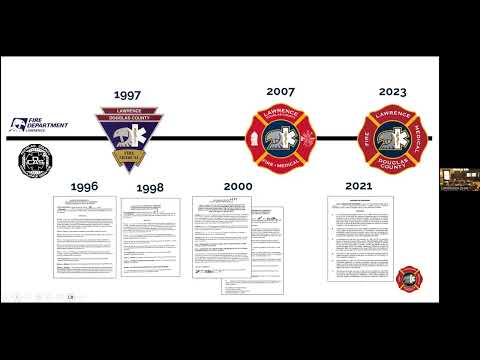
At a Jan. 22, 2025 Douglas County Commission work session, county commissioners and leaders of Lawrence Douglas County Fire Medical discussed updating the joint governance agreement that governs the countywide fire and emergency medical system and reviewed service levels, response-time benchmarks and staffing strategies.
At a Jan. 22, 2025 Douglas County Commission work session, county commissioners and leaders of Lawrence Douglas County Fire Medical discussed updating the joint governance agreement that governs the countywide fire and emergency medical system and reviewed service levels, response-time benchmarks and staffing strategies.
Why it matters: The agreement sets how the City of Lawrence and Douglas County share costs and governance for fire suppression, advanced life support (ALS) ambulance transport and other technical-response programs across roughly 475 square miles of Douglas County. Changes could affect response times, budgets and deployment in rural townships as well as service levels inside Lawrence.
Acting Fire Chief Joe Hardy and Mackenzie Zell, interim chief of staff for Lawrence Douglas County Fire Medical, told commissioners the governance committee—comprised of staff from the city and county and LDC FM leadership—has been meeting to define the scope of a rewrite and next steps. "I am Joe Hardy, the acting fire chief for LDC FM," Hardy said during the presentation. Zell summarized the service footprint: "We have 7 stations," and described how LDC FM staffs five frontline fire apparatus in Lawrence plus a ladder truck at station 5, and seven frontline ambulances (five in Lawrence, one in Baldwin City and one in Eudora).
Leaders provided operational totals and benchmarks. LDC FM reported roughly 160 staff, and 2024 dispatches of 17,572 calls for service, about 70% of which are medical in nature; the department uses a 4-minute travel-time benchmark for urban areas and an 8–10 minute benchmark for rural areas. Zell said the department evaluates response performance at the 90th percentile under its accreditation process and will publish an annual compliance report in the coming weeks that will identify where benchmarks are and are not being met.
Zell and John Darling, division chief of EMS, explained a recent personnel decision to require new hires to enroll in paramedic school within three years to reduce burnout among existing paramedics and expand ALS capacity. Zell said eight employees were scheduled to begin paramedic school the following Monday and that one employee was already in school, a total of nine in training at that moment.
Data and metrics were recurring topics. Staff described limitations in current reporting systems and said a new federal reporting platform scheduled for 2026 should allow integrated countywide datasets, clearer first-on-scene metrics (including volunteer and township first responders) and multi-incident classification (for calls that involve fire, EMS and technical rescue). LDC FM also uses the CARES cardiac arrest registry countywide for cardiac arrest survivability statistics.
Commissioners pressed several governance and budget questions. Multiple commissioners said the county should have a clearer role in decisions that affect county costs. One commissioner suggested moving from a three-year to a five-year agreement to reduce frequent renegotiation; another commissioner echoed that preference during the session. Commissioners also asked whether rural fire districts and cities such as Eudora and Baldwin should have a formal role or formal mutual-aid memoranda of understanding rather than relying on long-standing "handshake" agreements.
Staff described current mutual-aid practice as largely informal but said conversations to formalize cross-jurisdictional agreements—including participation by neighboring jurisdictions and regional planning for large events—are underway. Zell noted that mutual-aid pacts typically are not revenue-generating between departments except in special federal reimbursement situations.
Budget and allocation issues surfaced repeatedly. Presenters described a department budgeting tool (referred to in the presentation as a program-level "balancing act") that allocates expenses across programs (EMS, fire suppression, hazardous materials and technical rescue) and models service-level scenarios under different funding assumptions. Commissioners asked for clearer breakouts of the shared-cost model, the 10% administrative allocation used in the methodology and the lines of authority in budget decisions that affect both the city and county.
Next steps and directions from the session included creating a project charter, having the governance committee meet and return with specific recommendations, producing the annual compliance report on response times and following up to obtain certain first-on-scene data from township and volunteer departments. Zell said the governance committee would compile notes from both the city and county commissions and present next steps to both governing bodies.
No formal votes or contract changes were taken during the work session; commissioners instead provided policy direction and asked staff and LDC FM leadership to return with more detailed data and proposed language for the next agreement.
The County Commission recessed the work session to reconvene for its 5:30 p.m. business meeting; staff and LDC FM leaders said they will continue the governance review and return with proposed options.