Get Full Government Meeting Transcripts, Videos, & Alerts Forever!
Get email alerts on the Housing And Essential Needs topic
No spam. Unsubscribe anytime.
Committee hears bill to expand Housing and Essential Needs program, add cash assistance option
Summary
Senate Bill 5232 would extend a HEN pilot statewide, allow direct cash assistance, align administrative rates with other programs and remove a fixed 7% admin set-aside; Commerce and advocates supported the updates and said the bill carries no net cost under current funding formulas.
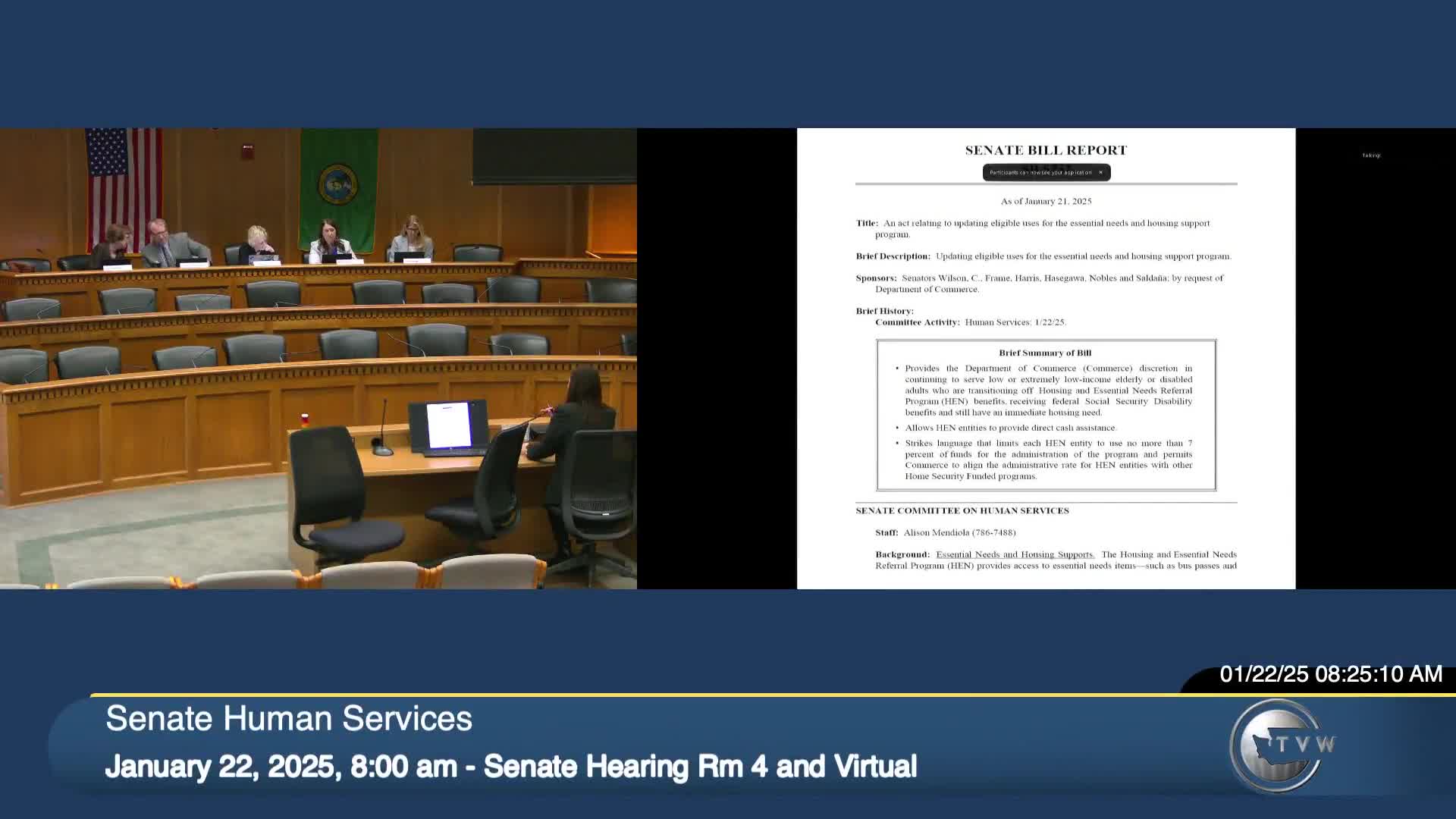
Senate Human Services Committee members heard Jan. 22 on Senate Bill 5232, sponsored by Sen. Claire Wilson, which would update the Housing and Essential Needs (HEN) program to extend the SSI-bridge pilot statewide, allow direct cash assistance for essential needs, and align administrative rates with other home-security-funded programs.
Allison Mendiola, committee staff, summarized the bill and said HEN provides essential items and housing assistance to low-income adults age 18-64 who are unable to maintain gainful employment for 90 days because of physical or mental incapacity or substance-use disorder. Mendiola said the 2019 bridge pilot served six counties (Clark, King, Kitsap, Pierce and Thurston) and the proposal would allow counties statewide to adopt that bridge at their option.
Ted Kelleher, acting assistant director of the Housing Division at the Washington State Department of Commerce, testified in support and described the bill as a no-cost proposal that preserves the program—s fixed appropriation while giving local providers additional flexibility, including an option to provide cash assistance where locally appropriate. Kelleher told the committee the program is not an entitlement and funding is finite; counties triage applicants to match resources to local priorities.
Rob Huff of the Washington Low Income Housing Alliance testified in favor of the bill and said the 2025 federal Social Security payment (cited as $967) is insufficient against the 2025 average rent cited in testimony (about $1,828), so counties should have the option to continue rental support for people who qualify for federal benefits. Huff also supported aligning administrative rates and allowing flexible cash assistance as more efficient and responsive to individual needs.
Sen. Claire Wilson, the sponsor, said the bill equalizes administrative rates, preserves rental assistance for people whose federal benefit checks do not cover rent, and adds a cash option backed by research. Committee members asked about safeguards against cash being used to support active substance use; witnesses said local providers or staff could describe outcomes and staff could follow up with more information.
A fiscal note accompanying the bill indicated no additional cost for implementation. The committee did not take a vote on SB 5232 at the hearing.
Proponents urged committee members to allow counties flexible tools to prevent eviction and address immediate household needs while noting finite state funding requires local triage of services.