Get Full Government Meeting Transcripts, Videos, & Alerts Forever!
Get email alerts on the Gambling Regulation topic
No spam. Unsubscribe anytime.
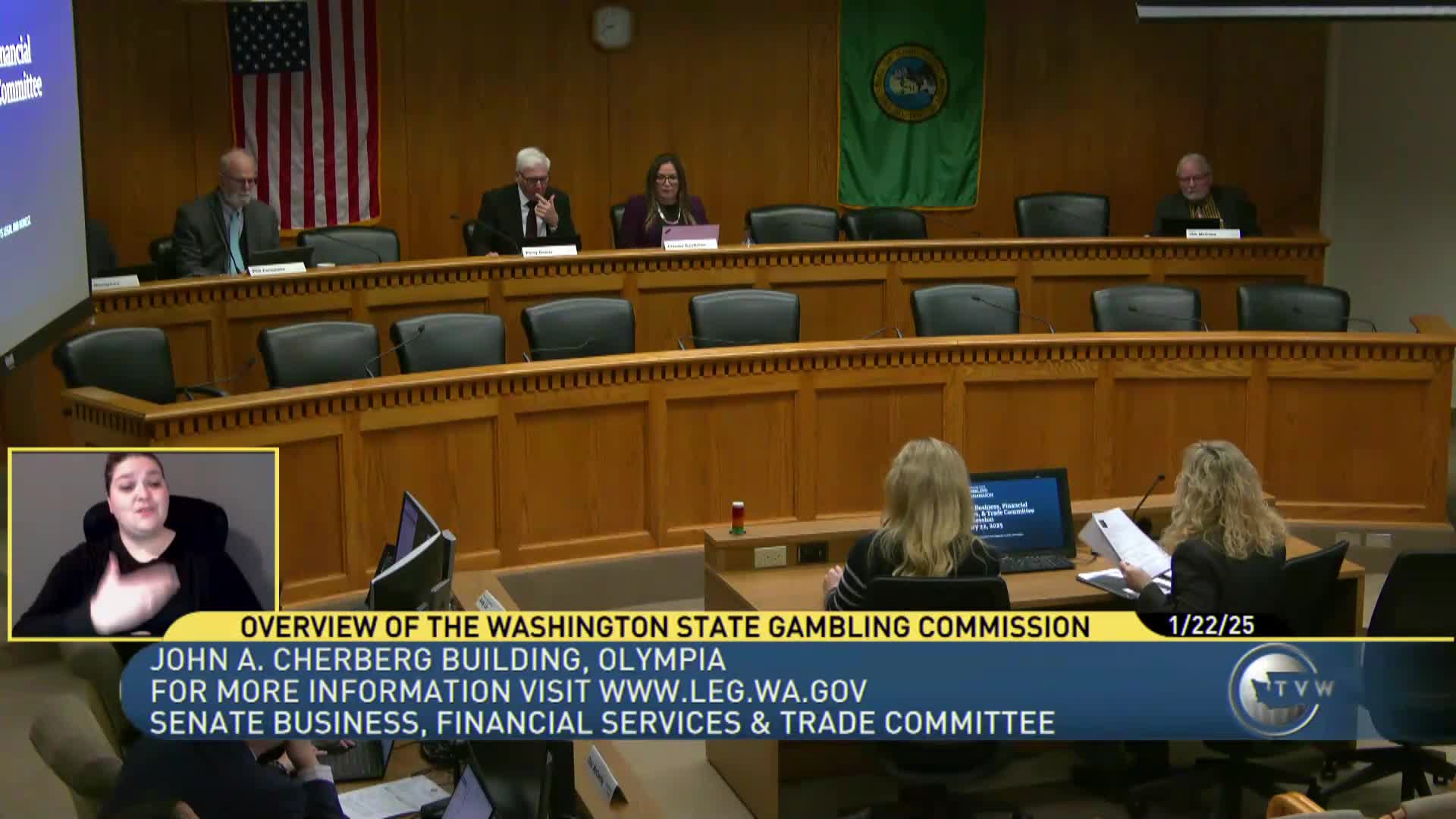
Gambling Commission briefs Senate committee on enforcement, licensing and self-exclusion program
Summary
Tina Griffin and a commission manager described enforcement authority under the Gambling Act, the agency’s funding model, an IT replacement project and a statewide self-exclusion program with more than 1,100 registrants.
Tina Griffin, director of the Washington State Gambling Commission, told the Senate Business, Financial Services and Trade Committee that the commission’s mission, drawn from the state Gambling Act, is “to protect the public by ensuring that gambling is legal and honest.”
Griffin described the commission as a limited-authority law enforcement agency that investigates crimes connected to gambling, including theft, money laundering and structuring. She said roughly 75% of the commission’s funding comes from license fees and about 25% from tribal cost reimbursements. Griffin said the commission is a non-appropriated agency that has set aside funds to replace legacy IT systems and expects to launch a new system within about a year.
The commission presented year-over-year licensing and receipts data and reported a 6% decline in active charitable nonprofit licensees and an 18% decline in commercial licensees since 2018, while net receipts increased for both sectors (25% for nonprofit organizations and 29% for commercial licensees). The presentation credited changes such as the 2020 legislative increase in punchboard and pull-tab value and a 2023 rule raising house-made cardroom wager limits for part of the revenue change.
Griffin summarized tribal gaming: the Indian Gaming Regulatory Act (1988) and the first state–tribal compact (1991), noting 29 federally recognized tribes in Washington have compacts and 23 tribes operate 29 gambling facilities. The commission’s units include licensing (conducting more than 20,000 background investigations annually), regulatory inspections and an electronic gambling lab that approves equipment.
The commission highlighted public-safety and consumer-protection work: criminal investigations of illegal online pull-tab operations, support to other agencies on gambling components of broader investigations, and outreach on problem gambling. Griffin noted the commission distributes new informational signage developed with the Evergreen Council on Problem Gambling and detailed a statewide self-exclusion program launched in May 2022 with more than 1,100 registrants; application materials are available in more than a dozen languages.
Tricia Naughing, legislative and rules manager, described the commission’s 2025 agency-request bill in the senate (Senate Bill 5196), a public-records exemption intended to protect proprietary financial and security information of licensees and tribal partners from disclosure that could increase fraud, robbery or cyber threats. She said the commission solicited feedback while drafting the exemption and incorporated some changes.
Committee members asked about bingo and small charitable raffles; Griffin explained unlicensed bingo and amusement gaming is allowed for organizations that meet the charitable-nonprofit definition and operate no more than twice per year with combined gross gambling receipts up to $5,000, otherwise a license is required. Griffin deferred some questions outside the commission’s purview (for example, mail-based raffle rules) to federal statutes or other state agencies.
The commission offered to provide additional follow-up information and to distribute updated signage and materials to licensees.