Get Full Government Meeting Transcripts, Videos, & Alerts Forever!
Get email alerts on the Lottery topic
No spam. Unsubscribe anytime.
Washington Lottery outlines operations, revenue distribution and responsible-gambling steps
Summary
Washington Lottery directors gave the Senate committee an overview of games, revenue flows and responsible-gambling measures, saying profit margins are near 25% and that most net revenue now goes to the Washington Opportunity Pathway account.
Washington Lottery Director Joshua Johnston and Christy Weeks, the lottery’s director of legal services, told the Senate Business, Financial Services and Trade Committee that the agency was created in 1982 and now directs most net revenue to the Washington Opportunity Pathway account rather than the general fund.
Johnston said the agency’s statutory mandate is “to produce the maximum amount of net revenue for the state, consonant with the dignity of the state and the general welfare of the people.” The directors told the committee the lottery’s overall profit margin is just under 25% and that in 2024 the Washington Opportunity Pathway account received nearly $190,000,000 (about 18.5% of revenue, per the presentation). Scratch-ticket sales represented about $665,000,000 last year and were described as roughly 65% of total sales.
The presentation described two main product lines: draw games (Powerball, Mega Millions and state draw games) and instant “scratch” tickets, which retail at multiple price points (from $1 up to $30). Weeks said draw games produce higher percentage profit margins (40–50% for some draw products) while high-price-point scratch tickets return a smaller percentage but a larger dollar amount per ticket.
The lottery described a retailer network and retail strategies: the agency reported approximately 3,658 active retailers when the slide deck was produced and a vending-machine presence it said increases total sales at participating locations. The agency also operates six regional offices and has experimented with mall storefronts and kiosks to convert cost centers into revenue centers and to provide prize redemption over the $600 retail limit.
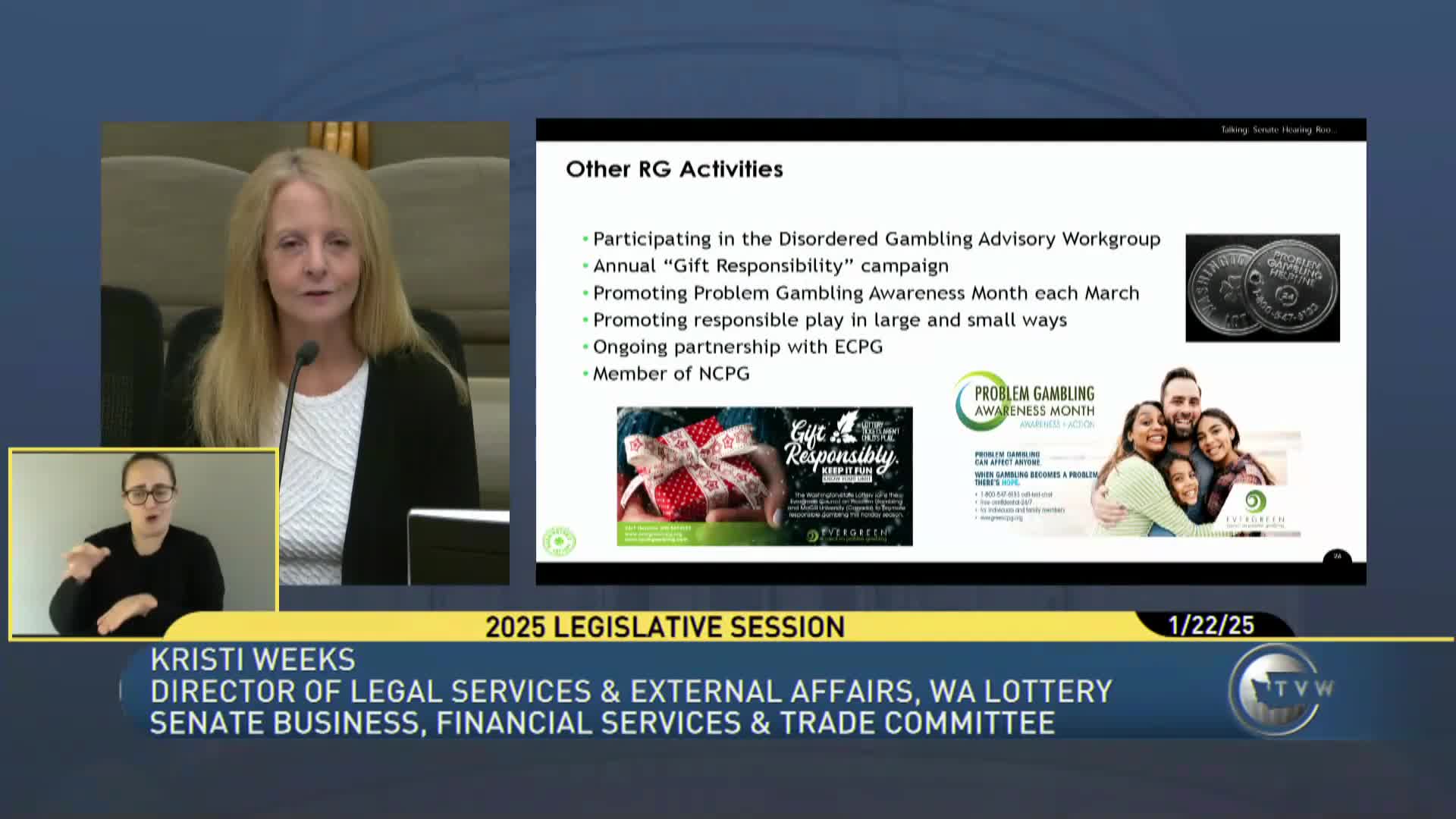
Johnston and Weeks addressed responsible-gambling steps taken by the agency. Weeks said the lottery received a “sustaining level responsible gambling verification” from the North American Association of State and Provincial Lotteries and the National Council on Problem Gambling after a five-year review of employee and retailer training, public awareness, product oversight and advertising. The agency prints the problem-gambling helpline on scratch tickets and participates in a legislatively mandated advisory work group on disordered gambling.
Committee members asked about how the agency gathers player demographic data. Weeks said tickets are anonymous and the lottery uses quarterly telephone surveys to estimate player age and income profiles. The directors emphasized that the lottery is prohibited from offering online sales in Washington and that evolving player expectations and competition from other gambling and entertainment options pose ongoing challenges.
The directors closed by offering to answer follow-up questions and noting the lottery’s outreach and retail experiments to increase convenience and revenue for the state while highlighting safeguards to preserve drawing integrity.