Get Full Government Meeting Transcripts, Videos, & Alerts Forever!
Get email alerts on the Special Education Funding topic
No spam. Unsubscribe anytime.
Lawmakers hear rival bills to boost special‑education funding; advocates urge ending 16% cap
Summary
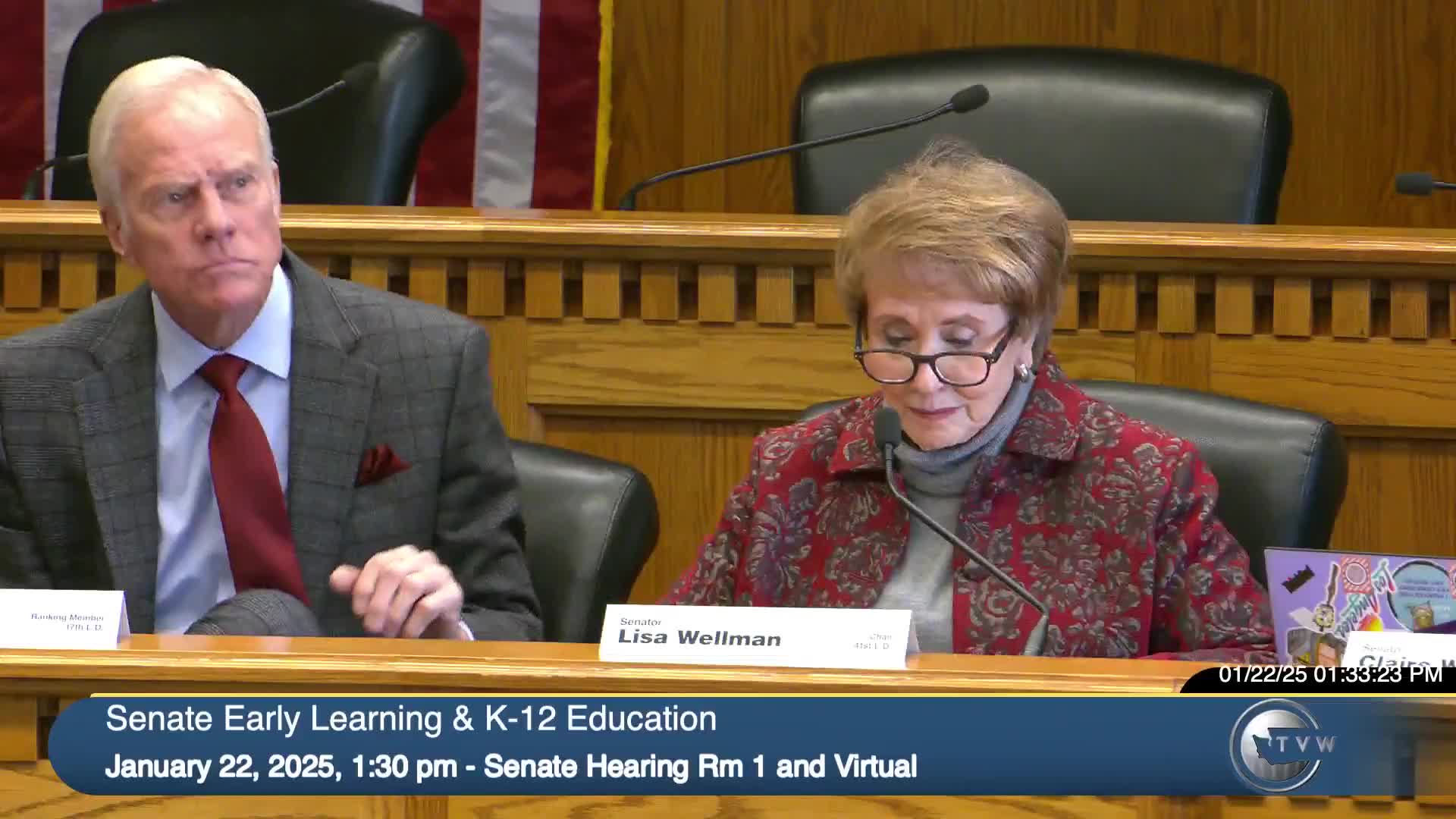
At a hearing of the Senate Early Learning & K‑12 Education Committee, staff and advocates presented Senate Bill 5263 (Sen. Jamie Peterson) and Senate Bill 5307 (Sen. Wellman), two competing proposals to raise special‑education funding, remove the statutory 16% funded‑enrollment cap and lower safety‑net thresholds.
At a hearing of the Senate Early Learning & K‑12 Education Committee, staff and education advocates presented two competing bills to change how Washington funds special education: Senate Bill 5263, sponsored by Sen. Jamie Peterson, and Senate Bill 5307, sponsored by Sen. Wellman. The bills were presented side‑by‑side and drew testimony from superintendents, school board leaders, parent advocates and disability‑rights organizations.
The bills share three principal goals: raise excess‑cost multipliers used to calculate special‑education allocations, remove the statute’s 16% funded‑enrollment cap, and lower the threshold for safety‑net eligibility. They diverge on multiplier design and several policy details. Alex Fairfortun, staff to the committee, summarized the bills and the key differences, including whether to retain a tiered multiplier based on time spent in general education.
Peterson framed his bill, SB 5263, around a single multiplier and removal of the 16% cap. "These are kids in our public schools who have disabilities of one sort or another, and state and federal law require our school districts to provide them services," Sen. Jamie Peterson said, arguing the state must treat those costs as part of basic education. Peterson also urged the Legislature and the Ways and Means Committee to address affordability and said eliminating the cap and lowering the safety‑net threshold are priorities.
Sen. Wellman, prime sponsor of SB 5307, described reasons she had previously supported a cap and a tiered multiplier, including concerns about disproportionality in identification. She said she is now persuaded to remove the cap but favors keeping a tiered structure in SB 5307 with a lower multiplier for students who spend less than 80% of the school day in general education. Wellman also highlighted two policy additions in SB 5307: permitting the Office of Superintendent of Public Instruction (OSPI) to reserve 0.5 of excess cost allocations for statewide special‑education services and authorizing OSPI to adopt a uniform percentage of general apportionment funding for proration to special education.
Both bills would reduce the safety‑net threshold that a district must meet to receive payments for unusually high special‑education costs. The existing thresholds are 2.2 times the average per‑pupil expenditure for most districts and 2.0 times for districts with fewer than 1,000 students. Both bills lower the threshold to 1.5 times the average per‑pupil expenditure; SB 5307 also eliminates eligibility based solely on community characteristics and would require quarterly safety‑net payments in certain cases, which proponents said would help small districts with cash flow.
Fiscal notes presented to the committee estimate large biennial costs. Staff cited estimated biennial expenditures of roughly $1.64 billion for SB 5263 and roughly $1.55 billion for SB 5307.
Education groups and districts testified in support of both measures. Tricia Lubach, executive director of the Washington State School Directors Association, said the bills represent the education community’s top priorities and noted that K‑12 funding as a share of the state budget has declined from 52.4% in 2019 to 43.1% in 2024. Joel Ahn, executive director of the Washington Association of School Administrators, called the current system inadequate and said removing the cap and increasing multipliers would ensure students receive needed supports while relieving districts of the financial burden. Melissa Stone of Washington State PTA urged that any funding increase be paired with investment in training for inclusionary practices so general‑education staff can serve students with disabilities effectively.
Several district leaders gave concrete examples of local strain. Larry Delaney, president of the Washington Education Association, cited the Mount Baker School District, which he said was in binding conditions with a roughly $1.4 million special‑education deficit. Dr. Brent Jones, superintendent of Seattle Public Schools, said the statewide special‑education funding deficit has been on the order of $74 million per year and is growing as student needs increase. Smaller districts told the committee long‑standing cash‑flow problems make quarterly safety‑net payments important: Sen. Wellman and others noted that some rural districts must pay out‑of‑state providers on a pay‑as‑you‑go basis.
Advocacy organizations and family members also testified. Ramona Hattendorf of The Arc of King County urged ending the cap and increasing multipliers while funding technical supports for inclusive practices, arguing that more intensive supports do not require segregated settings. Mike Stewart of Boyer Children’s Clinic asked the committee to amend the bills to align multipliers for early‑intervention services (ages 0–3 and 3–5) so that infants and toddlers receive supports that can reduce later special‑education need.
Committee members asked technical questions about definitions and mechanics. Committee staff clarified that “pre‑K” in the bills covers children ages 3, 4 and 5 who are not yet enrolled in kindergarten, and that pre‑K multipliers differ from K‑12 multipliers. Members also pressed sponsors and witnesses about the relative fiscal impact of the single‑multiplier versus tiered approaches; Sen. Peterson and several superintendents said they favored the single multiplier in SB 5263 for simplicity and because they believe the current tiered structure has produced perverse incentives.
No formal committee vote was taken at the hearing. Witnesses on both sides asked the committee to refine language and emphasized the tradeoffs committees will face when reconciling policy goals with budget constraints. Committee staff and multiple speakers said additional work will be required in budget deliberations if either bill moves forward.
Ending note: The committee held extensive oral testimony from district leaders, advocacy groups and parents; it did not take a vote during the hearing and left several technical and fiscal questions for follow‑up in staff analyses and subsequent committee work.