Get Full Government Meeting Transcripts, Videos, & Alerts Forever!
Get email alerts on the Rangeland Fire Protection Associations topic
No spam. Unsubscribe anytime.
House committee hears testimony on pilot for Rangeland Fire Protection Associations
Summary
Lawmakers heard public testimony and agency briefing on House Bill 1048, a proposal to authorize a limited pilot for Rangeland Fire Protection Associations (RFPAs) in eastern Washington; committee scheduled the bill for executive session next week.
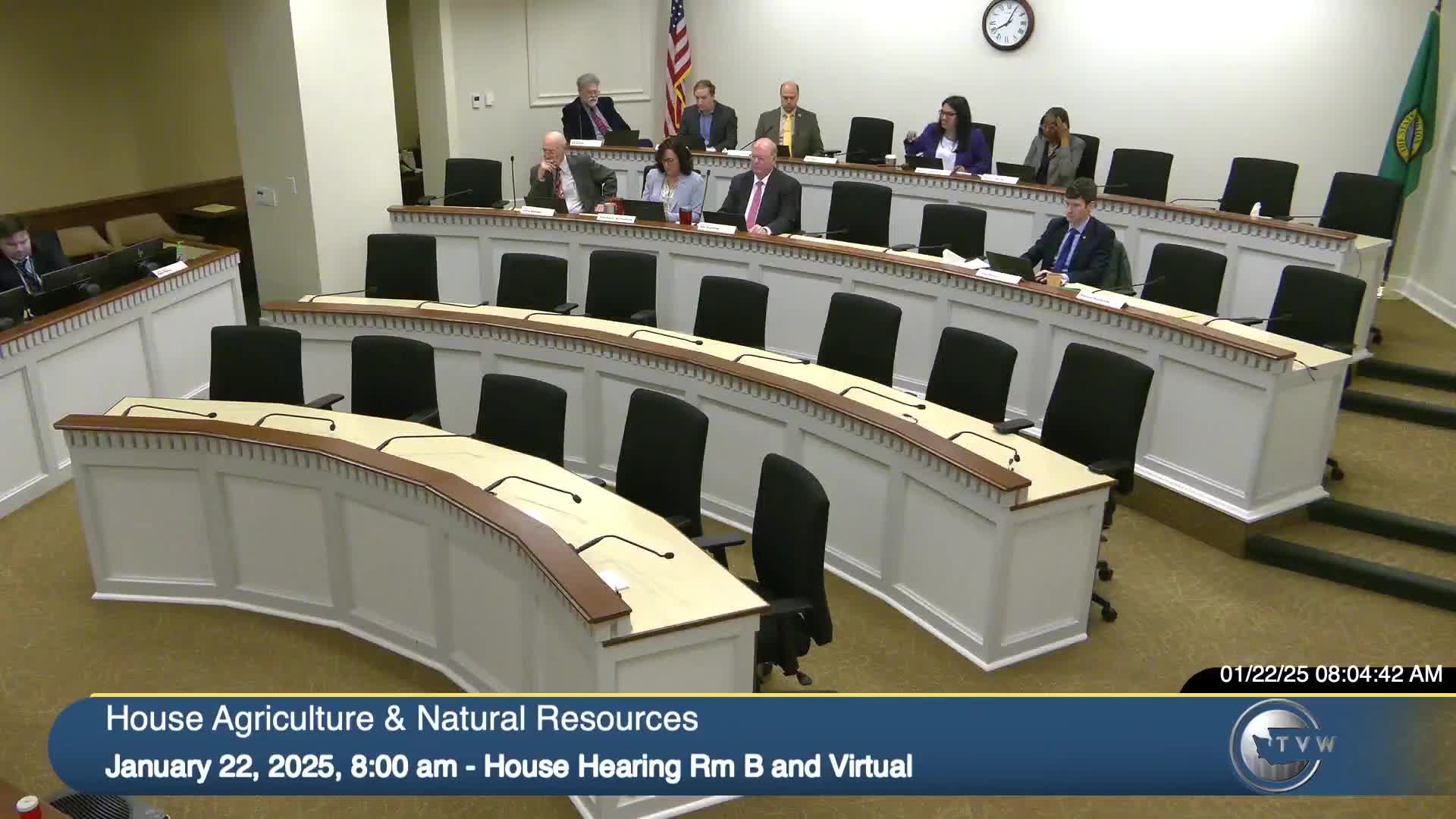
The Washington House Agriculture and Natural Resources Committee held a public hearing Jan. 22 on House Bill 1048, which would authorize a limited, DNR‑overseen pilot program to permit formation of Rangeland Fire Protection Associations (RFPAs) in eastern Washington.
The bill would require the Department of Natural Resources to implement a pilot that assesses management, training, insurance and equipment needs for RFPAs and to annually report recommendations to the Legislature. "House Bill 1048 before you today would create a pilot program that would explore the use of Rangeland Fire Protection Associations," said Lily Smith, staff to the committee.
Tom Dent, the bill—s prime sponsor, told the committee the idea grew from meetings after major rangeland fires and from examples in neighboring states. "If we have a fire out there, we're gonna go fight it anyway," Dent said. He described the measure as a scaled‑back pilot intended to give local ranchers and agencies a framework to work together while avoiding the taxing authority that would come with a fire district.
Conservation Northwest representative Jay Keeney and other supporters said a pilot is more realistic than asking a single organization to shoulder start‑up and funding costs. "Folks on the ground that have the tools, that have training, that have equipment, and have radios who are in connection with the firefighting response group could be super valuable," Keeney said, citing past fires that spread before they could be stopped.
State agency and fire service witnesses urged tighter training and coordination standards. Seamus Petrie of the Washington Public Employees Association, representing Department of Natural Resources wildland firefighters, urged that anyone participating beyond initial attack should meet NWCG "red card" qualifications. "It is vital that everybody who participates beyond initial attack have a red card," Petrie said.
Leonard Johnson, fire chief of the McLean Black Lake Fire Department and chair of the Washington State Fire Defense Committee, said coordination with adjacent local fire districts must be explicit in the bill. He also noted concerns about liability coverage, saying most volunteers and career staff are covered by workers' compensation when injured on the job and the draft bill needs clarity on responder insurance.
Committee vice chair Morgan reported public signups: 42 pro, 0 con and 3 other. The committee closed the public hearing and staff said the bill is scheduled for executive session next week; no committee vote was recorded during the hearing.
Key provisions discussed at the hearing include a requirement that pilot RFPAs meet criteria such as liability insurance, personal protective equipment, communication equipment, training and an age minimum of 18. The bill limits RFPA formation statewide to participants in the pilot through the program—s conclusion in 2029 and directs DNR to inspect and approve associations before they contract with the agency.
Questions from committee members and witnesses focused on definitions of acceptable training and how RFPAs would coordinate with existing protection arrangements and mobilization plans.
The committee requested that parties with concerns work with Representative Dent on possible amendments before executive session.