Get Full Government Meeting Transcripts, Videos, & Alerts Forever!
Get email alerts on the Personnel Files Hb1308 topic
No spam. Unsubscribe anytime.
Committee hears testimony on bill to require employers to provide personnel files within 21 days
Summary
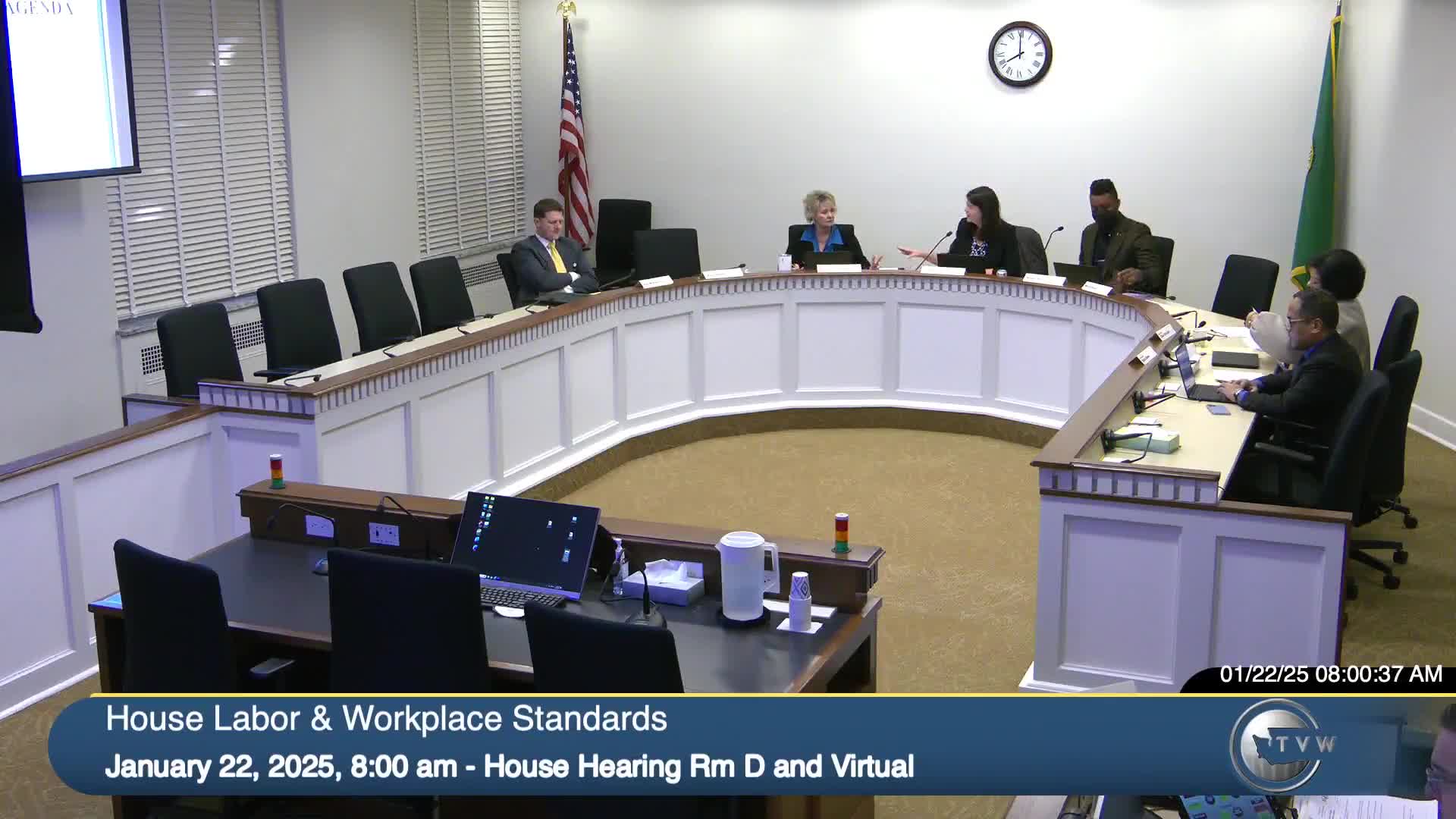
House Bill 1308 would define which employer records count as a personnel file, require employers to provide a copy at no cost within 21 calendar days of a request, and create a private cause of action with statutory damages and attorney fees, committee staff said at a Jan. 22 public hearing of the Labor & Workplace Standards Committee.
House Bill 1308 would define which employer records count as a personnel file, require employers to provide a copy at no cost within 21 calendar days of a request, and create a private cause of action with statutory damages and attorney fees, committee staff said at a Jan. 22 public hearing of the Labor & Workplace Standards Committee.
The bill matters, proponents said, because current state law — administered by the Department of Labor and Industries — obliges employers to make personnel files available for inspection but lacks an effective enforcement mechanism. "This is really honestly a bill about simple fairness," Representative Julia Reed, the bill's prime sponsor, told the committee, saying the measure gives workers access to records that affect benefits, appeals and future employment.
Supporters described specific provisions and harms. Kelly Leonard, staff to the committee, said the bill clarifies what documents count as a personnel file and would require employers to provide a copy within 21 calendar days; Leonard noted the department has interpreted a "reasonable" time as 10 days under current practice. Jesse Wing, a lawyer speaking for the Washington Employment Lawyers Association, said many employers do not comply and urged the committee to "put teeth into the law" so that workers can obtain records that already exist.
Workers and workers' advocates said access is necessary for claims and benefit calculations. Patrick McGaugh described being labeled a low-performing employee and told performance evaluations were "confidential" and thus withheld; "Why do we even have a statute if there's no way to enforce it?" he asked. Jane Dale, a workers' compensation attorney with the Washington State Association for Justice, said injured workers cannot accurately calculate wage‑replacement benefits without payroll records and that the current lack of compliance forces attorneys and claimants into litigation and long delays.
Unions and labor groups also urged passage. John Traynor, legislative director for the Washington State Labor Council, said workers already have a right to personnel records but that "there's no enforcement mechanism to make employers provide [a copy]." Matthew Hepner of the International Brotherhood of Electrical Workers said employees deserve an explanation when they are removed or denied work, and that personnel files are part of how workers can correct problems.
Business groups, local governments and public employers expressed concerns about the bill's enforcement design and timeline. Patrick Connor of NFIB and Amber Carter of the Washington Retail Association opposed the private right of action in section 2 and recommended a low‑cost administrative remedy through the Department of Labor and Industries instead of litigation. "Allowing a worker to go to LNI, giving LNI the authority to investigate and adjudicate before going to court makes good sense," Connor told the committee. Candice Bach of the Association of Washington Cities and Paul Jewell of the Washington State Association of Counties asked for flexibility to extend the 21‑day deadline in extenuating circumstances and raised potential fiscal and operational burdens for small local employers and certain public agencies.
The bill includes several specific provisions that witnesses highlighted: the list of records that may constitute a personnel file (examples cited during testimony included job applications, performance evaluations, disciplinary records and employment agreements); a requirement that employers furnish, within 21 calendar days of a request by a former employee or their designee, a signed written statement stating the effective date of discharge and whether the employer had a reason for discharge and, if so, what that reason was; statutory damages that escalate depending on the time elapsed after the 21‑day deadline (witnesses mentioned ranges from $250 to $1,000); and a prerequisite notice-of-intent-to-sue timeline before a private action may be filed.
Business witnesses also cited the bill's fiscal notes and said record systems, distributed records, integration with state technology, and the need to redact information subject to other laws could require new resources and complicate compliance. Julia Gordon of the Washington Hospitality Association pointed to past litigation under other private‑enforcement labor laws and warned that settlements can produce large legal fees with small worker recoveries.
The committee took no formal action on HB 1308 at the hearing; members closed public testimony and moved to executive session on other bills. Committee staff and witnesses agreed on some technical fixes and asked for further work on enforcement mechanisms and timing, but supporters urged the committee to advance the bill to provide an enforceable remedy for workers who cannot obtain records now.
Looking ahead, Representative Reed said she hopes the committee "move[s] this bill forward for passage," while business and local government groups asked the committee to consider agency enforcement and limited extensions to the 21‑day window to address practical burdens.