Get Full Government Meeting Transcripts, Videos, & Alerts Forever!
Get email alerts on the Virtual Currency Kiosks topic
No spam. Unsubscribe anytime.
Committee hears bill to regulate virtual-currency kiosks; law enforcement cites scam risks
Summary
The House Consumer Protection & Business Committee on Jan. 22 heard testimony on HB 1268, a bill that would classify virtual-currency kiosks as money transmitters and impose disclosures, operational rules and consumer protections; the committee deferred executive action.
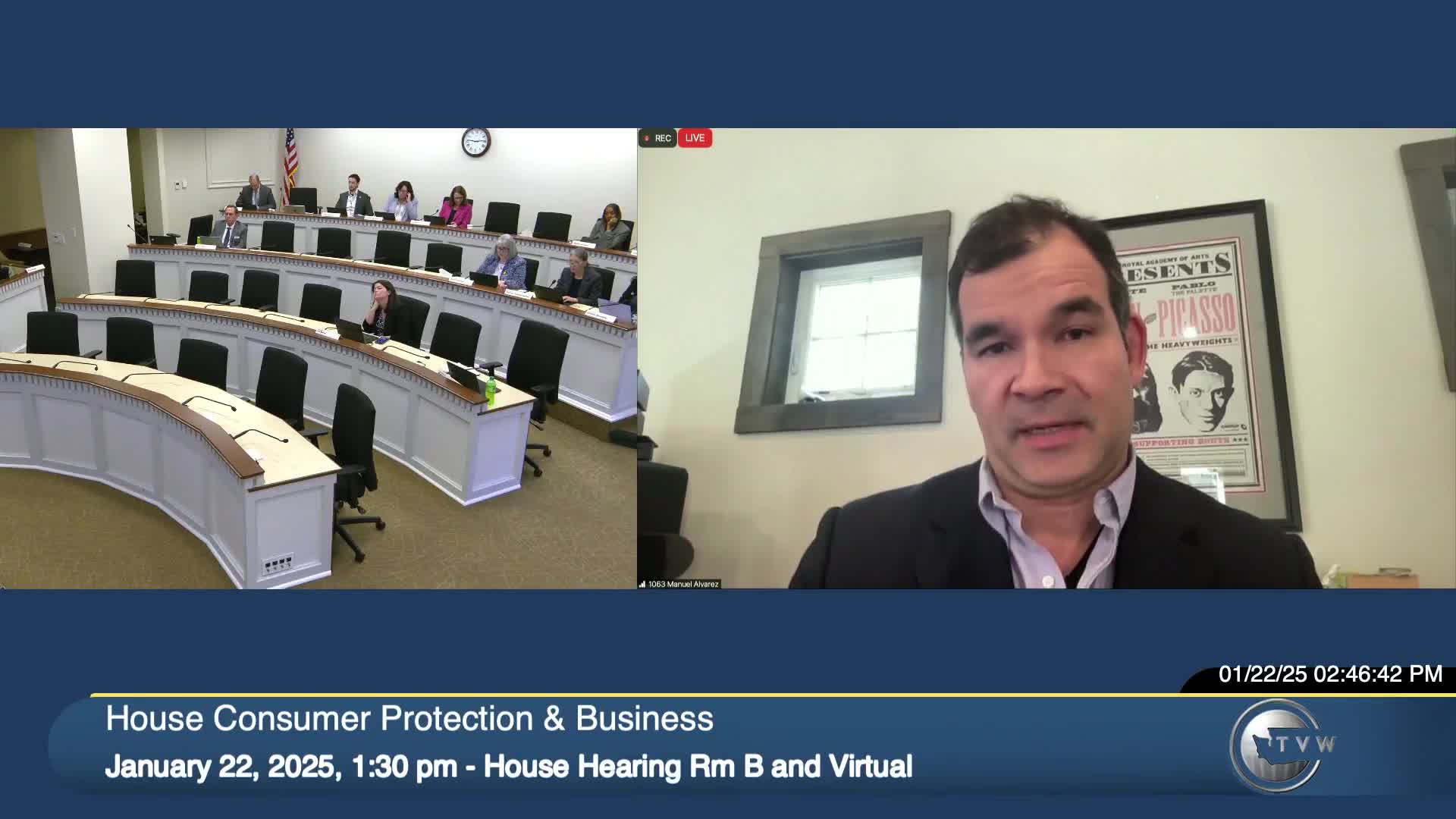
The House Consumer Protection & Business Committee on Jan. 22 held a public hearing on House Bill 1268, which would deem virtual currency transaction kiosks to be engaged in the business of money transmission and impose licensing, disclosure and operational requirements. The committee took testimony from the Department of Financial Institutions, kiosk operators, industry trade groups, bankers, law enforcement and consumer advocates and then closed the hearing without taking executive action.
The bill defines a virtual currency transaction kiosk as an electronic device that accepts or dispenses cash in exchange for virtual currency and would bring such kiosks explicitly under the Uniform Money Services Act. Staff briefing noted the Department of Financial Institutions already considers many kiosk operators to be money transmitters and has issued policy guidance; the bill would codify that treatment and add required receipts, risk disclosures and operational plans for winding down a kiosk business.
Industry witnesses—including CoinFlip and Bitcoin Depot—supported baseline consumer protections and urged inclusion of technological and compliance requirements such as blockchain analytics, robust anti-money-laundering (AML) programs, and live customer support. Kevin Lalley of CoinFlip recommended clear, visible warnings, blockchain analytics, and robust compliance programs but opposed transaction caps and fee caps that might impair regulatory reporting or make operators noncompliant with federal reporting thresholds.
Local law enforcement and consumer advocates urged stricter limits. Detective Tim Schwering of the Spokane Police Department described ‘‘pig butchering’’ and other romance and investment scams that funnel victims’ funds through crypto kiosks to overseas accounts, and said victims have lost large amounts with little chance of recovery. He and others cited federal reporting and suspicious-activity thresholds used by law enforcement (FinCEN SAR reporting often triggered at $2,000 or more) and recommended transaction limits and fee caps to reduce rapid-money flows to fraudsters.
The Washington Bankers Association supported the bill with amendments to align fee caps and transaction limits with Senate companion language, saying caps similar to cash ATM limits would protect consumers. AARP and other consumer groups described kiosks as a growing source of scams that often target older adults.
DFI testified that kiosks are already subject to licensure under existing law and recommended that the committee avoid creating two conflicting licensing regimes; the Department said it prefers rulemaking authority under existing statutes but supported added consumer-protection provisions where appropriate. Committee members, industry and regulators indicated a need to reconcile licensing language and to consider whether fee caps or transaction limits would impair law enforcement reporting requirements.
The committee closed the hearing and deferred executive action to allow the sponsor and stakeholders to reconcile licensing questions and consumer-protection provisions.
Ending: Committee members asked staff to continue discussions on fee caps, transaction limits, and how to reconcile the bill with existing Department of Financial Institutions licensure and federal reporting requirements.