Get Full Government Meeting Transcripts, Videos, & Alerts Forever!
Get email alerts on the Court Interpreters topic
No spam. Unsubscribe anytime.
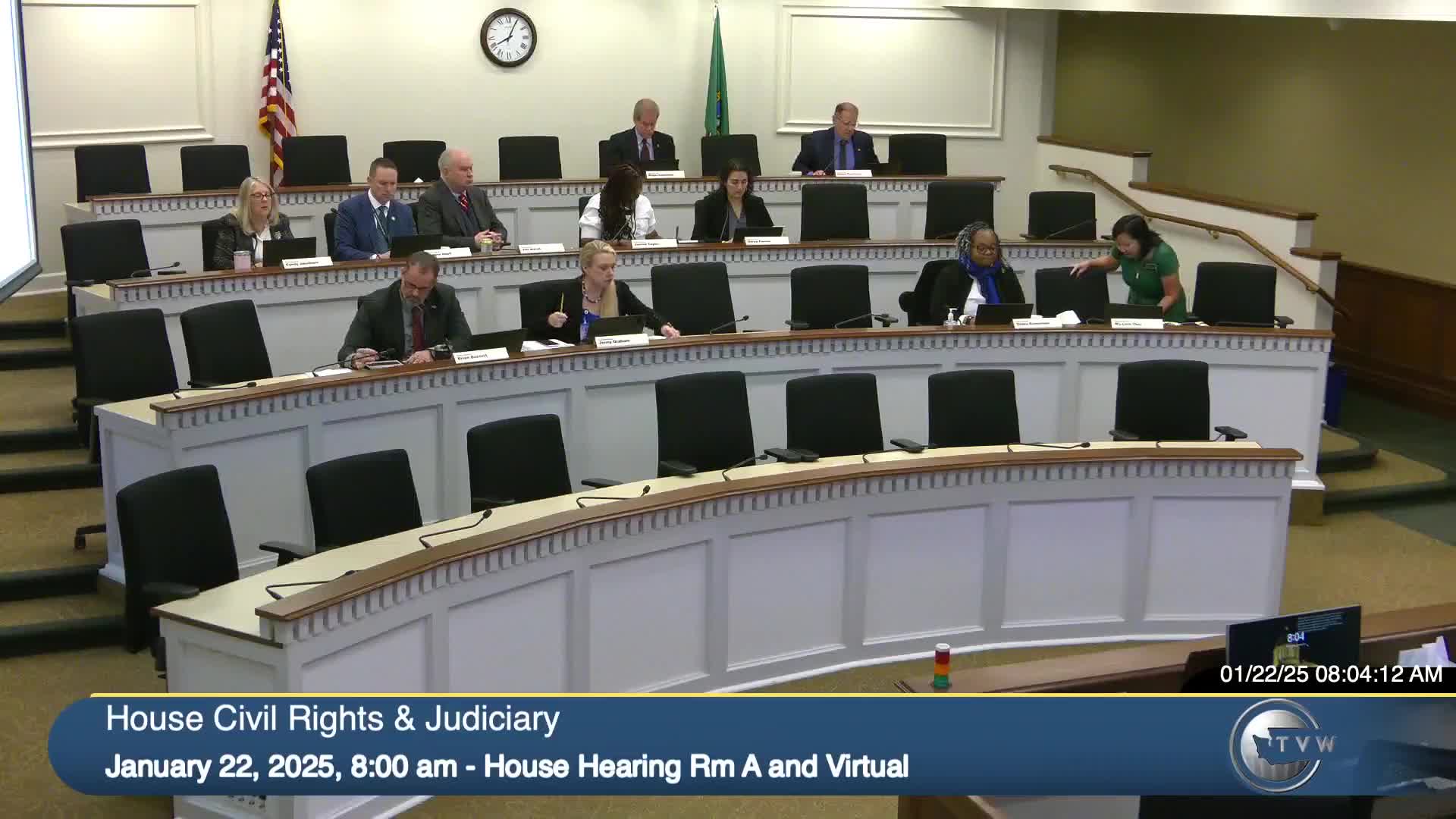
Committee hears bill to modernize court interpreter rules and reimbursement
Summary
The Civil Rights & Judiciary Committee heard testimony on House Bill 1174, which would update interpreter credentialing, appointment, waiver, cost and court language-plan rules and expand Administrative Office of the Courts support and reimbursement for language access.
House Bill 1174, a measure to update Washington state law on court interpreters, drew testimony Tuesday that framed the proposal as an access-to-justice and equity step for people with limited English proficiency.
The bill would direct the Administrative Office of the Courts (AOC) to maintain a credentialing program, authorize multiple credential types, require courts to appoint credentialed interpreters in proceedings involving people with limited English proficiency absent good cause, revise waiver rules, revise cost and reimbursement rules, and require courts to submit language access plans to the AOC every two years.
Why it matters: Supporters said the changes would align statute with current practice and federal guidance and make language access more consistent and reliable across courts. “For me this is really an issue ... Number 1 is access to justice,” said Representative Peterson, the bill sponsor. Brittany Gregory, associate director of judicial legislative relations for the AOC, said the proposal “really is an equity and access issue.”
Key provisions summarized in staff testimony include: AOC authority to create and guide credentialed and noncredentialed interpreter use; mandated appointment of credentialed interpreters unless a judge finds good cause for a noncredentialed interpreter; appointment of interpreter teams where required by Supreme Court rule; a procedure for on-the-record interpreter waivers that may be reasserted later; and changes to cost and reimbursement so that a person with limited English proficiency is not responsible for interpreter costs when the person is a party, subpoenaed or summoned, is a parent/guardian/custodian of a juvenile, or compelled to appear. Staff said the AOC would reimburse participating state courts for language access service costs and one-half of interpreter payments unless the budget sets a higher reimbursement rate.
Practitioners and court staff told the committee the changes would reduce confusion and improve accuracy. Luisa Gracia, a Spanish court interpreter and manager of Sierra Municipal Corps interpret services, testified that replacing older statutory terms with “credentialed interpreter” provides clarity for judges and courts; she said the changes “provide the steps to allow judges to carry out their duties in a more effective manner.” James Wells, language access supervisor at the AOC, said the statute has “fallen behind” current federal requirements and practices and that HB 1174 would help Washington remain a leader in court language access.
Opposition or concerns: The public hearing record included no organized opposition; committee members asked about AOC system reliability and reimbursement funding. Ranking Member Walsh asked whether AOC’s computer system would be robust enough to support courts; Gregory replied the office had made security changes after an outage and was seeking a decision-package to strengthen systems.
Next steps: The committee held a public hearing and took testimony; no executive action on HB 1174 occurred during this session.
Ending note: Supporters urged the committee to advance the measure so courts can use the additional clarity, templates and technical assistance the AOC would provide.