Get Full Government Meeting Transcripts, Videos, & Alerts Forever!
Get email alerts on the Health Equity Justice topic
No spam. Unsubscribe anytime.
Bill to rename and expand governor’s health‑disparities council draws mixed testimony
Summary
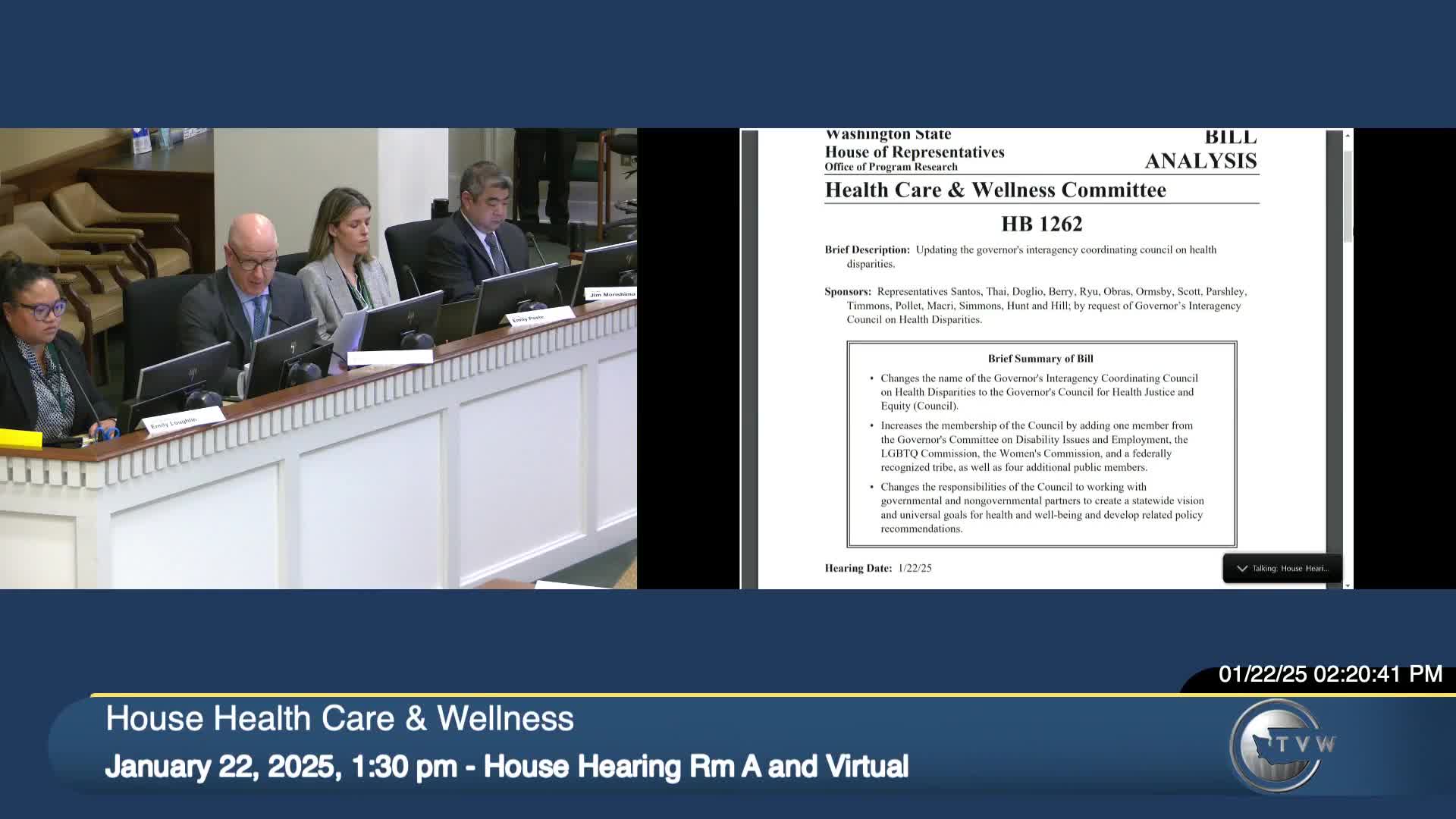
House Bill 1262 would rename and expand the governor’s health‑disparities council into the Governor’s Council for Health, Equity and Justice, add several commission representatives and youth members, and require a statewide vision and policy recommendations, witnesses told the House Health Care & Wellness Committee.
House Bill 1262 would rename and reconstitute the Governor’s Interagency Coordinating Council on Health Disparities as the Governor’s Council for Health, Equity and Justice, expand membership to include additional commissions and a federally recognized tribe, increase public membership and require the council to develop statewide vision and universal goals for health and well‑being, the committee heard on Jan. 22, 2025.
Committee staff described multiple changes: the name change; addition of representatives from the Governor’s Committee on Disability Issues and Employment, the LGBTQ Commission, the Women’s Commission and a federally recognized tribe; expansion of public members from two to six with at least two youth aged 26 or younger; and replacement of the council’s current responsibilities with a duty to create a statewide vision and policy recommendations rooted in a health justice framework. Staff said the council may hold hearings, research state actions that impact inequities, and must report its vision and goals to the governor and legislature by Oct. 31, 2027, with biennial updates through 2039.
Representative Milin Tai introduced the bill for the sponsor and said the updates would better position the council to ‘‘serve Washingtonians’’ and to address populations being left behind. Proponents, including the Commission on Asian Pacific American Affairs and the Health Disparities Council, said the changes reflect lessons from the COVID‑19 pandemic and formal recognition that racism is a public‑health crisis.
Supporters argued the council needs broader representation and a stronger mandate to coordinate agency action on systemic drivers of poor health. Lydia Faitulia, chair of the Commission on Asian Pacific American Affairs, called the proposal a commitment to "advancing policies that acknowledge and rectify system issues contributing to health disparities," and noted language‑access commitments in the bill.
Opposition testimony came from diverse speakers. Mary Long of Conservative Ladies of Washington said labeling racism as a public‑health crisis was "divisive" and argued the bill would expand bureaucracy. Blair Daley of Initiative for Boys and Men asked that the bill include explicit representation for boys’ and men’s health; he cited higher male mortality and suicide rates. Other opponents expressed concern that the term "public health crisis" evokes pandemic‑era trauma and that the bill politicizes health policy.
Supporters and opponents also raised fiscal concerns: staff and witnesses noted expanded membership and duties could require additional resources, while proponents said the council’s redesign aims to reduce long‑term costs by coordinating more effective prevention and equity strategies.
The committee did not take a vote. Sponsors and agency partners said they are open to public feedback and amendments before executive session consideration.