Get AI Briefings, Transcripts & Alerts on Local & National Government Meetings — Forever.
House bill would let public colleges buy health insurance for student athletes
Summary
House Bill 1298 would allow governing boards of public institutions of higher education in Washington to make available and pay the costs of health insurance premiums for currently enrolled intercollegiate student athletes, supporters said at the Jan. 22 committee hearing.
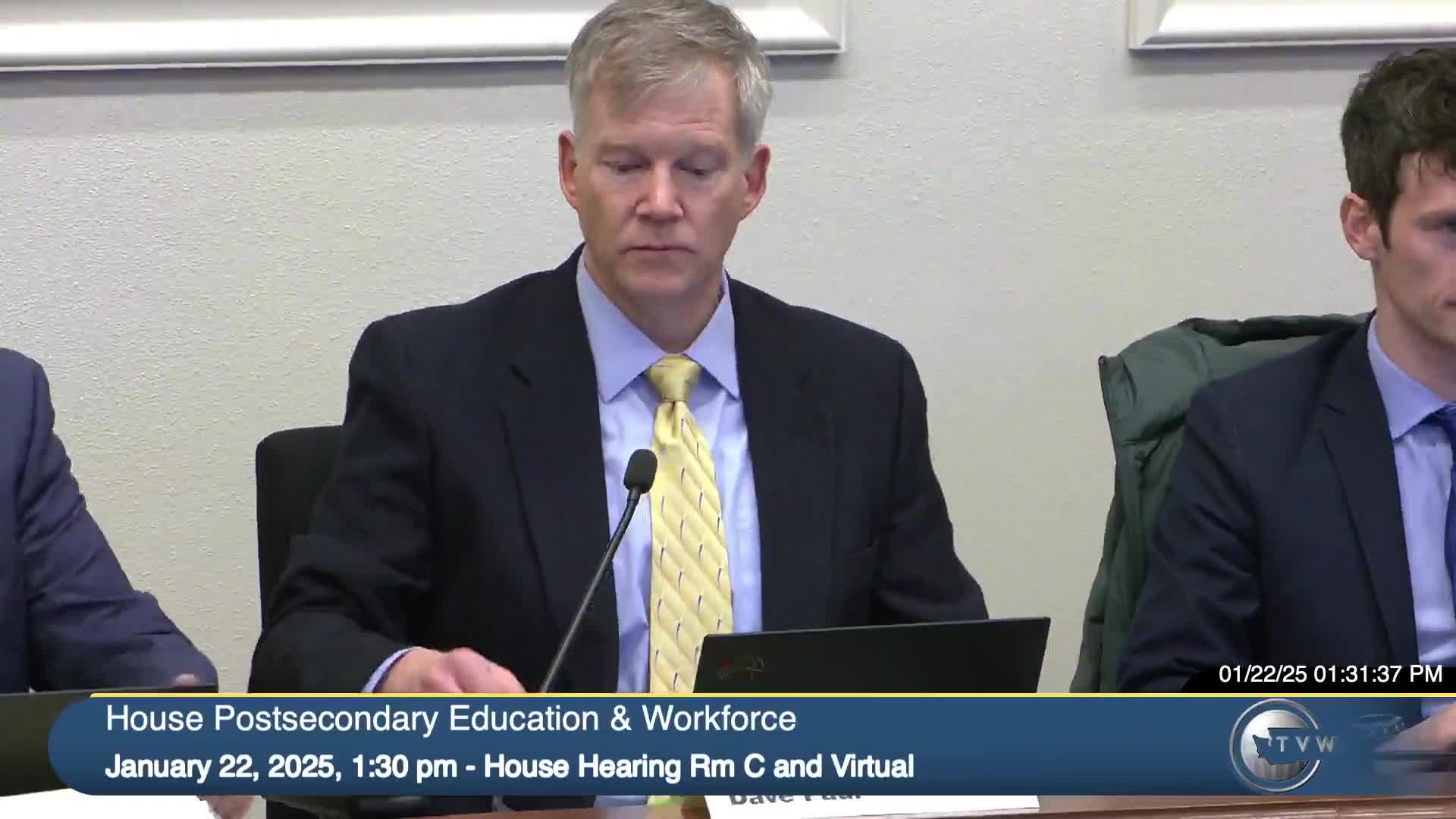
House Bill 1298 would allow governing boards of public institutions of higher education in Washington to make available and pay the costs of health insurance premiums for currently enrolled intercollegiate student athletes, supporters said at the Jan. 22 House Postsecondary Education and Workforce Committee hearing.
Saranda Ross, counsel to the committee, summarized the bill during the staff briefing: “Before you is House Bill 1298, allowing governing boards of public institutions of higher education to pay health insurance costs for intercollegiate student athletes.”
The bill would change an existing provision of state law (referred to in testimony as an RCW) that staff and sponsors said currently prevents institutions from purchasing insurance plans that cover athletes’ premiums. Representative Teresa Berg, the bill’s prime sponsor, told the committee that the NCAA (referred to in testimony as “NC 2A”) already requires institutions to cover medical costs and injuries not reimbursed by a student’s personal plan and to provide certain post‑graduation medical coverage, but state law currently bars institutions from buying insurance to manage those costs.
University witnesses said the change would create predictable, manageable costs. Joe Dacko of the University of Washington told the committee the current approach forces institutions to pay medical bills ‘‘out of pocket’’ and that allowing premiums would smooth year‑to‑year volatility. Michael Dillon of UW athletics explained how secondary athletic policies typically operate: they “become primary for individuals that do not have a primary insurance policy and are inclusive of co pays [and] deductibles … so those don't trickle down as extra cost to the university; it’s all rolled into the assumed cost that's covered by the premiums.”
Sponsors and university witnesses offered several data points about current institutional expenditures for injuries at UW: according to Representative Berg’s testimony, UW pays for roughly 4,500 unique physician visits, about 1,000 diagnostic medical tests, some 60 surgical procedures, and approximately 1,250 counseling visits annually related to student athletes. Washington State University told the committee it spends about $1.5 million a year on medical services and medical expenses for athletics, which can fluctuate depending on injuries.
Committee members asked whether adopting insurance would reduce universities’ out‑of‑pocket spending (witnesses said yes, by replacing ad‑hoc payments with predictable premiums) and whether any state funds would be used (witnesses said no, premiums and related costs would not be paid from state general funds). UW counsel said their office had not located the original basis for the statutory prohibition and recommended a statutory exception to make the universities’ authority explicit.
No formal vote or final action was taken at the hearing. Proponents asked the committee to move the bill forward and indicated they expect no fiscal note because institutions would use nonstate funds to purchase policies.
What’s next: the bill remains at the hearing stage; no committee action was recorded on Jan. 22. If advanced, the measure would require drafting by staff to add the specific statutory exception and any implementing language.