Get Full Government Meeting Transcripts, Videos, & Alerts Forever!
Get email alerts on the Horse Racing Industry topic
No spam. Unsubscribe anytime.
Washington horse-racing officials warn HISA assessment could cripple Emerald Downs and statewide industry
Summary
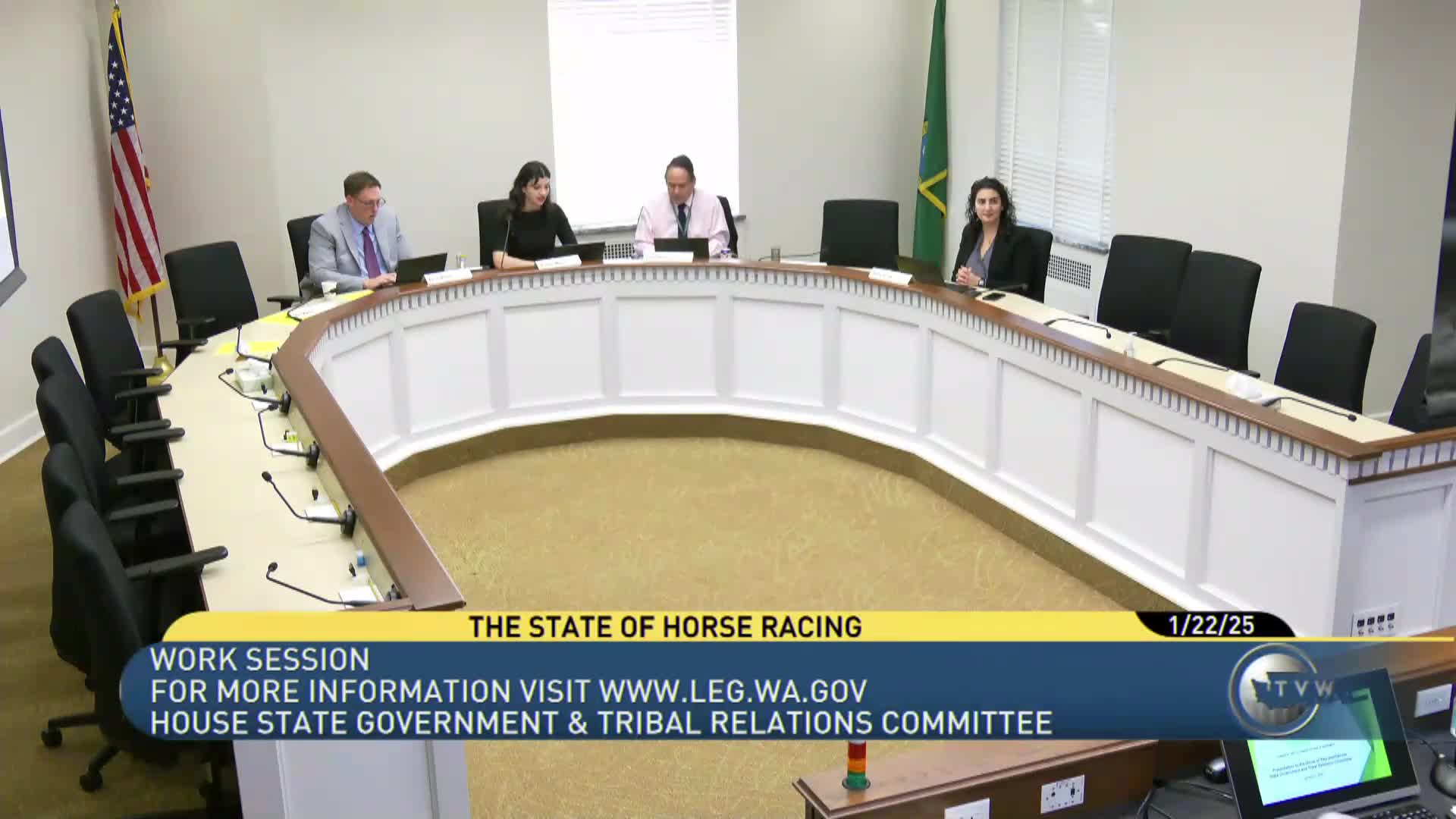
Members of the State Government & Tribal Relations Committee heard on Jan. 22 from the Washington Horse Racing Commission and Emerald Downs that a federally created oversight body’s assessment fees are rising and could make parimutuel racing in Washington economically unsustainable.
Members of the State Government & Tribal Relations Committee heard on Jan. 22 from the Washington Horse Racing Commission and Emerald Downs that a federally created oversight body’s assessment fees are rising and could make parimutuel racing in Washington economically unsustainable.
The commission’s executive secretary, Amanda Benton, and commission chair Doug Moore told the committee that the Horse Racing Integrity and Safety Act (HISA) — a federal law enacted in 2020 — has imposed new testing, antidoping and safety programs administered by a private body that bills states and tracks for its costs. Benton said the commission paid about $419,000 to HISA in 2024 and expects a 2025 assessment of roughly $712,000 before credits, which the commission estimates might lower to about $424,000; Moore said HISA’s assessment methodology is expected to change in 2026 and Washington’s bill could rise to between $1.2 million and $1.3 million.
The potential jump in assessment fees matters because the state’s racing economy is small compared with other racing states. Phil Ziegler, president of Emerald Downs, told the committee Emerald Downs drew “over 200,000 people” last season and said Washington’s total racing-related economic impact is roughly $240 million with about 1,000 jobs at stake. Benton and Moore detailed downstream agricultural and service activity that depends on racing: the commission estimates about 700 horses are stabled at Emerald Downs; Benton gave an example that feeding one racehorse costs about $20 a day, which she said equates to nearly $3 million in feed purchases over a seven-month meet for horses stabled at Emerald Downs.
HISA, Benton said, is a private self-regulatory organization created by federal law to establish antidoping, medication control and racetrack safety rules. “They administer the rules and enforcement mechanisms of the antidoping and medication control program,” Benton said, describing HIWU, the unit that handles testing and investigations. Moore characterized the imposition of the program and its fees as abrupt: “We were blindsided, had no opportunity to make comments, and we were stuck with a hefty assessment fee to the industry that we just simply cannot continue on in the path it’s going,” he said.
Moore and Ziegler described how assessment fees are assessed and why they say the state and industry cannot absorb higher costs. Moore told the committee the assessment formula changed to remove adjustments tied to purses, meaning smaller tracks with lower purses now face bills similar to much larger tracks. Ziegler said, by their estimates, combined regulatory costs (state commission plus HISA) could amount to about 43% of purses in Washington — far above the typical rate of about 5% in many other states.
Committee members asked whether federal remedies or litigation could alter the program. Moore said the industry has contacted federal legislators and that legal challenges to HISA are pending at the U.S. Supreme Court; he said those efforts are underway but would not be quick fixes.
Speakers emphasized the social and community role of Emerald Downs in South King County beyond wagering, including family events and tourism, with Ziegler noting viral promotional events and regular summer crowds. Longtime industry representative Ron Crockett described the track and its surrounding farms as “a family event” and stressed the social and employment ties of stable workers and other participants.
Ending: Officials urged the legislature to consider support to bridge the industry through the immediate assessment impacts while federal or legal changes to HISA progress, characterizing the request as an investment in a longstanding state industry rather than a simple subsidy. No committee action or vote on funding was recorded during the Jan. 22 session.