Get Full Government Meeting Transcripts, Videos, & Alerts Forever!
Get email alerts on the School Redistricting topic
No spam. Unsubscribe anytime.
Braintree officials present seven redistricting and consolidation options, seek public feedback
Summary
Braintree Public Schools officials and consultants presented seven options that could close one or two elementary schools, reopen Old South as an elementary campus, and redistribute students to address uneven enrollments, facility costs and budget pressures. The school committee will review refined recommendations after public feedback.
Braintree Public Schools Superintendent Jim Lee and consultants from AppGeo (part of the Sanborn Map Company) presented seven redistricting and consolidation options at a public information meeting designed to gather community feedback. The proposals include permutations that would close one or two elementary schools, reopen the district—s Old South building for elementary use, and reassign students across north and south neighborhoods to address uneven building utilization and class-size disparities.
The presentation focused on three problems the district says the options would address: uneven elementary class sizes across neighborhoods, long-term facility and maintenance costs driven by multiple older buildings, and constrained operating budgets that have already produced cuts. Superintendent Jim Lee said the work is advisory: "This falls to the school committee. They will undergo their own process to vet the information. They have committed to doing a public hearing," and asked the public to submit feedback through the district survey.
Priya Sankalia, project manager for AppGeo, described the consultant—s approach: geocoding student addresses, building 36 geographic "components" as moveable planning units, and assembling more than 30 scenarios into seven options for review. "We are a geospatial consulting firm," Sankalia said, describing how the components are combined to test contiguity, walking distances, transportation impacts and capacity outcomes.
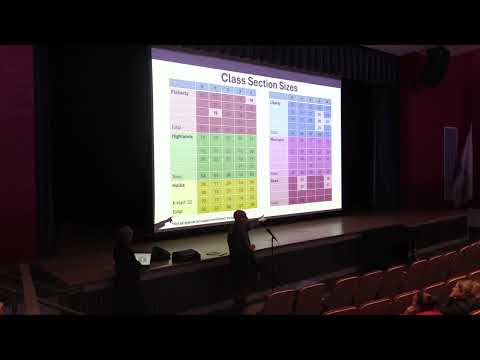
Officials and consultants told attendees that current capacity and class-size data show significant variation across elementary schools. Presented figures included building capacities and current usage (Clarity: 368 seats, ~83% used; Highlands: 398 seats, ~89% used; Hollis: 564 seats, ~65% used; Liberty: 376 seats, ~97–99% used; Morrison: 400 seats; Ross: 292 seats, ~64% used). Examples given from the current year included an average Grade 1 class size of about 21.3 at Highlands versus about 14 at Ross, and Grade 3 class sizes approaching 25 at Liberty while other schools had mid-to-high teens.
Consultants and district staff said the district—s most recent on-site capacity survey was performed to reflect modern classroom usage; the older construction-era capacities were last audited in the 1970s. Speakers also noted budget reductions made in the prior year, including about nine elementary teacher positions and more than 40 district positions overall, and said those cuts increased average class sizes in some grades.
The seven options presented share several common elements: Old South would be brought back into service in every option, and each option tests different pairs of school closures or reassignments in the northern and southern parts of town. Options the consultants showed included combinations such as Highlands + Ross closing; Highlands + Morrison; Highlands + Flaherty; Highlands + Hollis; Liberty + Ross; and Hollis + Ross. For each option the consultants presented one or more scenarios showing how adjacent components would be reassigned to preserve contiguity and balance capacities.
Consultants cautioned that some options risk overcrowding in recipient schools. For example, scenarios that consolidate very large elementary populations into fewer buildings could raise one or more schools above the district—s desired 80–95% capacity range or create pressure on corresponding middle-school feeder patterns. The Massachusetts School Building Authority (MSBA) was noted as a stakeholder for projects that previously received MSBA funding; presenters said any closure that affects a building with recent MSBA-backed work would require discussion with the authority because the MSBA may seek a repayment or other remedy for grant or reimbursement funds.
The consultants said guiding principles used to evaluate scenarios came from a district survey on ParentSquare and included: financial sustainability; use of the district facilities-condition report; minimizing student reassignment where possible; using Old South as an asset; maintaining separate special-use spaces (gym/arts/media); and avoiding elementary schools that feed to two different middle schools. Attendees were told that special-education placements and programs were considered in each scenario and that program relocations would be spelled out if a particular school closed.
Next steps outlined by district staff: the full slide deck and a recording will be posted to the district—s materials, and a feedback survey is open for community responses. The consultant team will refine scenarios using public input and district review, then submit recommendations to the school committee. Superintendent Lee said the school committee will hold a public hearing and will make any formal decisions. No final decisions or votes were taken at the presentation.
Questions and comments at the meeting focused on transportation and walking distances, how the component boundaries were drawn, the potential for middle-school feeder disruptions, the timing of kindergarten inclusion in elementary buildings, and the fiscal trade-offs between maintaining multiple older buildings versus consolidating. Officials repeatedly emphasized that the presentation was conceptual and intended to collect community feedback before the school committee—s public hearings and subsequent deliberations.
The district asked attendees to complete the posted survey to ensure their priorities and concerns are incorporated as consultants finalize the scenarios for the school committee review in February.