Get Full Government Meeting Transcripts, Videos, & Alerts Forever!
Get email alerts on the Education School Construction topic
No spam. Unsubscribe anytime.
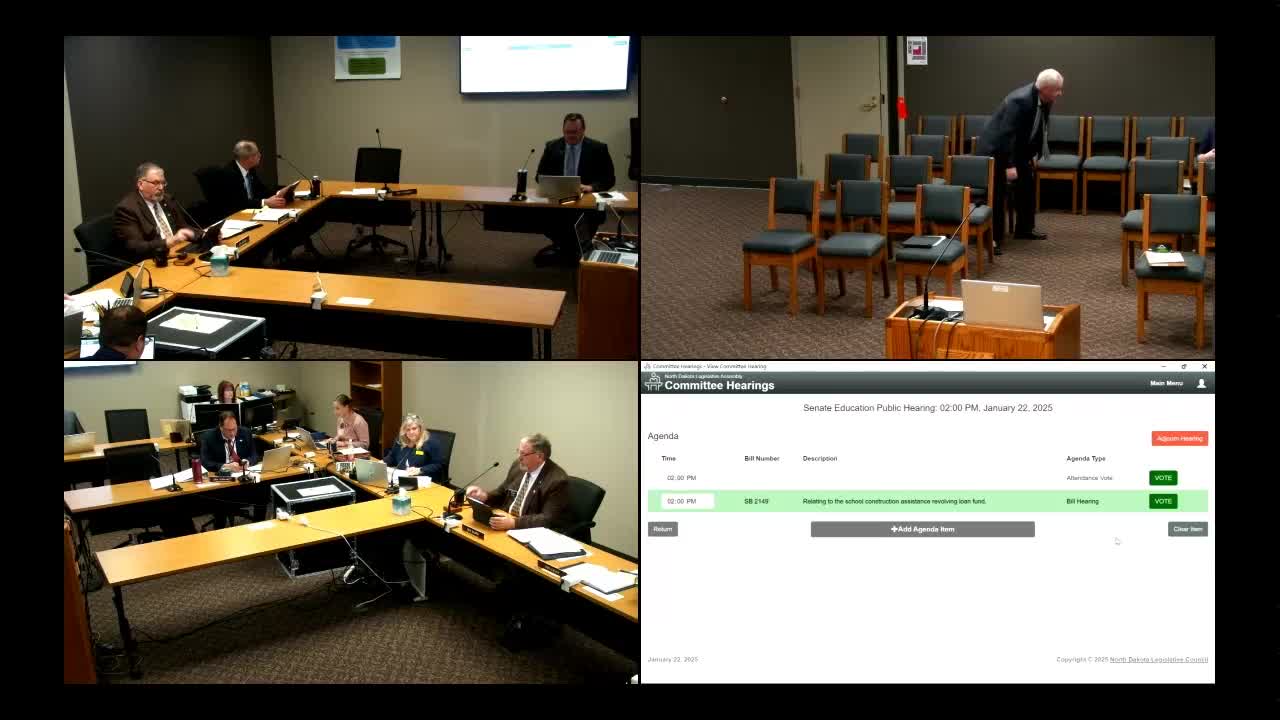
Senate panel hears bill to let Air Force base schools use low‑interest school construction loans
Summary
Senate Bill 2,149 would allow schools on Air Force bases to access the state School Construction Assistance Revolving Loan Fund with 2% loans and a cap of $20 million; committee heard bank and sponsor testimony and scheduled follow-up with the Department of Public Instruction.
Senator Don Schauble, District 31, introduced Senate Bill 2,149 to the Senate Education Committee to allow schools located on Air Force bases to access the state School Construction Assistance Revolving Loan Fund when they receive federal construction priority.
The measure would exempt Air Force base schools from current law requirements tied to property tax‑based repayment and would instead allow a 2% loan option, with individual loans up to $20,000,000, to cover the local 20% match required when a facility receives 80% federal funding. "This bill is to create an opportunity for schools on our Air Force bases to take advantage of low interest school construction loans, just like the rest of our districts," Schauble said during the hearing.
The bill sponsor and Bank of North Dakota staff described how Air Force base districts lack a conventional property tax base to repay loans and therefore have been unable to use the revolving loan fund under current statutory repayment rules. Kylie Merkel, a business banker at the Bank of North Dakota, said the current Century Code requirement that repayment be backed by property tax referendum or other property‑tax‑based mechanisms has limited base schools' ability to participate. "They don't really have the ability," Merkel said, citing the limited local tax base available on bases and the disproportionate impact on the small number of property owners there.
Bank staff provided figures on the loan fund's size and expected availability. Kelvin Holett, chief business development officer at the bank, said the fund holds roughly $400,000,000 in assets, with about $340,000,000 in loans outstanding; the fund typically revolves about $32,000,000 annually and has about $65,000,000 available per biennium for new loans. Under the bill's language, Holett said, the $20,000,000 cap proposed for Air Force base loans "would kinda be carved out," reducing available funds for other projects unless additional capital is provided.
Committee members pressed on prioritization and fairness. Senator Wabemath asked how many non‑base schools might be delayed if $20,000,000 were reserved for bases and whether the bill would effectively move base projects ahead of others on the Department of Public Instruction's prioritized list. Schauble and bank staff said Department of Public Instruction (DPI) prepares a prioritized construction list and that the committee will need that list to assess impacts. "Once they reach the top of the list, they have to be ready to go with that 20%," Schauble said, explaining the timing pressure when federal funding becomes available.
No vote was taken. Chairman Beard said he will schedule committee work and invite DPI to testify so members can see the current prioritized list and better understand how the proposed $20,000,000 cap would affect other projects. The hearing on Senate Bill 2,149 was then closed.
The bill remains under committee consideration; sponsors and bank officials framed the proposal as a mechanism to let base‑affiliated schools take advantage of federal construction dollars without imposing an immediate, large local tax burden on base property owners.