Get Full Government Meeting Transcripts, Videos, & Alerts Forever!
Get email alerts on the Zoning Use Variance topic
No spam. Unsubscribe anytime.
Allentown Zoning Board Says Convenience‑store Use Requires a Use Variance, Denies Application at 4446 N. 13th St.
Summary
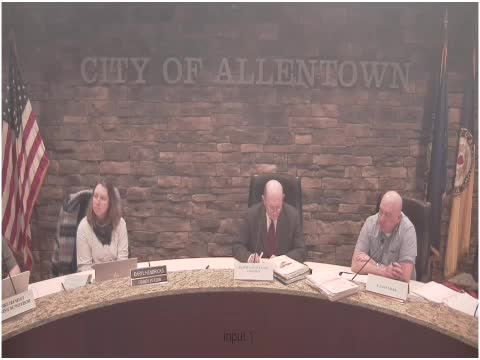
On Jan. 13, 2025, the Allentown City Zoning Hearing Board ruled that a proposed first‑floor convenience store at 4446 N. 13th St. requires a use variance under the RH district rules and denied the applicant’s request, voting 2–1.
The Allentown City Zoning Hearing Board on Jan. 13, 2025 ruled that a proposed first‑floor convenience store at 4446 North 13th Street must obtain a use variance and denied the applicant’s request, with the board voting 2–1.
Board members said the RH (high‑density residential) district table in the city zoning ordinance conditions “permitted” retail on meeting certain dimensional criteria in Annex K; the board concluded that the permissibility of a retail variety store at this address depends on those dimensional thresholds and therefore requires a use variance rather than only dimensional variances.
Proponents — including V. Ausubel, the managing member of 44 North 13th Street LLC, and prospective tenant Adil Al Mahmoudi — said the space has been difficult to lease since a church tenant was evicted during the early COVID period and that the proposed retail operation would be neighborhood‑serving. Ausubel told the board that the building covers the full lot and that “it’s been a very difficult undertaking to find a suitable, responsible tenant” and that he supports the tenant’s request for variances. Adil said his plan was a small convenience operation selling candy, cigarettes and groceries and that service would be “pay and go.”
The owner’s representative and tenant described existing physical constraints the board considered: the commercial unit is roughly 1,000 square feet on the first floor of a three‑story, mixed‑use building whose footprint the owner estimated at about 33 by 120 feet; there are no off‑street parking spaces tied to the commercial unit; the owner said a separate electrical panel was recently installed for the commercial unit and the meter final was obtained in October 2024. City staff had flagged that Annex K requires interior entrances and minimum size/parking thresholds that the proposed use would not meet.
During deliberations board members said the proposed convenience store represents a higher intensity of use than the property’s prior permitted use (city records showed the last permitted use about two decades ago was a personal‑service business such as a tanning salon) and that the combination of hours, projected customer volumes, and lack of off‑street parking weighed against approval. The board characterized the notice and the zoning officer’s interpretation as requiring the board to treat permissibility as conditional on meeting Annex K criteria.
The board first voted to interpret the ordinance to require a use variance for the proposed convenience store; it then voted to deny the application for conversion of the vacant commercial space into a first‑floor retail convenience store. The denial followed arguments from the applicant that dimensional relief (parking and square footage) would be the only relief needed and from the owner that the space has been vacant or underused for years. The board’s denial leaves the applicant the option to seek a use variance or to pursue an alternative, lower‑intensity permitted use that complies with Annex K and other dimensional rules.
The record includes testimony about the property’s recent history: a previously permitted place of worship occupied the space until eviction for nonpayment around early 2020, and before that a personal‑service use was on file. The owner said the building contains residential units on the upper floors and there is no internal access between the commercial unit and the residential portion.
The board’s full decision language is recorded in the hearing minutes and will be reflected in any follow‑up filings by the applicant.