Get Full Government Meeting Transcripts, Videos, & Alerts Forever!
Get email alerts on the Technology Policy topic
No spam. Unsubscribe anytime.
Northwestern Lehigh board reviews broad rewrite of technology, mobile-device and AI policies in first reading
Summary
The Northwestern Lehigh School District board held a lengthy first reading of multiple updated technology-related policies, including separate staff and student mobile-device rules, a social-media policy and a new artificial intelligence policy, district staff said.
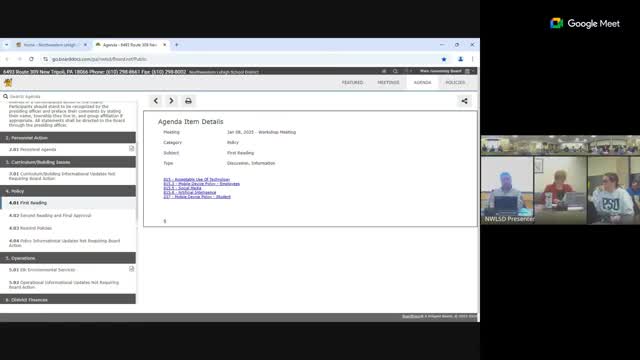
The Northwestern Lehigh School District board held a lengthy first reading of multiple technology-related policy revisions, including an updated acceptable-use policy, separate mobile-device rules for staff and students, a social-media policy and a new artificial intelligence policy. District staff said the changes are intended to reflect current technology, privacy and instructional needs and will be returned for final action at a future meeting.
District staff presented the package as a consolidation and modernization of policies last reviewed in 2012. "This policy outlines the general guidelines and prohibitions for anyone using the district's network or devices," the presenter said, describing proposed changes to policy 815 and the rescission of three older policies (815.1, 815.2 and 815.4). The presenter said the revisions drew on model language from the district's attorneys and the Pennsylvania School Boards Association.
Why it matters: board members and administrators said clearer, up-to-date language is needed to give building leaders and teachers workable rules they can enforce and to reduce inconsistent practice between buildings. The draft separates staff and student mobile-device rules, defines authorized use at each grade band, and creates an explicit new policy for generative AI.
Key details: - Acceptable use (policy 815): staff described a rename and consolidation of older policies into a single acceptable-use policy covering district networks and devices. - Mobile-device staff policy (proposed rewrite of 815.3): the draft limits employee use of personal devices during instructional time and directs staff to route emergency contacts through the school office so classroom supervision is maintained; staff said administrators will be "very understanding" about true emergencies but expect teachers to use established office procedures when possible. - Mobile-device student policy (proposed 237 rewrite): the draft proposes school-level authorization and different rules by grade band. For elementary and middle schools, devices must generally be "powered off and kept out of sight" except when a teacher or building administrator grants permission. For high school students, the draft says devices are “prohibited by any high school student during instructional times” unless prior permission is given; devices would remain allowed during noninstructional times (hallways, lunch, before/after school). - Wearables and smartwatches: board members asked where wearables would fit; staff said the draft will treat wearables that receive communications (texts/calls) as electronic devices and that they will add an explicit reference to wearable technology for the second reading. - Social media: the draft distinguishes district-run, third-party (for example booster) and personal accounts, and it outlines expectations for staff who run or post to personal accounts; staff reiterated that the policy would not bar personal pages but would, for example, discourage friending current students on personal accounts. - Artificial intelligence (new policy 815.6): the board heard a new policy that would permit the instructional and operational use of AI while prohibiting uses that expose personally identifiable information. Staff emphasized data-privacy risks and said tools that generate sexually explicit or defamatory content would be blocked; they said the district will maintain filter protections required by the Child Internet Protection Act (CIPA) and the Children’s Online Privacy Protection Act (COPPA).
Training and timeline: staff said administrators will develop administrative regulations and building-level handbook language and will roll out communications to families if and when the board adopts the policies. The district plans an AI-focused staff training and public primer during an in-service day on February 26 featuring guest presenter Lui Yang Chow; the presenter invited board members to attend. Staff also described staged professional development (hands-on training for instructional staff followed by support-staff sessions in spring).
The board did not take final action; the changes were presented as a first reading and will return for subsequent consideration. Board members asked staff to add a wearable-technology callout to the definition section and to consider parents' safety-tracking concerns when finalizing middle-school rules. The presenter said those suggestions would be incorporated for the second reading.
Ending: District staff said updated building handbooks and communications to families will accompany adoption, and administrators will continue to refine administrative regulations on implementation and enforcement.