Get Full Government Meeting Transcripts, Videos, & Alerts Forever!
Get email alerts on the Short Term Rentals topic
No spam. Unsubscribe anytime.
Pacifica planning panel recommends approval of strict short‑term rental rewrite, with amendments
Summary
The Planning Commission voted unanimously to recommend City Council approve a text amendment to repeal and replace Article 49 of the zoning code, tightening rules for short‑term rentals (STRs). Commissioners and staff recorded changes on signage, parking and enforcement language before forwarding the ordinance with a recommendation.
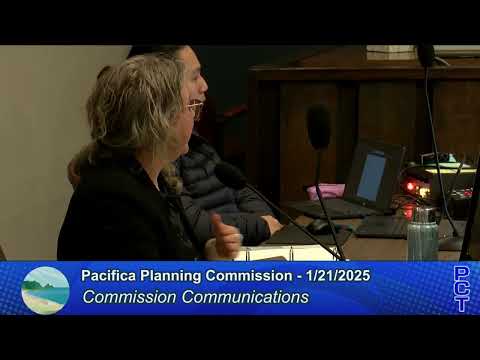
The Pacifica Planning Commission unanimously recommended that City Council approve a draft ordinance to repeal and replace Article 49 of the city zoning code and tighten rules for short‑term rentals (STRs), after more than two hours of public comment and discussion at its Jan. 2025 meeting.
The proposed text amendment (File No. TA‑127‑25) would require STRs to be located in the operator’s primary residence, prohibit STRs in many multifamily units, set new occupancy and parking rules and add operational requirements such as a designated responsible party and a posted QR code for contact and complaint information. Staff said council had given policy direction on most of the changes and asked the commission to forward a recommendation.
Why it matters: Commissioners and speakers framed the issue as a balancing act between preserving neighborhood quality and coastal access, and protecting city revenue. Staff warned the new rules could substantially reduce transient‑occupancy tax (TOT) revenue and increase administrative costs; neighborhood speakers said the draft does not go far enough to curb nuisance activity, while many STR operators and hosts warned the changes would shutter responsible hosts and damage local businesses.
Staff presentation and fiscal outlook
Samantha Updegrave, Pacifica’s community development director, presented the draft and summarized council direction. “A short‑term rental or an STR is the use of a dwelling unit or portion of it for the rental of less than 30 consecutive days,” Updegrave said while explaining the ordinance history and the changes being proposed.
Among the draft provisions she highlighted: a primary‑residence requirement that would bar unhosted STRs in multifamily buildings; a 90‑night annual cap for unhosted STRs; a two‑night minimum stay for unhosted rentals; a one‑parking‑space‑per‑STR‑bedroom requirement in the coastal zone; occupancy limits set as two people per legally permitted bedroom (children under 12 were treated separately in the draft); time restrictions for outdoor pool/spa use; and a required responsible party who must respond to complaints.
Updegrave also described potential fiscal effects, saying the city currently collects roughly in the range of $1.6 million to $1.8 million in TOT and that staff expected the draft rules to reduce that revenue substantially. Staff told commissioners the ordinance would also raise administrative and enforcement costs because of permit tracking, enforcement and appeals work.
Public comment: competing priorities
About two dozen members of the public spoke. Many long‑term residents and neighborhood advocates urged stricter limits and faster timelines for enforcement, arguing STRs have caused noise, parking strain, trash and safety concerns. Bob O’Donnell, a 51‑year Pacifica resident who lives two doors from an STR he said has caused repeated problems, urged faster implementation and argued for inspections on all rentals.
Opposition came primarily from STR hosts and co‑hosts. Albert Zhang, who said he and his husband sometimes list their home, called the draft “overly restrictive, harmful to the city, and illogical,” warning that a 90‑day cap and primary‑residence rule would “effectively shut down operations for most hosts” and cut tourism dollars. Anna Tong, a host, said STRs allow multigenerational families to access the coast and asked commissioners to “consider maintaining affordable vacation rental for families.”
Several speakers emphasized that the bulk of STR complaints come from a small number of properties and urged focused enforcement or grandfathering for compliant hosts. Others said revenue loss from a stricter ordinance would force cuts to city services.
Commission questions and changes requested
Commissioners pressed staff on enforcement history, the cap selection and technical details: how many permits have been revoked (staff said one full revocation in the prior year and several non‑renewals), whether a moratorium was considered (staff said it was discussed but judged legally difficult), and why council chose a 90‑day limit.
After discussion and public comment, commissioners and staff agreed on a set of clarifying edits and items to convey to council. The Planning Commission’s recommendation (as read into the record before the vote) asked staff to forward the ordinance to City Council with these clarifications and changes included:
- Require the responsible party listed on the application be a natural person and add clearer response expectations for that person. - Clarify that a single STR permit covers one unit on one site (no omnibus permits for multiple units). - Add a clear cross‑reference to the city’s refuse/garbage code so trash violations related to an STR can be enforced and logged as permit‑related violations. - Require that safety and habitability declarations be signed under penalty of perjury on renewal/application documents. - Refine the draft sign/QR provision so each STR posts a weatherproof, administrator‑approved notice (QR minimum size 3" x 3", maximum sign size 2 sq. ft., visible and within five feet of the public right‑of‑way) that provides operator contact and a web or email address to lodge a complaint that is also logged with the city. - Preserve the council’s direction requiring one off‑street parking space per STR bedroom in the coastal zone; outside the coastal zone require a minimum of two off‑street parking spaces per STR (subject to administrator review where site‑specific zoning or legal nonconformities apply).
Commission action and next steps
After deliberation, a commissioner moved that the Planning Commission find the draft exempt from CEQA (citing the 15061(b)(3) exemption) and forward the ordinance—incorporating the agreed clarifications—to City Council with a recommendation for approval. The motion passed unanimously. The Planning Commission did not adopt the ordinance; it sent a recommended draft and the record to City Council, which will make the final decision and must coordinate Coastal Commission certification for changes that affect the coastal zone.
What remains unresolved
Commissioners and many public speakers asked the council to revisit several policy choices: whether the 90‑night cap should be 60 nights, how to refine platform cooperation for enforcement, whether signage/QR code language can be made less likely to provoke confrontations, and how the city will offset reduced TOT if many hosts stop operating. Staff and commissioners noted these topics were debated during four council study sessions last year; nevertheless, commissioners said they expect the council to see a range of comments and possibly to ask for more economic analysis before adopting a final ordinance.
Votes at a glance
- Planning Commission recommendation on TA‑127‑25 (repeal/replace Article 49): Motion to find the project CEQA exempt and recommend approval to City Council; passed unanimously (6‑0). The commission recorded the clarifying edits listed above for the staff report to council.
Ending note
The Planning Commission’s recommendation sends the draft ordinance and the meeting record to City Council for final action and for any necessary coastal certification. Council will hold its own hearings, where the public and affected stakeholders can again present testimony.