Get Full Government Meeting Transcripts, Videos, & Alerts Forever!
Get email alerts on the Sentencing Reform Sb2128 topic
No spam. Unsubscribe anytime.
North Dakota senators hear hours of testimony on SB 2128, split over 'truth in sentencing' and impact on reentry programs
Summary
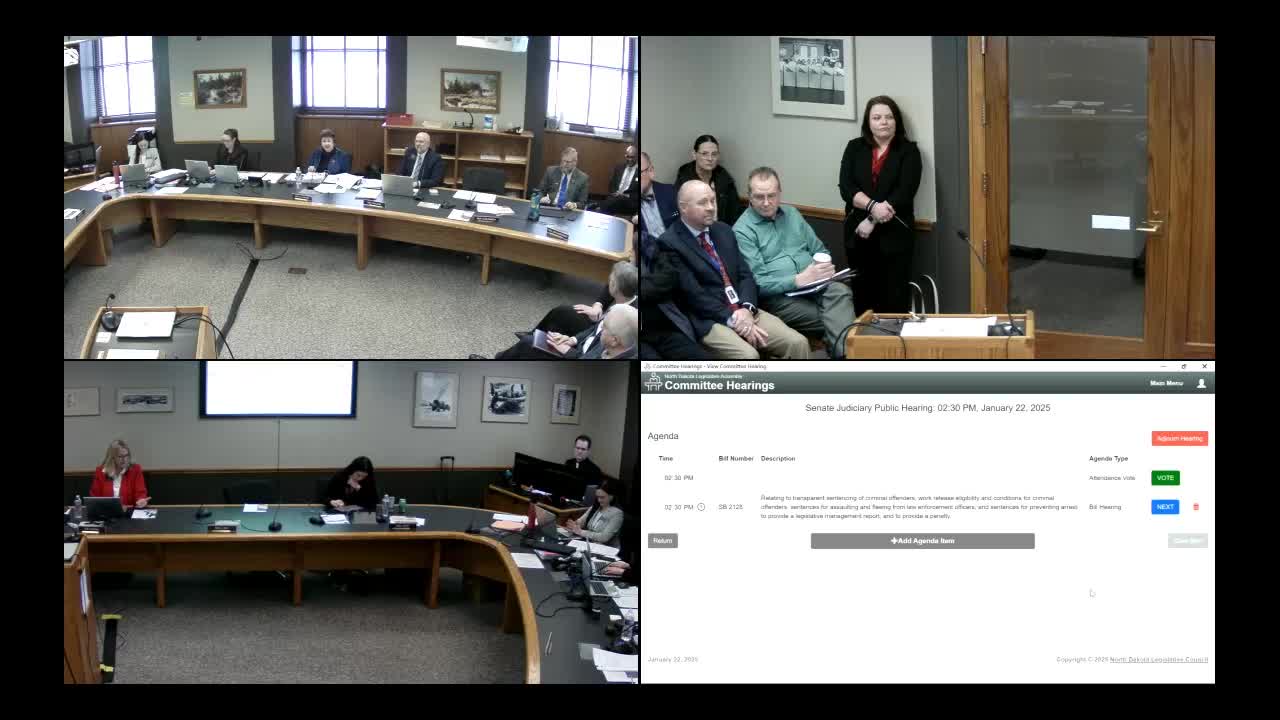
BISMARCK — The Senate Judiciary Committee reopened public hearings on Senate Bill 2128 on a bill that backers described as restoring "truth in sentencing" and opponents said would sharply restrict parole and reduce use of transitional housing and work-release programs.
BISMARCK — The Senate Judiciary Committee reopened public hearings on Senate Bill 2128 on a bill that backers described as restoring "truth in sentencing" and opponents said would sharply restrict parole and reduce use of transitional housing and work-release programs.
The measure, which drew more than a dozen witnesses and more than two hours of testimony on both sides, would change who is eligible for parole and transitional placement and tighten how good-time or earned credit can reduce time behind bars. Attorney General Drew Wrigley urged the committee to move forward, saying the public has been misled about how long people actually serve. "Truth and Sentencing. What we're offering to this committee and to the full legislature is truth in sentencing," Wrigley told the panel. Supporters, including law-enforcement groups, said the bill would ensure judges' sentences are respected and make prison terms more predictable.
Opponents — including corrections officials, reentry providers, defense lawyers and faith- and community-based programs — said the bill would reduce access to transitional facilities and work-release programs that officials say are vital to lowering recidivism and helping people return to stable housing and work. Scott Payton of Prison Fellowship testified in opposition, saying the bill's expansion of mandatory components and reduced early-release credits "risk creating unnecessary barriers to successful reentry while failing to enhance public safety meaningfully." Several witnesses cited national research and state experience they said show longer mandatory incarceration alone does not reduce recidivism.
Why it matters: The committee heard competing claims about public safety, prison capacity and program effectiveness. Department of Corrections and Rehabilitation Director Colby Braun said the bill would force immediate housing changes and significant new costs, while transitional program operators warned of service losses for employers and communities that rely on work-ready residents from reentry centers.
What witnesses said
• Attorney General Drew Wrigley (support): Wrigley said current practice undercuts judges' sentences, producing a system with "precious little predictability." He compared North Dakota to the federal model, noting federal prisoners "can earn up to 15%" of their sentences for program participation and conduct, and argued SB 2128 would bring transparency and "truth" to state sentencing.
• Scott Payton, director of government affairs, Prison Fellowship (opposition): Payton told the committee Prison Fellowship opposes SB 2128, saying mandatory minimums and reduced early-release opportunities would "harden individuals" and make reentry harder. He described Prison Fellowship programming in North Dakota and urged lawmakers to preserve options that combine accountability with rehabilitative opportunities.
• Colby Braun, director, North Dakota Department of Corrections and Rehabilitation (opposition): Braun warned passage would immediately remove placement authority that allows DOCR to send people to transitional facilities. He said on Jan. 9 there were 238 people in transitional beds and that under the bill only eight of those 238 would remain eligible. He testified the state would need substantial additional bed capacity and cited an estimated capital cost scenario that could reach into the hundreds of millions or more.
• Kevin Arthott, administrator, Bismarck Transition Center (opposition): Arthott described programming and case management at the Bismarck Transition Center, which he said currently houses 123 residents (101 in "inmate" status) with a 140-bed capacity. He said the center provides jobs and services to the community and reported that walkaways occur — "I would say we normally it could be 5 walk away a month" — but that staff, employers and law enforcement generally locate and return most absconders.
• Travis Fink, Executive Director, Commission on Legal Counsel for Indigence (opposition): Fink urged the committee to examine 30–40 years of research on truth-in-sentencing policies, which he said tends to show higher costs and mixed or negative outcomes on recidivism. He cited Virginia as a complex example and encouraged members to review academic studies rather than relying solely on press statements.
• Law enforcement associations (support): Stephanie Ingebretsen (Chiefs of Police Association) and Kelvin Benson (North Dakota Peace Officers Association) both asked the committee for a "due pass" recommendation, saying chiefs and many peace officers see the bill as a tool to strengthen public safety and support officers.
• Community providers and reentry advocates (opposition): Adam Martin (FI Project) and other community providers described lives changed by diversion and reentry programs and warned that removing incentives for participation could undercut outcomes. Martin recounted his own pardon and recovery path as an argument in favor of rehabilitation options.
Fiscal and operational details offered to the committee
• DOCR data and estimates: Director Braun testified that transitional placements generated about $100,000 in fines, fees and restitution in 2024 and more than $400,000 in room-and-board revenue for contracted facilities; he said roughly 484 people (about 60% of those granted parole in 2024, per his testimony) were placed into transitional facilities. He also summarized a fiscal exercise using a women's facility cost of $161 million for 304 beds (about $530,000 per bed) and suggested that meeting projected demand under strict truth-in-sentencing might require capital investment measured in hundreds of millions to more than $1 billion over time.
• Transitional-center operations: Bismarck Transition Center officials described daily controls — breathalyzers, patch searches, case managers, employer checks — and said program completion rates are high: Braun said "nearly 80% of inmates who participate in an adult transition program and a transitional facility successfully complete." He said inmates in transitional programs also contributed a paid workforce and local spending.
Points of disagreement among witnesses
Experts and advocacy groups disagreed about empirical effects. Proponents emphasized officer safety, predictability and respecting judicial sentences; opponents cited academic research and state experience they said show mandatory-minimum approaches do not reliably reduce recidivism and can increase institutional misconduct, staffing pressures and overall costs.
Process notes and next steps
The hearing reopened for SB 2128 and concluded with no final vote recorded. Committee members asked for additional data in several areas, including recidivism tracking tied to release pathways and counts of first-time versus repeat offenders. Multiple witnesses urged broader stakeholder collaboration in the months ahead.
Ending note
Lawmakers and witnesses on both sides said they were willing to continue the debate. "This is gonna be a long, engaged process," Attorney General Wrigley said, and several witnesses asked the committee to convene further work sessions to reconcile public-safety concerns with reentry and fiscal realities.