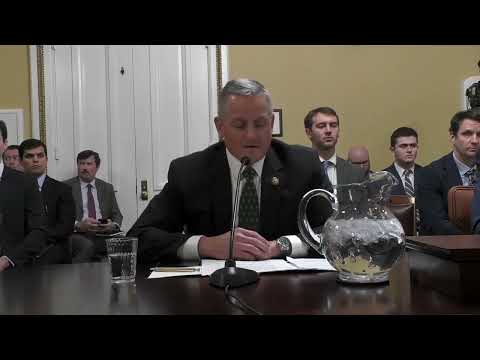
House member urges Natural Resources Committee to advance Fix Our Forest Act to speed forest treatments
Get AI-powered insights, summaries, and transcripts
SubscribeSummary
An unnamed House member told the House Natural Resources Committee that the Fix Our Forest Act would shorten approval timelines for forest management projects, prioritize high-risk areas and create an interagency program to streamline grants and repayment to local fire departments.
An unnamed Representative, speaking to the House Natural Resources Committee, urged the panel to report a rule that would allow the Fix Our Forest Act to reach the House floor, saying the bill would speed up forest treatments and help prevent catastrophic wildfires.
"It does not waive a single environmental law," the Representative said, adding the bill would make existing tools more flexible so work can happen "when the sky is blue, not when it's orange and fire is on the doorstep." The speaker described the measure as a bipartisan package that uses science to prioritize treatment near communities at higher risk.
The speaker cited recent wildfire impacts while urging action: "These fires have claimed the lives of 28 people. They've destroyed over 15,000 structures and the estimated damages right now are $250,000,000,000." He said since the bill last passed the House on Sept. 24 of the previous year, another 1,500,000 acres have burned across the United States.
According to the speaker, the bill would identify the top 20% of "fire sheds" and prioritize treatments near communities most at risk. He said the legislation expands categorical exclusions so that some projects would require far fewer individual clearances — offering the example that treating an area roughly the size of the Palisades fire would currently require eight separate categorical exclusions but would require two under the bill.
The bill, the speaker said, would also: create an interagency community wildfire risk reduction program to consolidate federal programs and standardize grant applications for community wildfire defense funds; encourage technological innovations for faster detection and response; and standardize repayment timelines between local fire departments and the federal government to aid local first responders.
The Representative said he and "my good friend from California, Representative Scott Peters," negotiated the measure in good faith for more than a year and incorporated ideas from members of both parties. He noted the bill passed the House on Sept. 24 of last year, passed a Natural Resources Committee markup last year by voice vote, and that this year it has 17 Democratic cosponsors. "Forest management should not be a partisan issue," he said.
The remarks in the transcript are a request that the committee report a rule to allow House consideration; no formal committee vote or other final action on the bill was recorded in the provided transcript excerpt.
The speaker closed by asking the committee to act so the bill can be considered on the House floor and yielded back to the chair.