Get Full Government Meeting Transcripts, Videos, & Alerts Forever!
Get email alerts on the Property Tax System topic
No spam. Unsubscribe anytime.
House Tax Committee briefing outlines Minnesota property tax structure, classification system and state levy
Summary
House Research legislative analyst Jared Swanson briefed the House Tax Committee on Minnesota’s levy-based property tax system, classification rates, net tax capacity and the state general levy, and placed the tax in the context of the state–local fiscal relationship dating to the 1971 “Minnesota Miracle.”
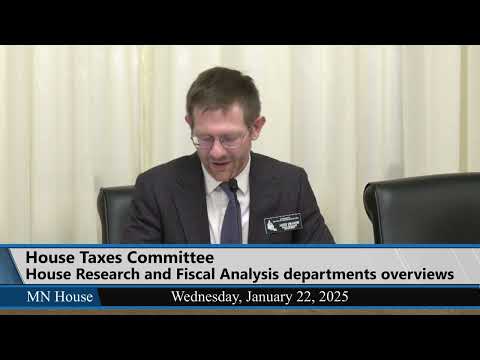
Chair Davids opened the House Tax Committee and asked Jared Swanson, legislative analyst, House Research, to present an overview of Minnesota’s property tax system.
Swanson said property taxes accounted for about 26% of state and local tax collections in fiscal year 2024—roughly $12 billion of approximately $46.5 billion in state and local taxes—and that the state general property tax levy totaled about $759 million in 2024. He described Minnesota’s levy-based system, in which local jurisdictions set a dollar levy that is allocated across properties based on each property’s share of the tax base and collected by counties on behalf of local taxing units.
The presentation explained two taxable bases: referendum market value, used primarily for school operating referendum levies and accounting for about 13% of property taxes, and net tax capacity (NTC), the principal base used by counties, cities, townships, school districts and special taxing districts. Swanson described NTC as market value less exclusions (for example, homestead market value exclusion and disabled-veterans exclusion) multiplied by classification rates. He noted Minnesota uses an unusually large number of classification tiers—“somewhere between 50–60” unique classifications—and described a common homestead tier in which value up to $500,000 is taxed at 1.00% and value above that at 1.25%.
Swanson summarized the practical effect of classification rates: lower classification rates shift tax away from a property type and raise it on property types with higher class rates. In Minnesota that shift tends to reduce the residential and agricultural shares and increase the commercial, industrial, public utility and apartment shares of net tax capacity. Counties collect taxes and distribute them to recipients; roughly 30% of property tax dollars go to counties, 30% to cities and about 30% to school districts, with special taxing districts and the state general levy making up the remainder.
The briefing placed today’s arrangements in historical context. Swanson said the state–local fiscal relationship changed substantially with the 1971 reform commonly called the Minnesota Miracle, when the state increased aid to local governments and schools and relied on higher state income and sales tax revenue to reduce local reliance on property taxes. Representative Anderson asked whether Minnesota’s reliance on income taxes explained greater fluctuation between surplus and deficit years; Swanson and committee members discussed that state-level revenue volatility affects local aid funding.
Chair Davids closed by noting committee follow-ups and that later presentations would cover tax increment financing and additional property tax relief mechanisms.