Get Full Government Meeting Transcripts, Videos, & Alerts Forever!
Get email alerts on the Hb1019 Parks Recreation topic
No spam. Unsubscribe anytime.
Parks and Recreation seeks millions in SIF, staffing and infrastructure funds in House Bill 1019 hearing
Summary
North Dakota Parks and Recreation Director Cody Schulz told the Appropriations — Education & Environment Division that HB1019 requests SIF and general fund dollars for storm‑shelter comfort stations, deferred maintenance, Wi‑Fi and park automation, new and converted FTEs, grants to locals and improvements at the International Peace Gardens.
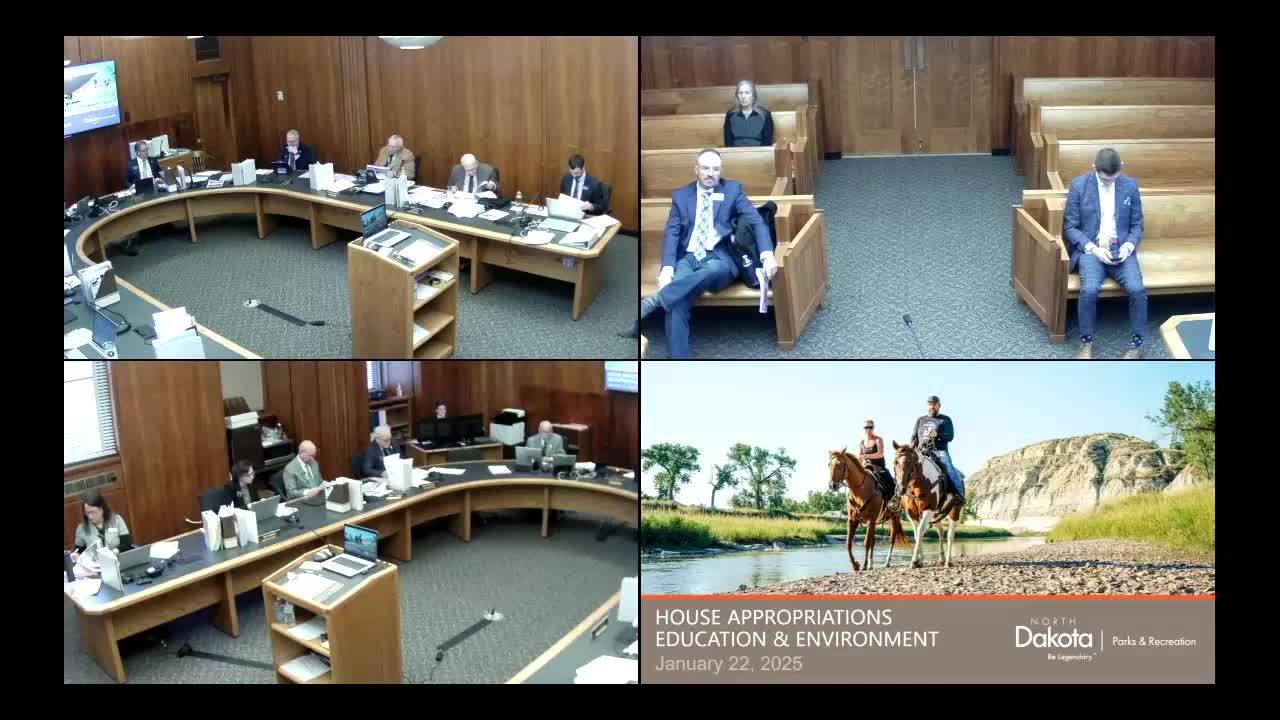
The Appropriations — Education & Environment Division opened and heard House Bill 1019 on Parks and Recreation, where Director Cody Schulz laid out a package of one‑time and ongoing requests that, if approved, would fund storm‑shelter comfort stations, deferred maintenance, park automation and staffing changes.
Schulz told the committee the first one‑time line item is $924,000 intended as state matching funds for comfort stations that could be engineered to serve as FEMA‑eligible storm shelters. "We're cautiously optimistic that we'll receive that funding and that buildings could be dual use," Schulz said, adding FEMA would cover roughly 75% of the cost if the buildings meet shelter standards. Schulz and staff said the $924,000 would be the 25% state match on an approximate $2.75 million project total; staff indicated the money is currently presented to the committee as a SIF‑eligible request and could also be eligible from the disaster relief fund.
Schulz then reviewed staffing and position proposals. The agency asked for two new FTEs at a combined cost of $382,962 from general fund dollars, likely to be placed at Pembina Gorge State Park and at Roughrider (near Medora) as construction and expanded operations come online. He also requested authority and funding to convert nine "year‑round temporary" employees into full FTEs; the conversion carry‑cost for the nine positions was $269,900 in general funds, primarily to cover retirement and benefit differentials. Schulz said the agency currently employs about 20 year‑round temporary staff and that conversions are intended to reduce turnover and stabilize operations.
On capital needs, Parks and Recreation requested:
- $15,000,000 SIF for deferred maintenance and capital projects, described as part of a roughly $74,000,000 deferred‑maintenance backlog covering roads, marinas and vertical infrastructure. Schulz asked the committee to permit flexibility in legislative intent language so funds could be used for operationally sensible, proximate solutions (for example, purchasing a building near a floodplain park that cannot host a shop on site).
- $2,500,000 SIF for matching grants to counties, cities and tribes to support local infrastructure; the agency said recipients would be required to provide dollar‑for‑dollar local matches. In prior rounds the agency said demand exceeded available funding by a wide margin.
- $3,650,000 SIF to expand Wi‑Fi across park properties and $500,000 ($250,000 general fund / $250,000 park operating fund) for equipment life cycle replacement. The agency told the committee construction costs are covered in the Wi‑Fi line, while recurring service fees would run approximately $100,000 per year (about $200,000 per biennium), a figure the agency said it could provide in more detail.
- $10,000,000 SIF to establish an Outdoor Fine Arts Venue Improvement Grant program for local operators of outdoor performance venues; the department said it would work with the committee to define eligibility criteria and legislative intent.
Schulz also described two International Peace Gardens requests that flow through Parks and Recreation: $1.5 million SIF for HVAC, water‑heater and dining‑hall/dorm upgrades and $1.0 million SIF for sewer upgrades. Parks staff said the state has historically required Manitoba to match appropriations to the International Peace Gardens and asked for explicit legislative intent language on whether Manitoba’s match should be measured at an exchange rate at the time of payment or by another standard. Representatives raised fairness questions about exchange‑rate treatment and asked staff to draft language for committee consideration.
The department said it expects some sovereign‑lands permitting and permitting coordination with the Department of Water Resources on a separate Bismarck project; staff said the original appropriation for related work flowed through Commerce and Water Resources and that roughly $750,000 of a previously authorized $2,000,000 remains tied to the Bismarck project, with about $1.4 million of the $2.0 million available after reimbursements for other projects.
Throughout the hearing legislators asked for more detail on project lists and line‑item breakdowns for the Armstrong and Burgum budget proposals; staff said some Armstrong‑era items were consolidated in the handouts because of timing. Representative Lee Richter and others pressed the agency on the locations for comfort‑station storm shelters (Schulz said the priority list includes Icelandic State Park, Fort Ransom State Park, Lewis and Clark, and Fort Stevenson State Park) and on the agency’s seasonal hiring challenges.
Business services chief Jeff Indovina explained equipment disposition and surplus proceeds: for large equipment Parks and Recreation typically gets trade‑in value from dealers; when items are sold through surplus the agency receives 90% of the sale if the equipment sells for more than $1,000, with 10% retained by surplus.
No vote was taken. Representative Sanford indicated he will follow up with Parks and Recreation and staff to review language and data; the chair closed the hearing later that day.