Get Full Government Meeting Transcripts, Videos, & Alerts Forever!
Get email alerts on the Life Skills Transition Center topic
No spam. Unsubscribe anytime.
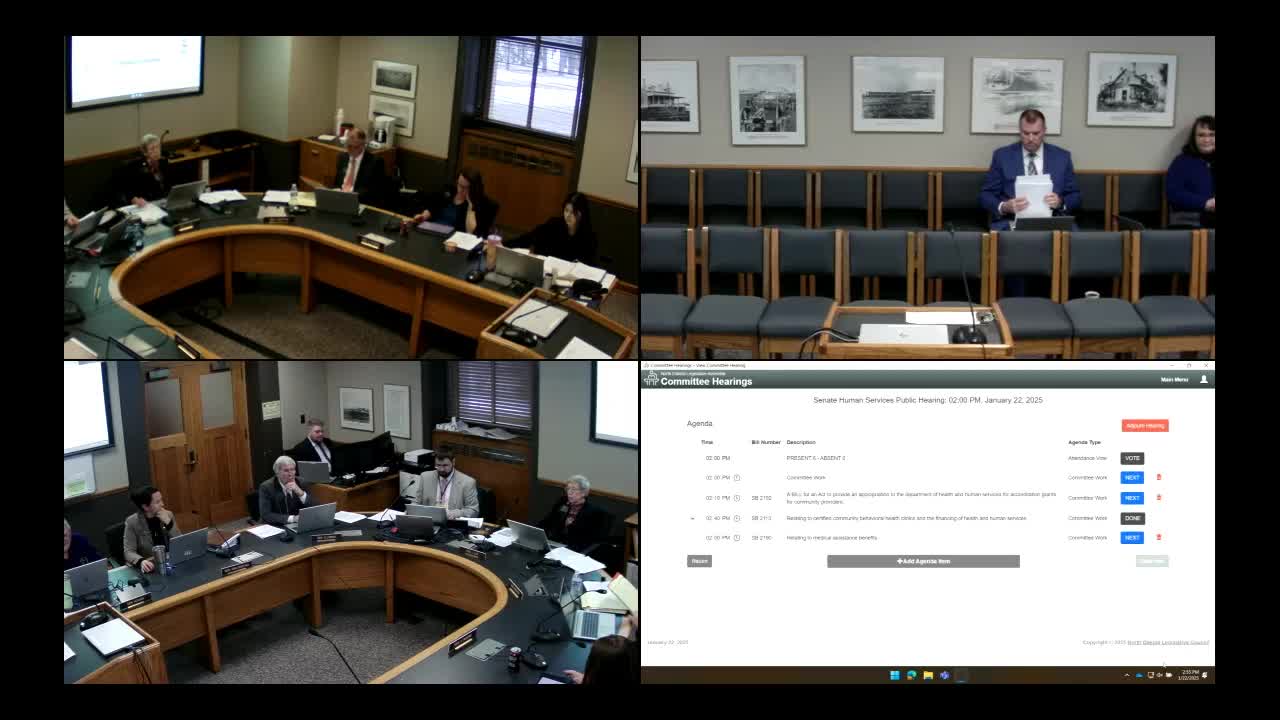
Senators discuss temporary use of life-skills center for hard-to-place youth, ask for data and time-limited authorization
Summary
Committee members and local zone directors discussed using a state life-skills and transition center as a temporary placement for youth with severe behavioral needs, and senators proposed time-limited authority and regular reporting to collect data and shape long-term solutions.
Senators and local human services officials discussed a short-term use of the state-operated Life Skills and Transition Center as a placement option for youth who are hard to place in foster care or community settings and called for a time-limited authorization and regular reporting to evaluate the approach.
Kim Jacobson, director of the Agassi Valley Human Service Zone and president of the Zone Directors Association, told the committee the center has been used to place youth the system had difficulty placing elsewhere and that the program reported positive outcomes for children placed there. "We have had a number of youth that are in the foster care system placed there since that time. And we're happy to report we've had really good outcomes," Jacobson said, adding that the center has the staffing and clinical capacity to provide 24-hour care while zones work to find durable placements.
Committee members and zone officials said some youth present with high needs — aggressive behavior, low cognitive functioning, or safety risks — and that, absent appropriate placements, those children have at times been kept in hotels or county offices for weeks. A committee member noted the facility had treated and released 12 individuals so far, a figure Jacobson cited as an example of outcomes to date.
Senator Hogan circulated a draft amendment that would authorize temporary use of the life-skills center for a two-year period, require semiannual reports to the legislature on the number of children referred and served (residential and nonresidential), and ask the department for a two-year plan to develop community-level alternatives. "I have a draft amendment which I showed to you...this authorization would end in in 2 years, but that add a whole new section at the end of the bill that every 6 months, DHHS would provide to legislative management human service committee the number of children referred and or served," Hogan said.
Department and zone directors cautioned the committee about federal confidentiality restrictions that limit the detail that can be published about individual children; department staff said they could provide de-identified trend information and statutory recommendations while keeping protected data private. "We can look at doing de-identified report back information," a department staffer said, noting that small population sizes can still make de-identification difficult.
Committee members asked for additional detail in the proposed reporting — geographic origin of referrals, whether youth were tribal, urban or rural, and reasons prior facilities denied placement — to help target future resources and decide whether more permanent community-based options are needed. Jacobson offered to help draft reporting elements that would be useful to zones and the Legislature.
No formal committee action was taken; senators directed staff and stakeholders to collaborate on amendment language, data parameters that protect confidentiality, and a plan to present a draft amendment and supporting materials at the committee's next meeting.