Get Full Government Meeting Transcripts, Videos, & Alerts Forever!
Get email alerts on the Crisis Services topic
No spam. Unsubscribe anytime.
Human service centers describe limits of evening mobile crisis coverage; law-enforcement partnerships used to fill gaps
Summary
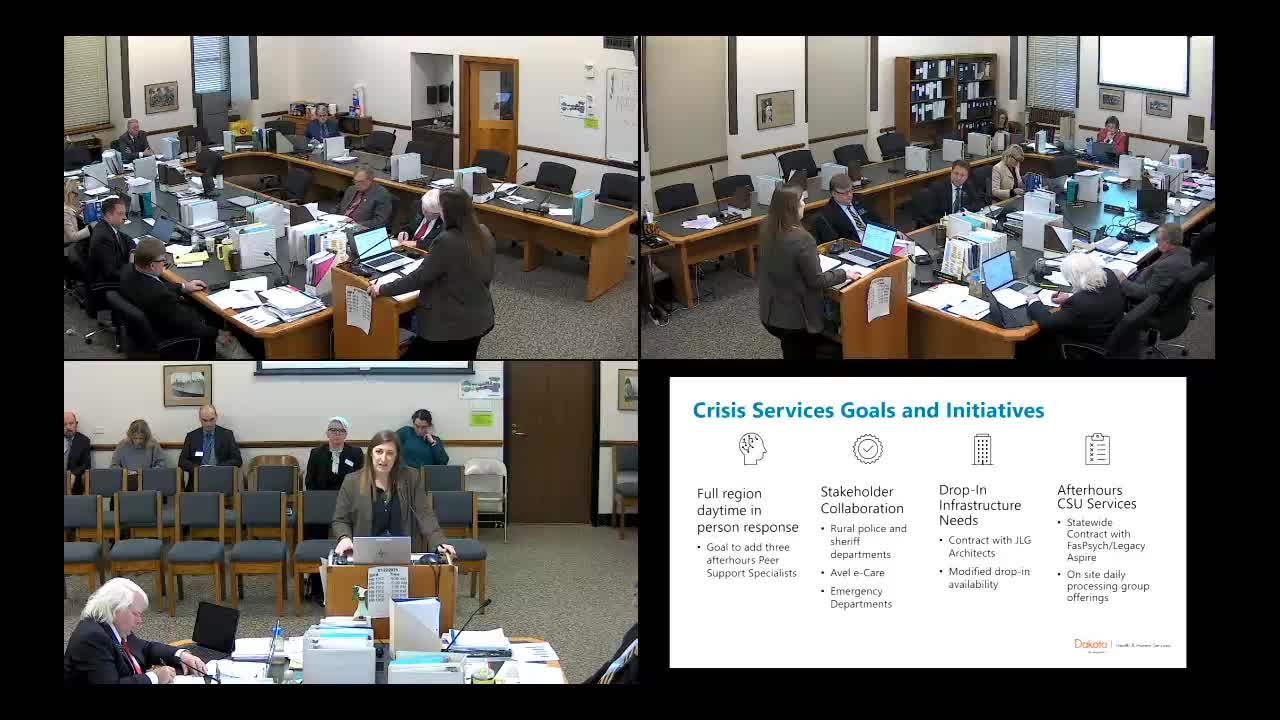
Presenters told the Appropriations Committee mobile crisis teams can cover their regions by day, but night coverage beyond local areas is constrained by staffing and travel time. Centers said they rely on Veil/Eval partnerships with law enforcement and regional collaboration to handle rural calls.
Directors representing multiple human service centers told the Appropriations Committee that daytime mobile crisis coverage is robust in most regions but after-hours coverage beyond a local radius is limited by staffing and travel time.
Elena Zeller of Southeast said the center "responds fully to the region during the day" with a sizable crisis team but is "limited at night" because night staffing rotates and putting a worker on a 45‑minute to one‑hour drive would reduce coverage for the busier Fargo metro area. She said Southeast has partnered with Veil E‑Care and local sheriffs to address rural after‑hours needs.
Jessica Oderman, Badlands regional director, described the center's crisis drop‑in infrastructure as partially constrained by space and said the region can respond during the day across its territory but has limitations at night for broad outreach. She noted plans to hire three peer support specialists to work nights alongside rotating nighttime clinicians so two staff would be on call together.
Jeff McKinnon of Northeast described successful VEL ECARE rollouts with county sheriffs and local police; Northeast staff said dispatch and hospital relationships aided responsiveness and that local partnerships allow handoffs when mobile teams cannot travel long distances.
Directors said practical responses include collaborative triage among centers, using telehealth to prioritize imminent needs, and placing peer support or clinician staff in strategic locations to reduce travel burdens. Several directors said that expanded CCBHC funding and strengthened law‑enforcement partnerships improve after‑hours reach but do not fully substitute for additional nighttime clinical staff.
Why it matters: Crisis response determines immediate safety for people in acute behavioral health crises. Multiple presenters told lawmakers that after‑hours staffing limits force tradeoffs between regional reach and covering high‑demand metro areas.
Committee members asked what options exist to improve coverage; presenters urged a mix of peer supports, telehealth, and stronger provider funding to maintain rural outreach.