Get Full Government Meeting Transcripts, Videos, & Alerts Forever!
Get email alerts on the Education topic
No spam. Unsubscribe anytime.
Senate panel advances bill widening Career Builders, ties need-based aid to tuition cap
Summary
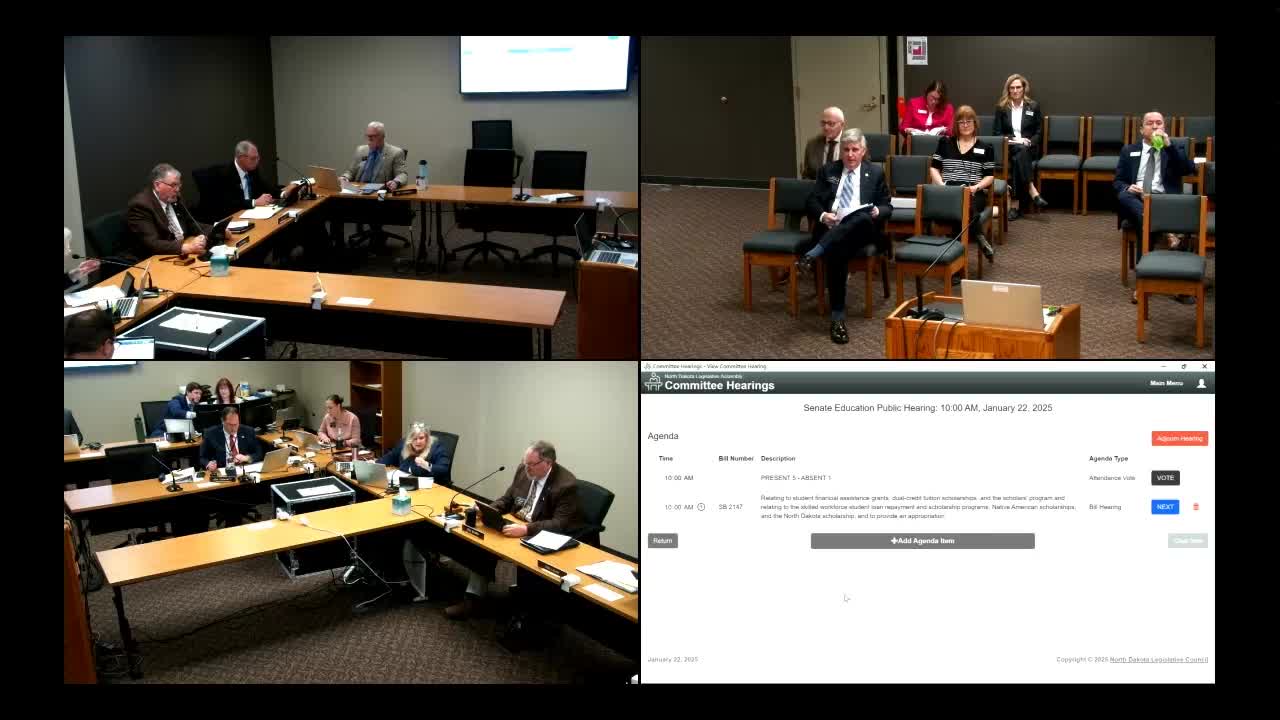
The Senate Education Committee voted 6-0 to give Senate Bill 2147 a ‘do pass’ recommendation to appropriations, approving changes to the Career Builders scholarship and loan-repayment program and creating a supplemental state grant tied to the highest in-state tuition rate.
BISMARCK, N.D. — The Senate Education Committee gave Senate Bill 2147 a unanimous do-pass recommendation Thursday, sending the bill to the Appropriations Committee with a $12.2 million appropriation that would fund changes to the state’s Career Builders program and create a supplemental need-based grant.
The bill would (1) amend the Career Builders scholarship and loan-repayment program—used to recruit and retain workers in designated in-demand occupations—by allowing workers who live within 50 miles of North Dakota but work in the state to qualify, clarifying private-sector donor language, and limiting repayment exposure for recipients; and (2) create a supplemental state grant that would fill tuition gaps for Pell-eligible, low- and middle-income resident students up to the highest in-state tuition rate.
Supporters described the changes as a mix of technical fixes and two substantive revisions intended to increase program uptake and better meet workforce needs.
Sen. Jonathan Sickler, Senate District 17, who testified in favor of the bill, said the legislation grew out of interim work to consolidate and streamline multiple scholarship and aid programs. "There are two main changes being made to two existing scholarship and financial aid programs," Sickler said, describing Career Builders and the supplemental grant as the bill’s primary elements.
Brenda Zastipold, financial aid director for the North Dakota University System, told the committee the bill adds clarifying and administrative language across multiple scholarship programs and establishes the supplemental award to help state grant recipients whose Pell grant and state grant together do not fully cover tuition. "The supplemental award may only be issued if the student is first issued a state grant and if total family income does not exceed $80,000," Zastipold said. She said the award would be limited to fall and spring semesters and capped at the highest tuition rate in the North Dakota University System.
On Career Builders, Sickler and Zastipold said the bill would allow greater flexibility for employers that match student aid or loan-repayment contributions and would adjust repayment mechanics so a recipient who received a total of $1 would not face a repayment obligation of more than $1. Sickler summarized the change this way: if a student receives a dollar in total, "they only have to put a dollar in reimbursement back." Zastipold said the Bank of North Dakota assists with collections when recipients fail to meet their service commitments.
Officials provided program data during testimony. Zastipold reported that in the 2023–24 year state-funded financial aid included 13,093 awards totaling $25,600,000 to North Dakota resident students attending in-state institutions, and 233 loan-repayment awards totaling $3,400,000. She said a five-year average of 6,329 students received the state need-based grant and that a sample evaluation showed about 2,426 state grant recipients still had a tuition gap that the supplemental grant would address; the modeled biannual cost for that supplemental program was $12.1 million, reflected in the bill’s appropriation.
Business and higher-education stakeholders including the Greater North Dakota Chamber, the National Federation of Independent Business in North Dakota, the Bank of North Dakota, the North Dakota Hospital Association, and Sanford Health offered testimony in support, with speakers saying the bill would help employers recruit and retain workers in health care, education and trades. Kelvin Hollett of the Bank of North Dakota described a technical change the bank requested to enable Dollars for Scholars funds to pair with Career Builders scholarships without requiring the private scholarship to be repaid when a repayable state match is collected.
Committee members discussed the 50-mile eligibility expansion for workers who live out of state but work in North Dakota. Some members said they were initially cautious about allowing eligibility to extend outside state lines but said the 50-mile limit mitigates concerns about unbounded expansion.
Sen. Jordan Axman moved a do-pass recommendation and to refer the measure to appropriations; Sen. Moshé seconded. The committee opened and closed the electronic vote; the clerk recorded six yays, zero nays. The committee also named Sen. Axman as bill carrier should the bill return from appropriations unchanged.
The bill now advances to the Senate Appropriations Committee for further consideration of the $12,200,000 biennial funding request.
Details from the committee record include program counts, repayment practices, and the appropriation; specifics about implementation, statutory citations and any detailed collection procedures were described as handled administratively (Bank of North Dakota collections) and by agency practice rather than as new statutory mechanisms in the bill itself.