Get Full Government Meeting Transcripts, Videos, & Alerts Forever!
Get email alerts on the Charitable Gaming Enforcement topic
No spam. Unsubscribe anytime.
Panel approves bill to let attorney general fine gaming sites instead of only suspending licenses
Summary
House Bill 1253 would allow the Office of the Attorney General to impose fines on owners of authorized gaming sites in addition to or instead of suspending site licenses for violations; the committee gave the bill a do‑pass recommendation after testimony from industry and site owners.
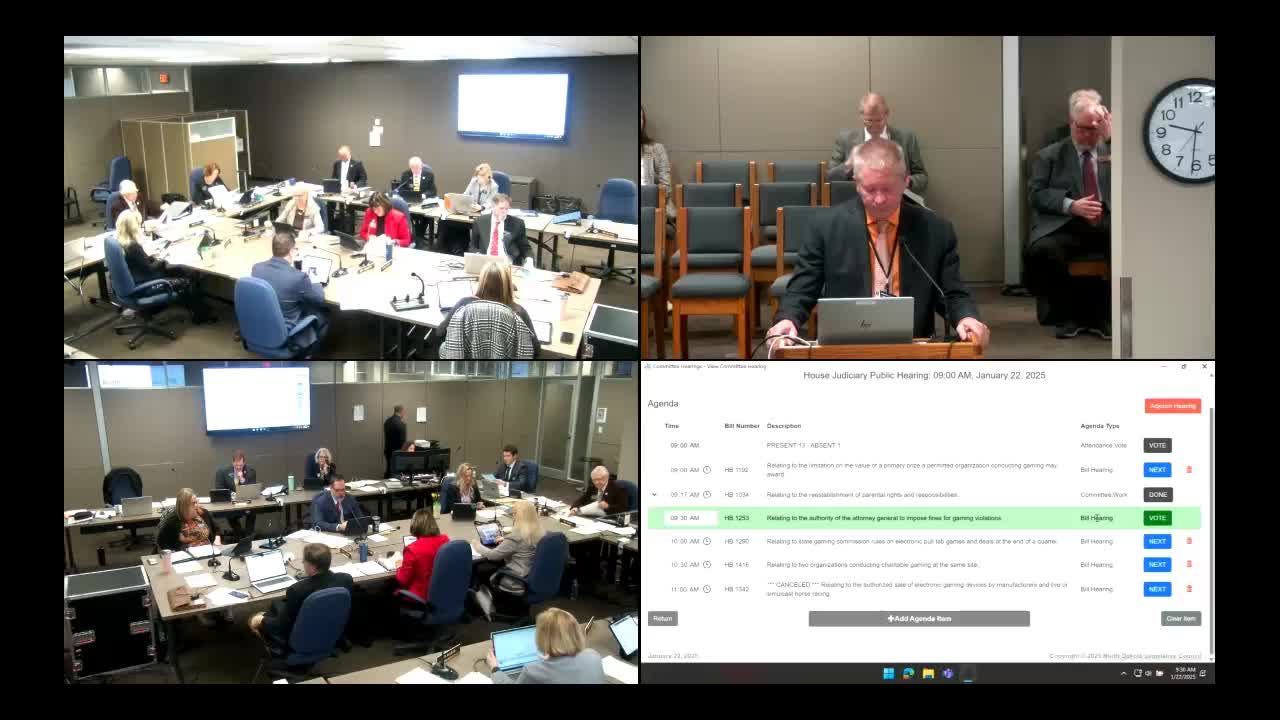
Bismarck — The House Judiciary Committee voted to advance House Bill 1253, which would give the attorney general’s office additional enforcement options for charitable gaming‑site violations.
Under current law, committee witnesses said, regulators can suspend a site’s authorized gaming at a location for one year but lack a flexible fine option targeted at the site owner. Proponents said the one‑size‑fits‑all suspension penalty can be excessive for minor infractions and can unfairly punish charities that partner with sites.
Jim Green Knight introduced the measure and described it as providing enforcing agencies an intermediate sanction — the ability to levy fines — so the most severe penalty (a one‑year suspension) would not be the only enforcement option. Scott Meske of the North Dakota Gaming Alliance and Rudy Martinson of the North Dakota Hospitality Association supported the bill, saying it provides regulators needed flexibility.
Committee members asked about the intended scope (whether the fine authority would apply only to sites or also to manufacturers/distributors or charities). Witnesses and the bill sponsor said the primary intent was to add site owners to the list of entities subject to fines and to ensure regulators could target the responsible actor. Members also sought examples of violations that might trigger fines; witnesses deferred to the attorney general’s office for specifics but mentioned possible issues such as employee play when prohibited or missing cash from machine banks.
The committee adopted a do‑pass recommendation; the roll call vote was 14–0. Representative Vetter agreed to carry the bill to the floor.