Get Full Government Meeting Transcripts, Videos, & Alerts Forever!
Get email alerts on the Minot Flood Control topic
No spam. Unsubscribe anytime.
Service River Joint Board outlines scope and inflation pressures for Minot flood project
Summary
Service River Joint Board leaders told the committee significant construction‑cost increases and limited contractor interest have pushed bid prices 40–50% above 2022 estimates; the board said $76.1 million was previously allocated but that rising costs could extend completion by more than a decade without additional funding.
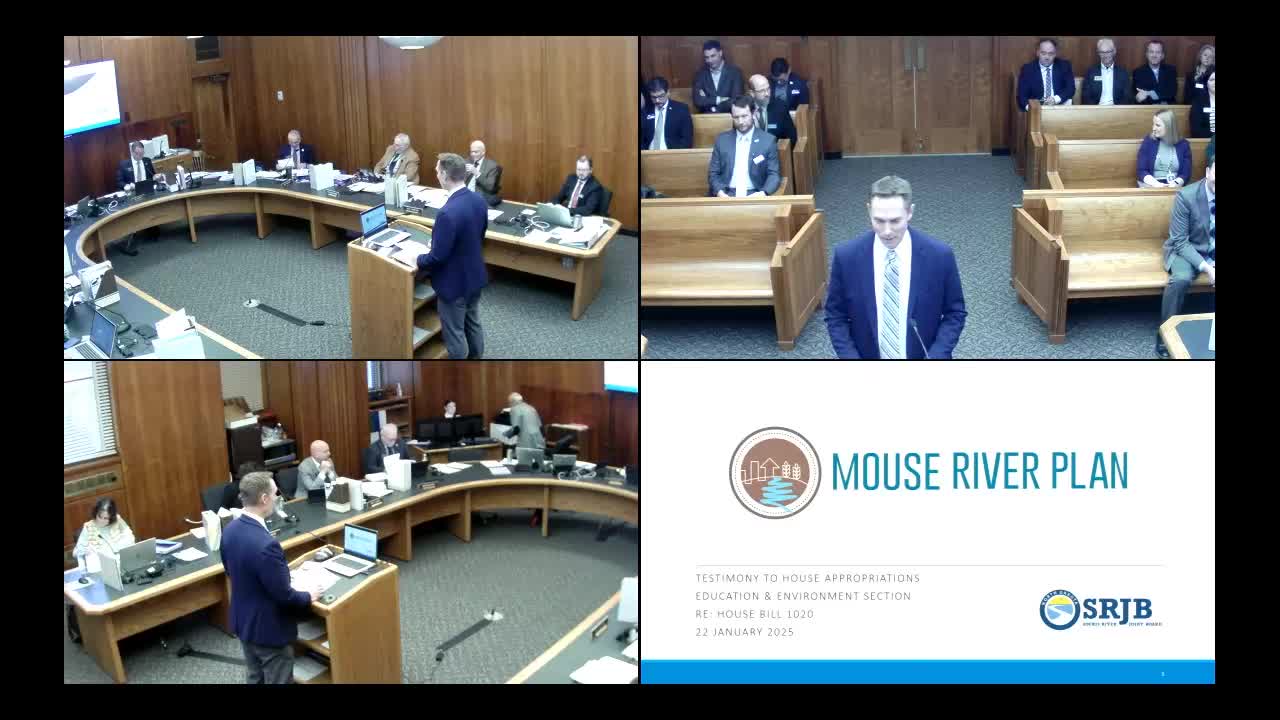
Officials with the Service River Joint Board (the Minot basin flood authority) updated the Appropriations - Education and Environment Division on the Maas/Moos River (Minot basin) flood control program and warned of sharp construction‑cost escalation and thin bidder pools that threaten project timelines.
David Ashley, chairman of the Service River Joint Board, reminded the committee of the scale and history of the program: “This summer will mark 14 years since the 2011 flood devastated our region,” he said, and added the joint board coordinates work among four counties, the City of Minot, the U.S. Army Corps of Engineers and federal partners. Ashley told the committee the joint board has received significant earlier legislative support and the group has advanced multiple construction milestones.
Ashley and other presenters told lawmakers the joint board had $76.1 million allocated in the current biennium: about $63.35 million for joint‑board construction, engineering and acquisitions outside Minot and $9.7 million for acquisitions inside the City of Minot. Construction of some phases (MI6, MI7) is partly under way and another component (MI4) is funded with Corps of Engineers money but awaits project actions; when the full set of milestones is complete the board projects removing roughly 60% of valley residents from the FEMA regulatory floodplain.
The board presented recent bid results showing much higher prices than earlier estimates — the lowest recent bids for several phases were 40–50% higher than comparable 2022 bids. The presentation flagged large increases in concrete and pump‑station pricing, and noted multiple bid rounds for some items produced no bidders for required bridges. Ashley said the joint board has re‑packaged contracts and rebid packages to attract bidders, with limited success, and is re‑evaluating program scope and phasing to reduce cost exposure.
Committee members asked about funding scenarios to avoid a protracted schedule. Ashley said one scenario assumed continued biennial funding at $76.1 million, which would stretch the program out into the 2040s and add substantial inflationary cost. A more aggressive scenario would provide larger state appropriations up front (examples discussed to illustrate tradeoffs) so the project could be bonded and accelerated; board staff offered to run bond‑and‑cash scenarios for the legislature to show costs and schedule tradeoffs. Ryan Ackerman, joint‑board financial administrator, confirmed staff could model 2‑, 3‑ and 5‑year bond scenarios and provide rough savings estimates.
Ashley said some phases could begin construction in 2026 and that partial completion of milestones could be possible in the late 2020s, but that full program completion depends on funding and contractor availability. He defended the program’s design standard (flood of record, a 20,774 cubic feet per second design noted in testimony), saying the U.S. Army Corps and joint board judged the flood‑of‑record design the best way to protect urban areas and to enable basin‑level operational management.
Ending: The joint board asked the committee to weigh more aggressive up‑front funding to limit the multi‑decade effects of inflation and contractor scarcity; staff committed to return with financial models showing the savings and schedule speed‑ups from possible bonding or larger appropriations.