Get Full Government Meeting Transcripts, Videos, & Alerts Forever!
Get email alerts on the Flood Protection Bismarck topic
No spam. Unsubscribe anytime.
Bismarck seeks state funds to complete South Bismarck flood project after FEMA award
Summary
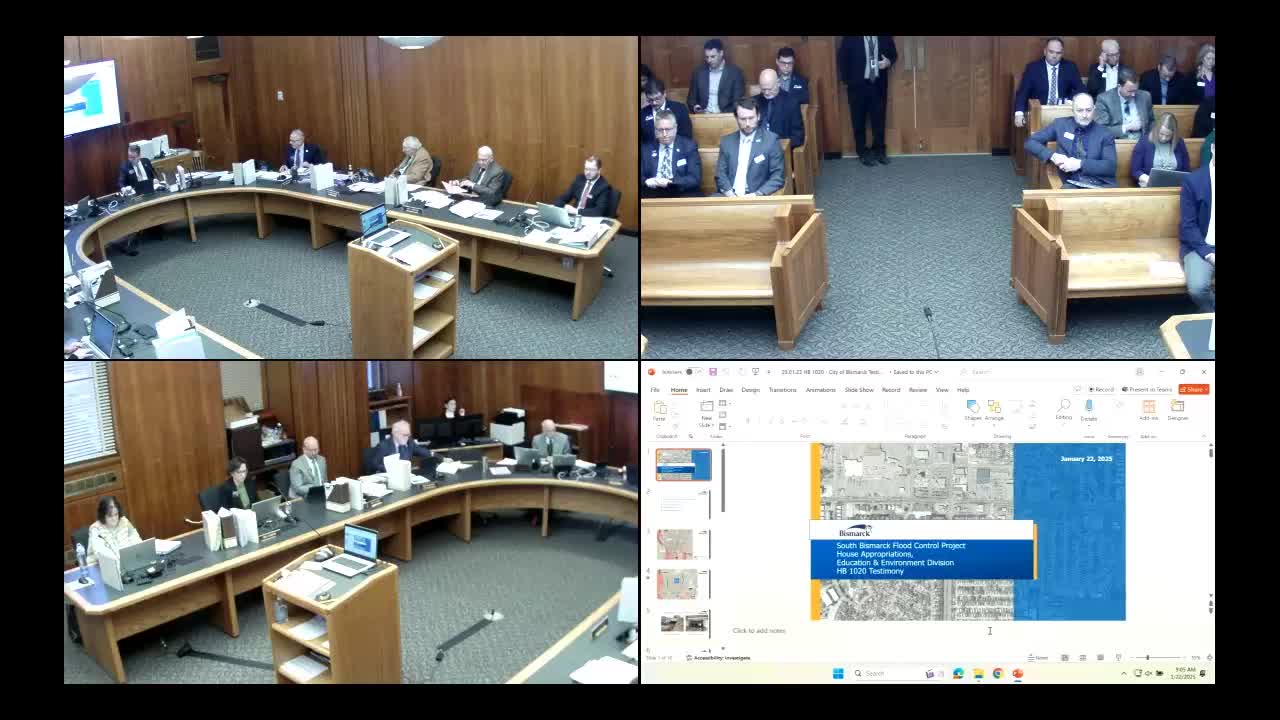
Bismarck city officials told the Appropriations - Education and Environment Division on Oct. 20 that a $50 million FEMA grant and city contributions leave a funding gap for a South Bismarck flood project that the city says would remove about 950 structures from mandatory federal flood insurance maps.
Bismarck city officials told the Appropriations - Education and Environment Division on Oct. 20 that they have secured a $50 million FEMA Flood Mitigation Assistance (FMA) grant for a South Bismarck flood‑mitigation project but still need state and local money to finish construction. Greg Zinker, a Bismarck City commissioner, said the award clears a major hurdle and that city engineers have identified roughly 950 structures newly mapped into the floodplain.
The project aims to bring the city’s South Washington closure structure and associated conveyance up to FEMA standards so the agency will remove those properties from the 1%‑annual‑chance floodplain and eliminate the federal flood‑insurance requirement for qualifying homeowners. “We cleared the FEMA hurdle… and were awarded a grant,” Zinker told the committee, noting the map change has large effects on underserved neighborhoods in South Bismarck.
City engineer Gabe Schell described the technical approach: improve conveyance in the existing South Bismarck drainage ditch, upgrade crossings and the South Washington closure structure, add on‑site pumping capacity, and add a second component that intercepts drainage near Bismarck Expressway and conveys it to a new outfall to the Missouri River. Schell said the combination would lower the mapped 100‑year flood elevations so FEMA would accredit the protection.
Schell provided the committee the project cost estimate used in the FEMA application: $172 million total (construction, engineering, right‑of‑way and mitigation). The current funding package shown to the committee includes $50 million from FEMA, roughly $49 million local cost committed by the city, and a $73 million request to the state’s updated water development plan for the 2025–27 biennium. FEMA’s award is reimbursement‑based and is capped; the city has three years from the award date to spend awarded funds and expects to request extensions if needed.
Schell told lawmakers the city is working with the North Dakota Department of Emergency Services (DES) (the state pass‑through for FEMA) and federal delegations’ offices on discretionary grant letters of support. He described a schedule that keeps final design in 2025–26, a fall 2026 bid target, and multi‑year construction beginning in 2027 and extending into 2028–29 depending on phasing and contractor availability.
Committee members pressed the city on local share and timing. Schell said no final local funding decisions have been made; options discussed include a combination of state grants, local sales tax, special assessments, storm‑water utility contributions or other local revenues. He emphasized the city’s commitment to match FEMA funding and said the certainty of state funding will influence contract‑award timing and public outreach.
City officials also noted non‑insurance benefits in benefit‑cost calculations: in their FEMA application they estimated about $278 million in benefits (including physical and social benefits) and said FEMA requires a benefit‑cost ratio above 1. The city stressed the FEMA certification steps are staged — initial modeling, design approval, construction and post‑construction certification — and that the city coordinated each step with FEMA to avoid construction that FEMA might later reject.
The city asked the committee to consider the state share request in the Office of Management’s water development plan so the project can go out to bid with assurance of funding.
Ending: Bismarck provided a project website and a story map for committee members and the public; officials emphasized urgency because the FEMA grant award carries a three‑year expenditure timeline and because construction inflation and limited contractor capacity could raise costs if the project is delayed.