Get Full Government Meeting Transcripts, Videos, & Alerts Forever!
Get email alerts on the Problem Gambling Funding topic
No spam. Unsubscribe anytime.
Committee sends expanded gambling-disorder funding bill forward after supporters cite rising treatment demand
Summary
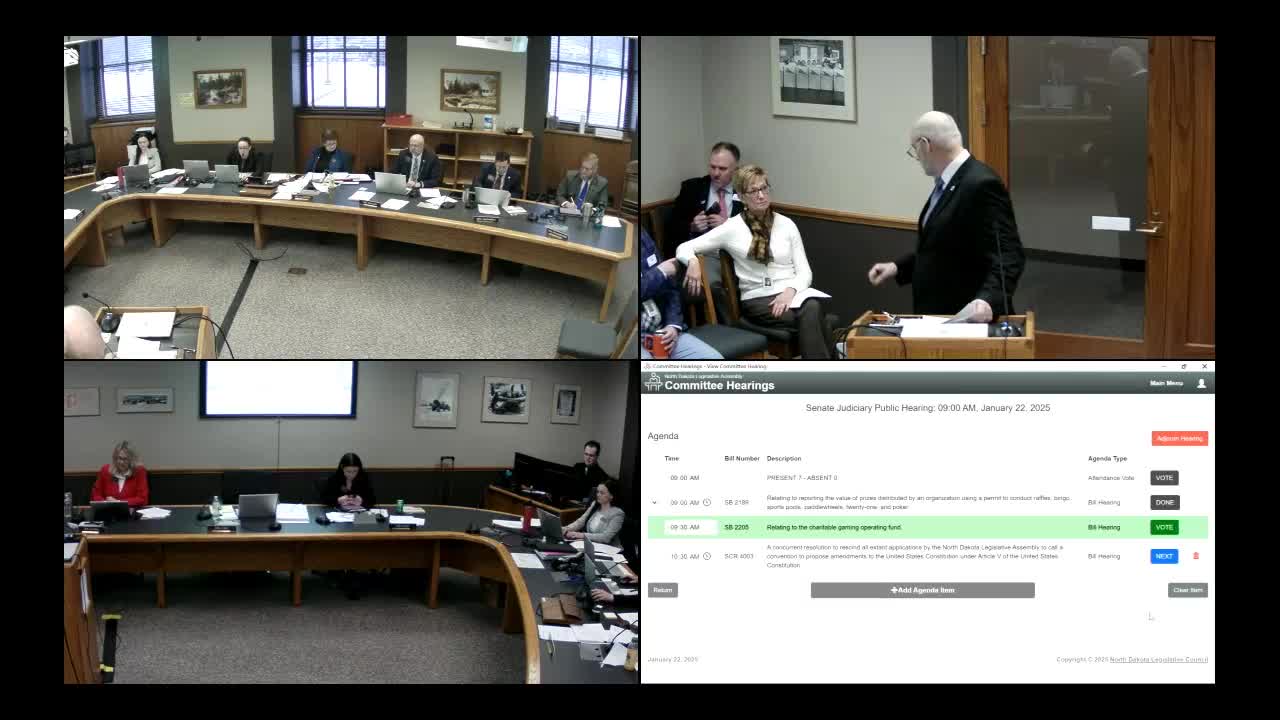
Senate Bill 2205, to continue increased transfers to the state problem-gambling fund, cleared the Senate Judiciary Committee after testimony that recent funding supports counseling and research but gaps in care remain.
The Senate Judiciary Committee voted to give Senate Bill 2205 a favorable recommendation to continue increased transfers to the problem-gambling treatment and prevention fund, which finances counseling, prevention and outreach.
Senator Larry Lueck, sponsor, told the committee that the bill would continue a recent increase in quarterly transfers into the gambling-disorder fund from $10,000 to $75,000. He said gambling activity and related harms have grown and the additional dollars help sustain treatment and prevention services.
Lisa Vigg, clinical lead and gambling-disorder counselor with the Department of Health and Human Services, testified in support and described services funded by the program. Vigg said the 68th legislative assembly allocated $500,000 to the problem-gambling fund, producing a biennial budget of about $1,212,800 for the program. Since fiscal year 2020, she said, 570 North Dakotans have received treatment and clinicians logged about 3,449 hours of in-person and telehealth counseling.
Vigg told senators that electronic pull-tab machines have been identified by clients as the most problematic gambling form since 2019 and that online gambling activity has recently tied casino gambling as a leading problem. She said the state currently staffs three certified clinicians (two serving the eastern side of the state and one in the west) plus an administrative assistant, and recommended expanding clinician capacity and training for screening and referral.
Vigg also described gaps in the continuum of care, including a lack of representative-payee services, debt-consolidation or restructuring programs tailored for people with gambling disorder, inconsistent self-exclusion tools across tribal and charitable gambling sites, limited access to inpatient treatment, and a shortage of residential recovery housing and prevention programs for schools and colleges.
Committee members pressed for operational detail. Vigg said intake capacity is prioritized: people who call the program are typically scheduled within a day or two. She described outreach tools funded by the program, including posters, some billboards, targeted online advertising and occasional television spots.
Senator Bromberger moved a “do pass” recommendation on Senate Bill 2205; the motion was seconded by Senator Bridal. The committee recorded affirmative votes including Senators Lueck, Paulson, Brownberger, Castaneda, Cory, Bridal and Chair Larson. The motion carried. Senator Lueck agreed to carry the bill after the committee action.
The committee record shows no adopted amendments. Supporters said continued funding will sustain the three-clinician statewide team and outreach and will allow the department to continue the incidence and prevalence study that the department has contracted to better quantify the state's treatment needs.